
A public-health department wants to understand whether community feedback about new clinic hours sounds frustrated, supportive, or mixed before staff reply. Which text-analysis capability should they apply first?
Select an answer to reveal the explanation.
Short Explanation
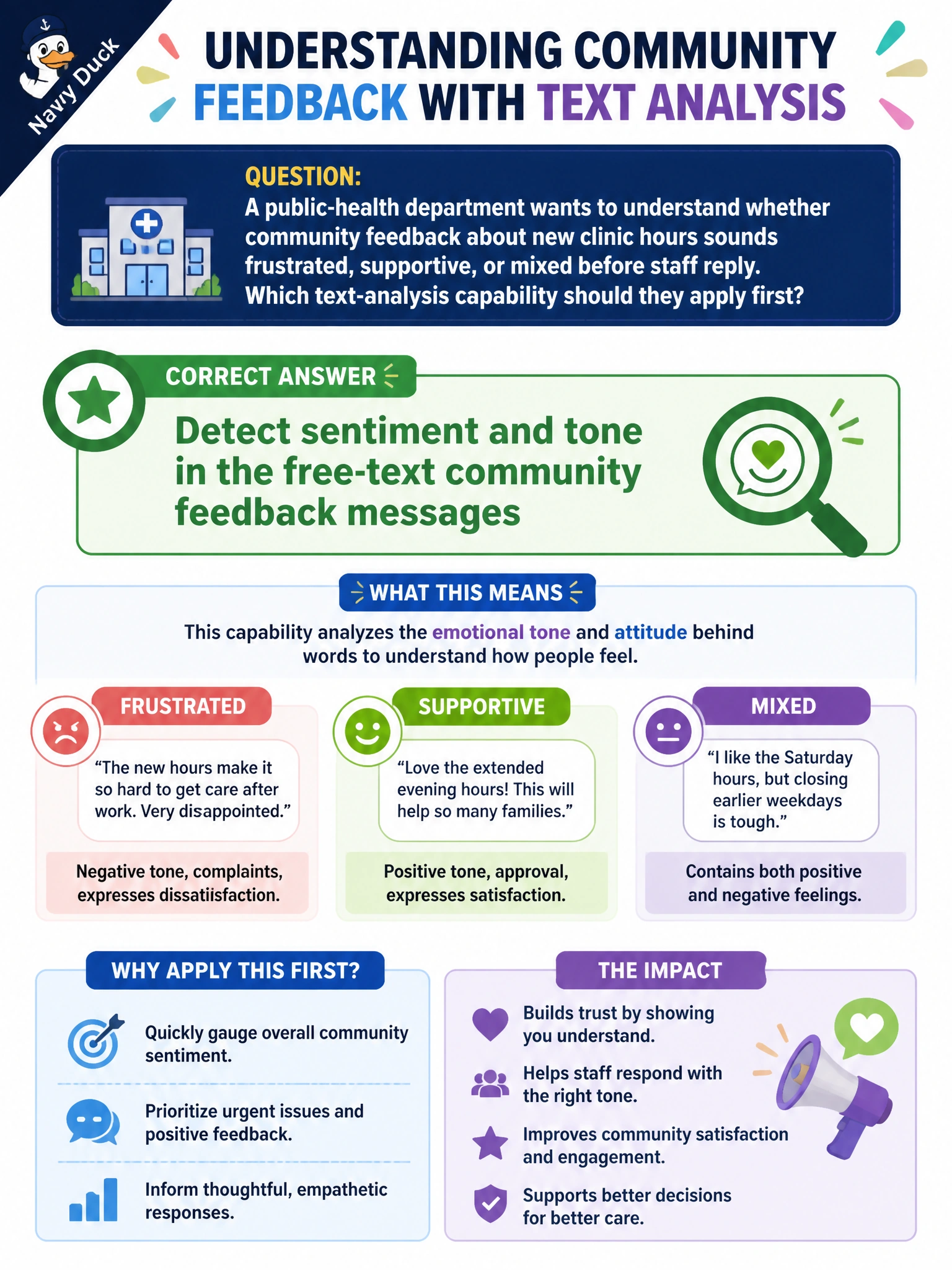
Clinic-hour comments are like reading the room before you walk on stage. Sentiment and tone analysis tells the health team whether folks sound frustrated, supportive, or mixed so replies land with the right care. Topic lists or key-phrase terms alone never hear that vibe. Entity recognition to pull out clinic names and hours just catalogs details without catching how people feel.
Full Explanation
The public-health department’s goal is to gauge how community comments about clinic hours feel—frustrated, supportive, or mixed—before staff craft replies. That requirement maps directly to sentiment and tone analysis over free-text feedback: the model scores polarity and emotional cues in the messages so outreach can be prioritized and worded appropriately. Sentiment is a first-pass text-analysis capability; it does not invent clinic policy, and it does not require multimodal models. It simply reads the civic inbox the way a seasoned community-liaison officer would, then surfaces which threads need careful human attention.
Topic extraction surfaces which subjects recur across the feedback but does not score whether each comment reads as frustrated, supportive, or mixed, so it misses the tone requirement the stem poses. Key phrase extraction pulls out salient terms from each comment without assigning any polarity or emotional reading to them, leaving staff without the mood signal they asked for. Entity recognition to extract clinic names and hours from the feedback only catalogs concrete details and says nothing about how the writer feels. Entity recognition to extract clinic names and hours from the feedback is a genuine text-analysis capability that still leaves the sentiment question unanswered.
Exam caveat: sentiment is not the same as intent classification, entity extraction, or content moderation. A comment can be negative yet not abusive, or positive yet still raise a concrete scheduling issue. On AI-102-style items, pick the capability that matches the stated outcome—here, understanding how feedback sounds—rather than the most elaborate Azure service on the page.
Operational check: sample a week of clinic-hour comments, run sentiment/tone scoring, and have liaison staff spot-check low-confidence or mixed results before automated reply templates fire. Confirm PII handling on the feedback channel, log review overrides, and verify that strongly negative clusters route to a human queue rather than a cheerful autoresponder.
Prefer to study offline? Printable PDF study book + test engine ($7.50, unofficial). These questions stay free here.