
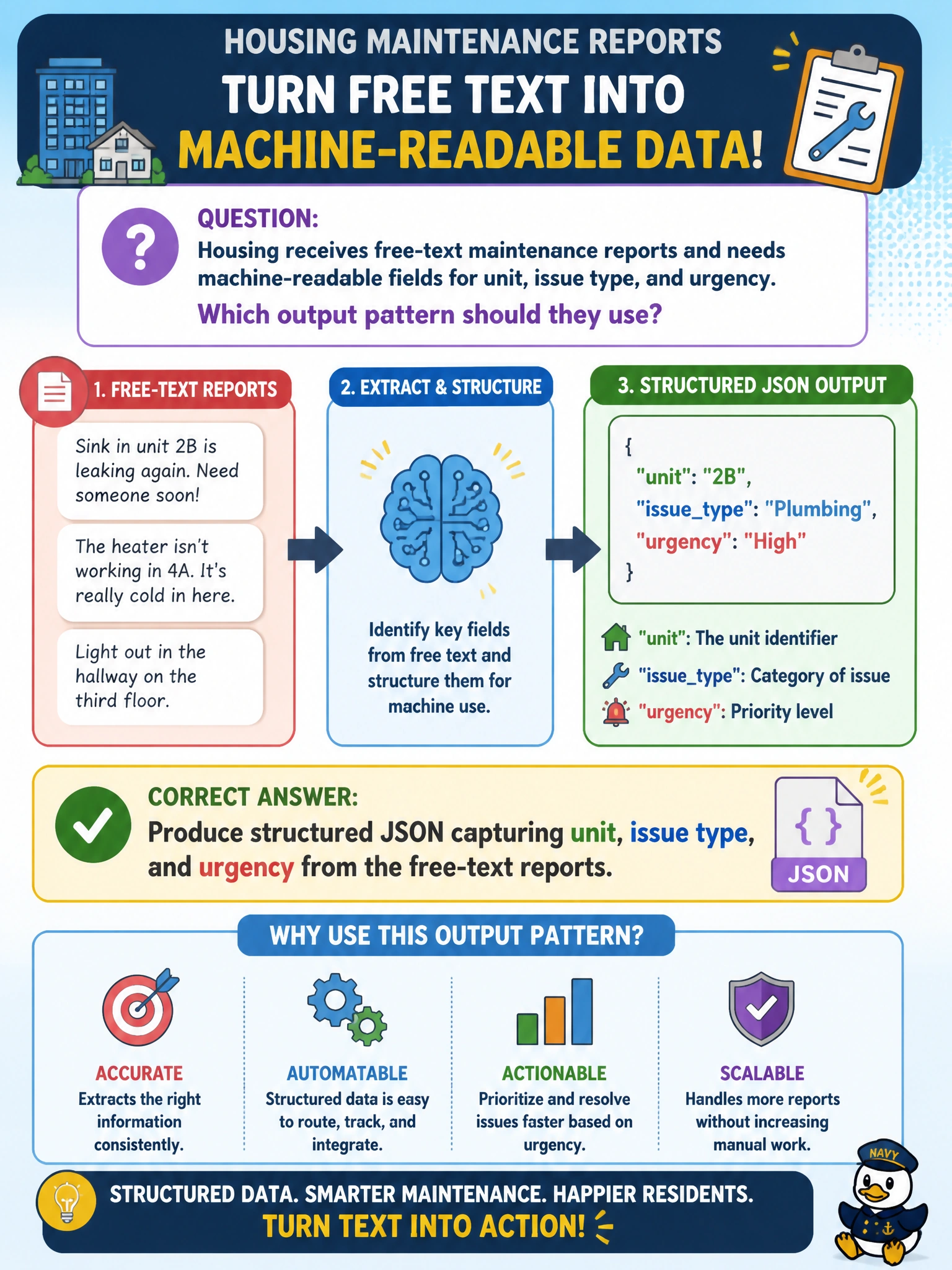
Housing receives free-text maintenance reports and needs machine-readable fields for unit, issue type, and urgency. Which output pattern should they use?
Select an answer to reveal the explanation.
Short Explanation
Free text is the sticky note; structured JSON is the work-order form. Have the model fill unit, issue type, and urgency so housing systems can act. Generating natural-language summaries, HTML snippets, or embedding vectors that capture unit, issue type, and urgency still leaves you without usable fields because you'll have to re-parse prose, markup, or numbers with nothing your systems can validate.
Full Explanation
Structured JSON extraction is the output pattern that turns free-text civic reports into machine-readable fields downstream systems can validate and act on. Housing receiving free-text maintenance reports should produce structured JSON capturing unit, issue type, and urgency so work-order software can open tickets without re-parsing paragraphs. The concept under test is structured output from unstructured maintenance narrative—not embedding vectors capturing unit, issue type, and urgency to support semantic search, which remain numeric similarity signals rather than validatable fields. Generating natural-language summaries capturing unit, issue type, and urgency for staff review leaves automation unable to file tickets reliably because the output remains prose for human readers rather than machine-readable fields, even when the details are mentioned in text. Returning formatted HTML snippets capturing unit, issue type, and urgency for dashboard display fails because the values are still locked inside presentation markup for dashboard display, so they are not machine-readable fields the work-order software can validate and act on without re-parsing. Generating embedding vectors capturing unit, issue type, and urgency to support semantic search does not produce the structured unit, issue type, and urgency fields required to create work orders; it only produces numeric vectors that enable similarity matching. Exam caveat: schema discipline matters—models must emit the agreed keys and enumerations; invalid JSON or free-text stuffed into fields should fail validation before ticket creation. Urgency especially needs constrained values. Operational check: define a JSON schema for unit, issue type, and urgency, extract from sample maintenance reports, validate against the schema, reject or quarantine malformed outputs, and create work orders only from validated structures.
Prefer to study offline? Printable PDF study book + test engine ($7.50, unofficial). These questions stay free here.