
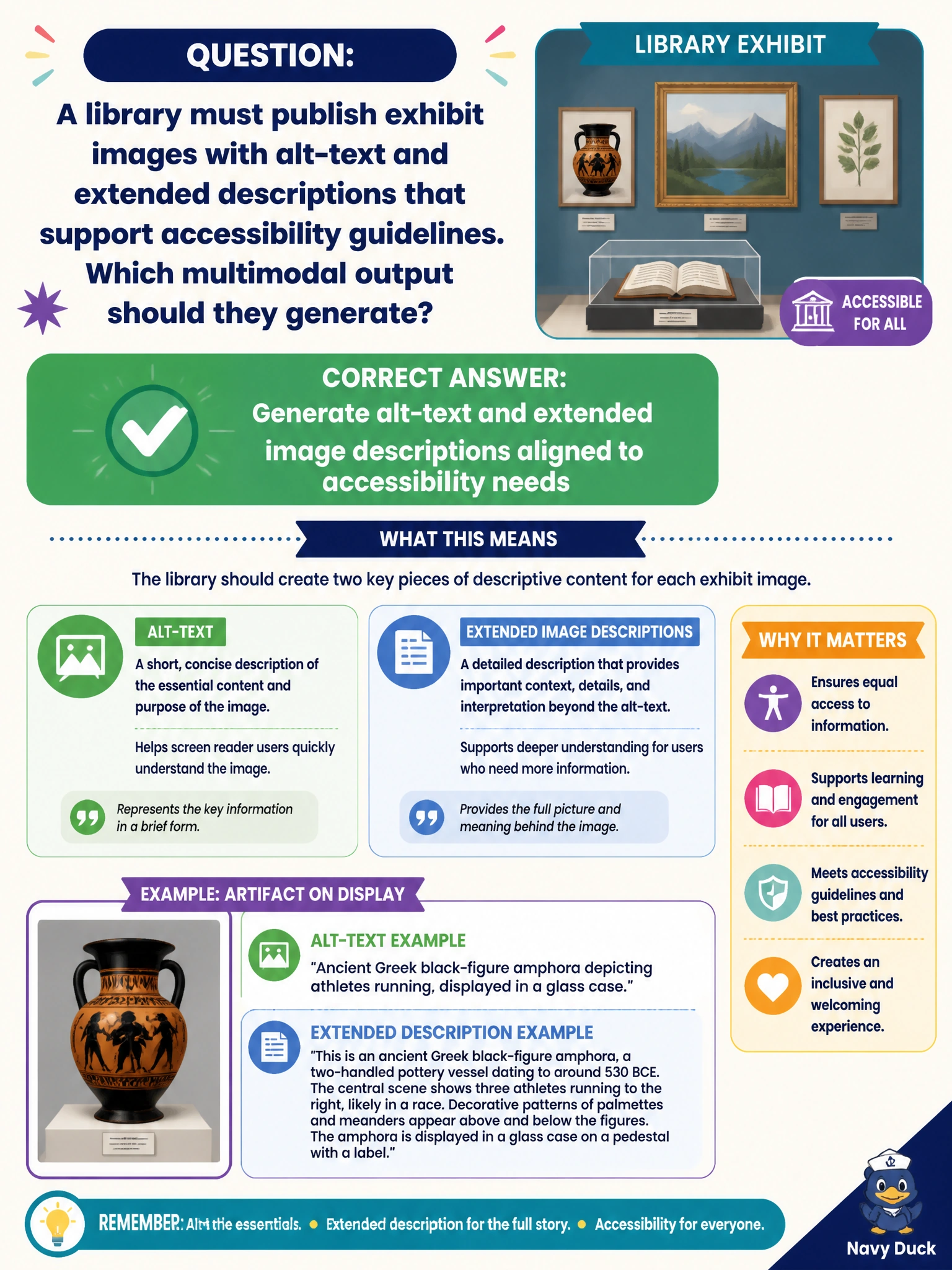
A library must publish exhibit images with alt-text and extended descriptions that support accessibility guidelines. Which multimodal output should they generate?
Select an answer to reveal the explanation.
Short Explanation
Alt-text is the museum label for screen readers—short for the thumbnail, extended when the story needs more. Generate both so exhibit images stay accessible. Text meeting color-contrast thresholds is about colors you'll see, text marked aria-hidden is hidden from your screen reader, and duplicated text just repeats the same playback, and they don't give your screen-reader users real equivalents; you'll need alt-text and extended descriptions aligned to accessibility needs.
Full Explanation
Multimodal systems can generate alt-text and extended image descriptions that align with accessibility guidelines for public web content. A library publishing exhibit images should produce short alt-text for concise equivalents and extended descriptions when the exhibit narrative requires more detail than a brief alternative text string. Those textual outputs make exhibit imagery usable with screen readers and satisfy civic accessibility expectations without removing the art from the site. Generating alt-text and extended image descriptions meeting WCAG color-contrast thresholds fails because color-contrast thresholds apply to visual presentation of text against its background, not to text alternatives; alt-text and extended descriptions are read by screen readers and have no color to measure, so a contrast ratio does not describe what any individual exhibit image actually shows. Generating alt-text and extended image descriptions marked aria-hidden to reduce noise fails because aria-hidden removes content from the accessibility tree; marking the equivalents aria-hidden would hide them from screen readers and leave people who cannot perceive the image with no equivalent at all. Generating alt-text and extended image descriptions duplicated for screen-reader playback fails because alt-text and extended descriptions are meant to provide a concise equivalent plus fuller detail where the exhibit narrative requires it; duplicating identical text creates repetitive playback without serving those different lengths and contexts. Exam caveat: alt-text and extended descriptions serve different lengths and contexts; stuffing a full essay into alt-text is as wrong as publishing images with empty alternatives. Generated text must be reviewed for accuracy and sensitive content. Operational check: generate alt-text plus extended descriptions for each exhibit image, review against accessibility guidelines used by the library, publish both with the assets, and re-test with assistive technology before launch.
Prefer to study offline? Printable PDF study book + test engine ($7.50, unofficial). These questions stay free here.