
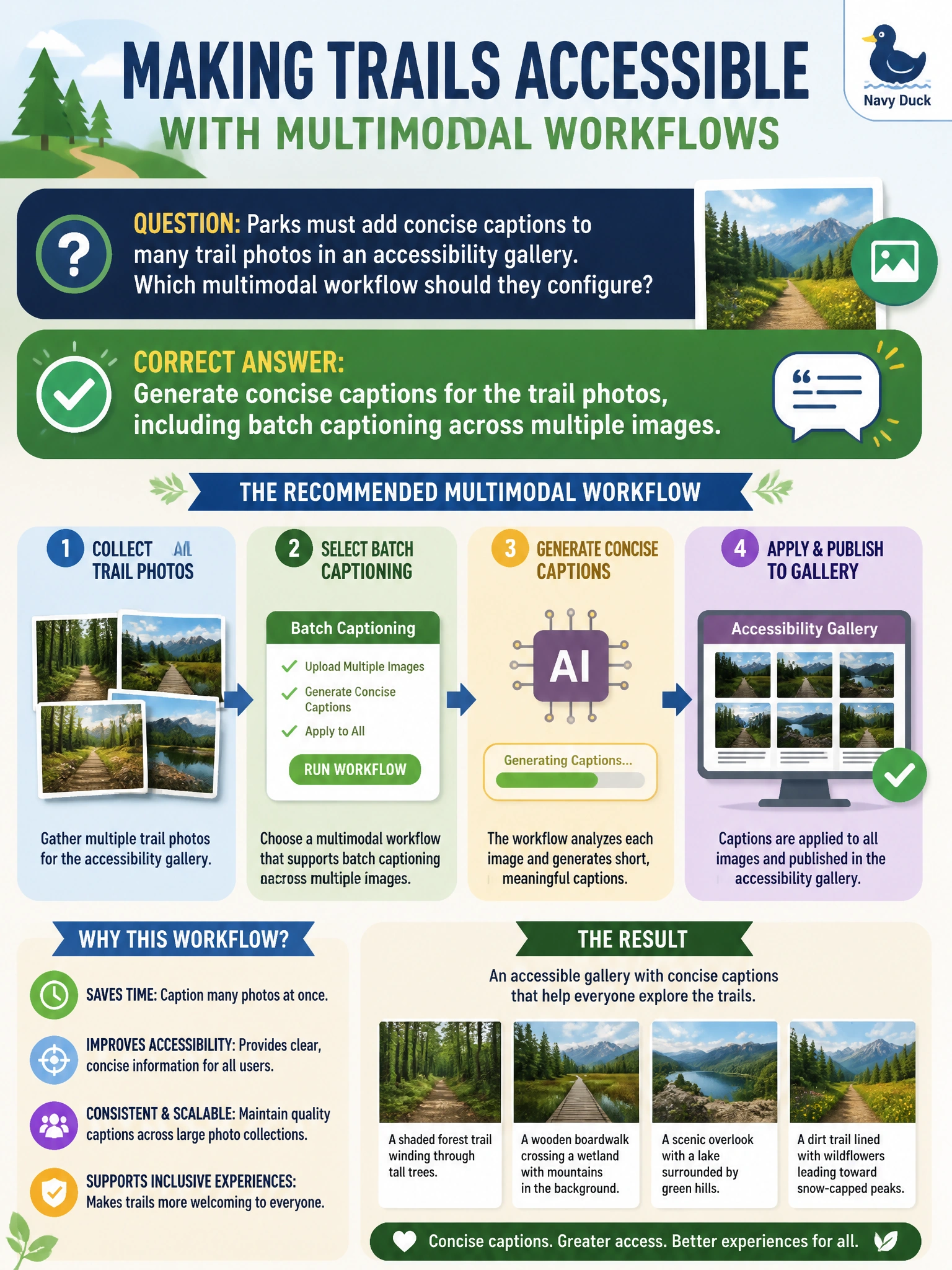
Parks must add concise captions to many trail photos in an accessibility gallery. Which multimodal workflow should they configure?
Select an answer to reveal the explanation.
Short Explanation
Captions are the trail markers for people who cannot see the photo. Parks should generate concise captions—and batch them when there are many images—so the accessibility gallery actually helps. Transcribing signage text with an OCR engine only grabs printed words, dense bounding-box labels just list objects, and answering per visitor query only helps if they ask, so you won't get concise captions for every image and they'll still be left stranded.
Full Explanation
Caption generation—including batch captioning across many images—is a core multimodal understanding workflow for accessibility and discoverability. Parks configuring an accessibility gallery of trail photos should generate concise captions that describe trail conditions, landmarks, and hazards in text form, and they should use batch captioning when the set is large so every image receives a usable description without one-off manual typing for each file. Concise captions support screen-reader users and improve search over the gallery.
Generating concise captions for the trail photos by transcribing printed signage text with OCR engine fails because OCR only extracts embedded text and does not generate concise per-image descriptions of trail conditions, landmarks, or hazards, leaving non-visual visitors without equivalent descriptions. Generating concise captions for the trail photos with dense bounding-box labels for catalog browsing fails because dense labels are object-detection outputs, not concise descriptive captions, and do not give screen-reader users usable per-image information about trail conditions, landmarks, or hazards. Generating concise captions for the trail photos through interactive question answering per visitor query fails because on-demand Q&A does not provide a concise caption for every image and leaves non-visual visitors without equivalent information unless they ask the right question.
Exam caveat: auto-generated captions still need spot-check review for accuracy on safety-relevant details (closures, washouts, wildlife warnings). Batch mode improves throughput; it does not guarantee every caption is publication-ready. Operational check: generate concise captions for the full trail set, review a sample against the photos, publish captions with the images in the accessibility gallery, and provide a path for staff to correct captions that misstate conditions.
Prefer to study offline? Printable PDF study book + test engine ($7.50, unofficial). These questions stay free here.