
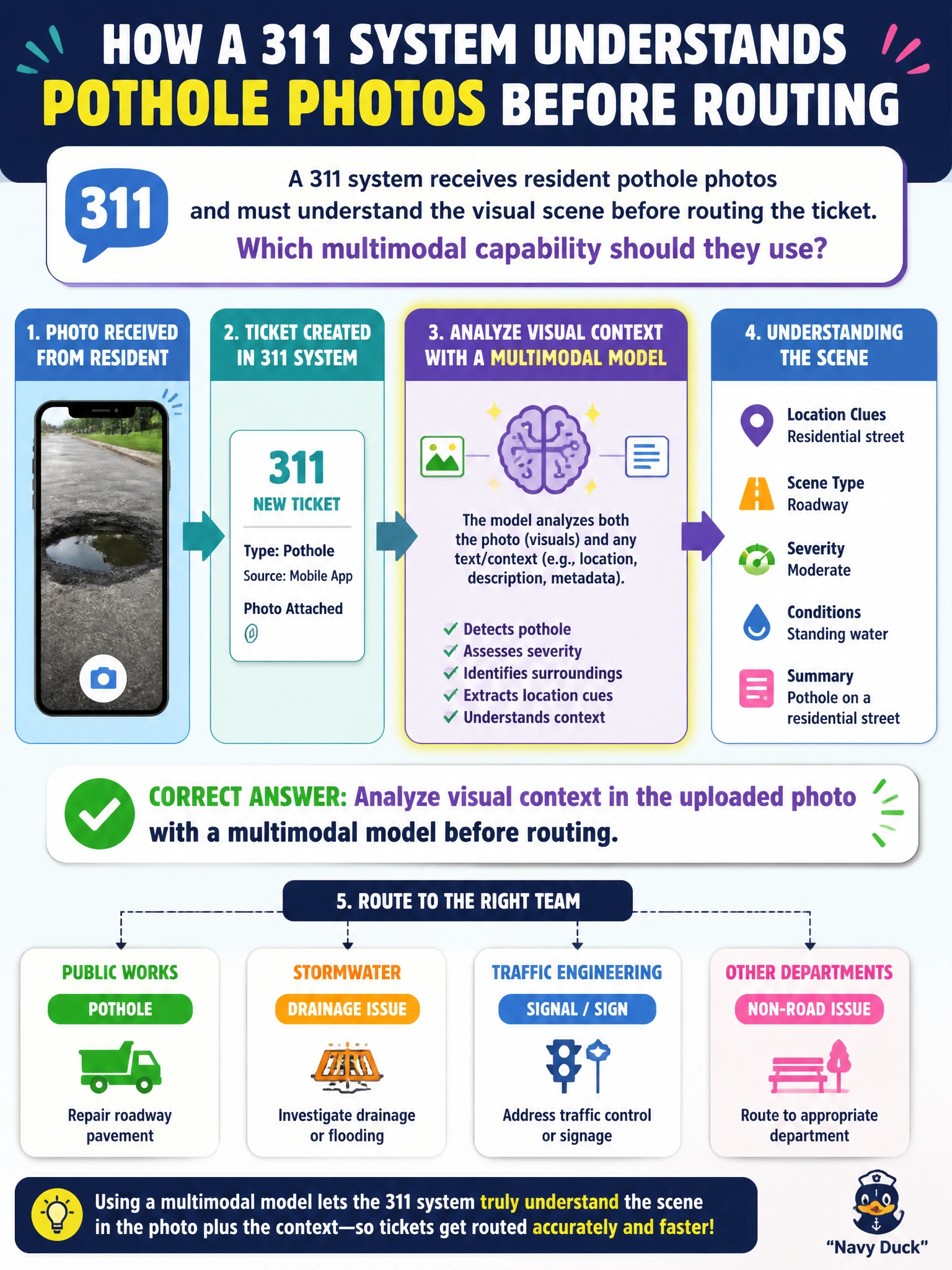
A 311 system receives resident pothole photos and must understand the visual scene before routing the ticket. Which multimodal capability should they use?
Select an answer to reveal the explanation.
Short Explanation
It's the real uploaded photo you've got to understand, but mapping pothole pixels with an image segmentation model won't help you because it outlines pixels and doesn't read visual context. Let a multimodal model read the visual context—street, damage, surroundings—then route with eyes open. Finding similar tickets with an image embedding model won't help you because it matches look-alikes without describing the scene, and OCR-ing street sign text just reads letters without showing you the pothole scene itself.
Full Explanation
Multimodal models can interpret visual context in uploaded imagery—scene type, damage cues, surrounding objects—before a municipal intake system routes work. A 311 workflow that receives resident pothole photos should analyze that visual context with a multimodal model so triage is informed by what the photo actually shows (road surface, severity hints, nearby landmarks) rather than by text alone. Richer routing follows: the ticket can be classified and prioritized with evidence residents already provided.
Mapping pothole pixels in the uploaded photo with an image segmentation model fails because segmentation models delineate pixel boundaries rather than interpret visual context, so it cannot implement visual-context understanding for routing that specific ticket. Finding similar tickets for the uploaded photo with an image embedding model fails because image embeddings support similarity retrieval, not scene interpretation, so it never describes the scene information—road damage, severity, surroundings—that the routing decision needs from the original image. Extracting street sign text in the uploaded photo with an OCR model fails because reading incidental signage is not the same as understanding the visual scene the routing decision is supposed to be based on, and it skips analysis of the pothole itself.
Exam caveat: visual analysis assists routing; it does not replace human verification when safety or liability is involved, and models can misread lighting, weather, or partial frames. Operational check: store the original photo with the ticket, log the model’s scene summary for agents, allow override when the resident’s text conflicts with the visual read, and measure whether multimodal triage reduces misroutes compared with intake that skips visual analysis.
Prefer to study offline? Printable PDF study book + test engine ($7.50, unofficial). These questions stay free here.