
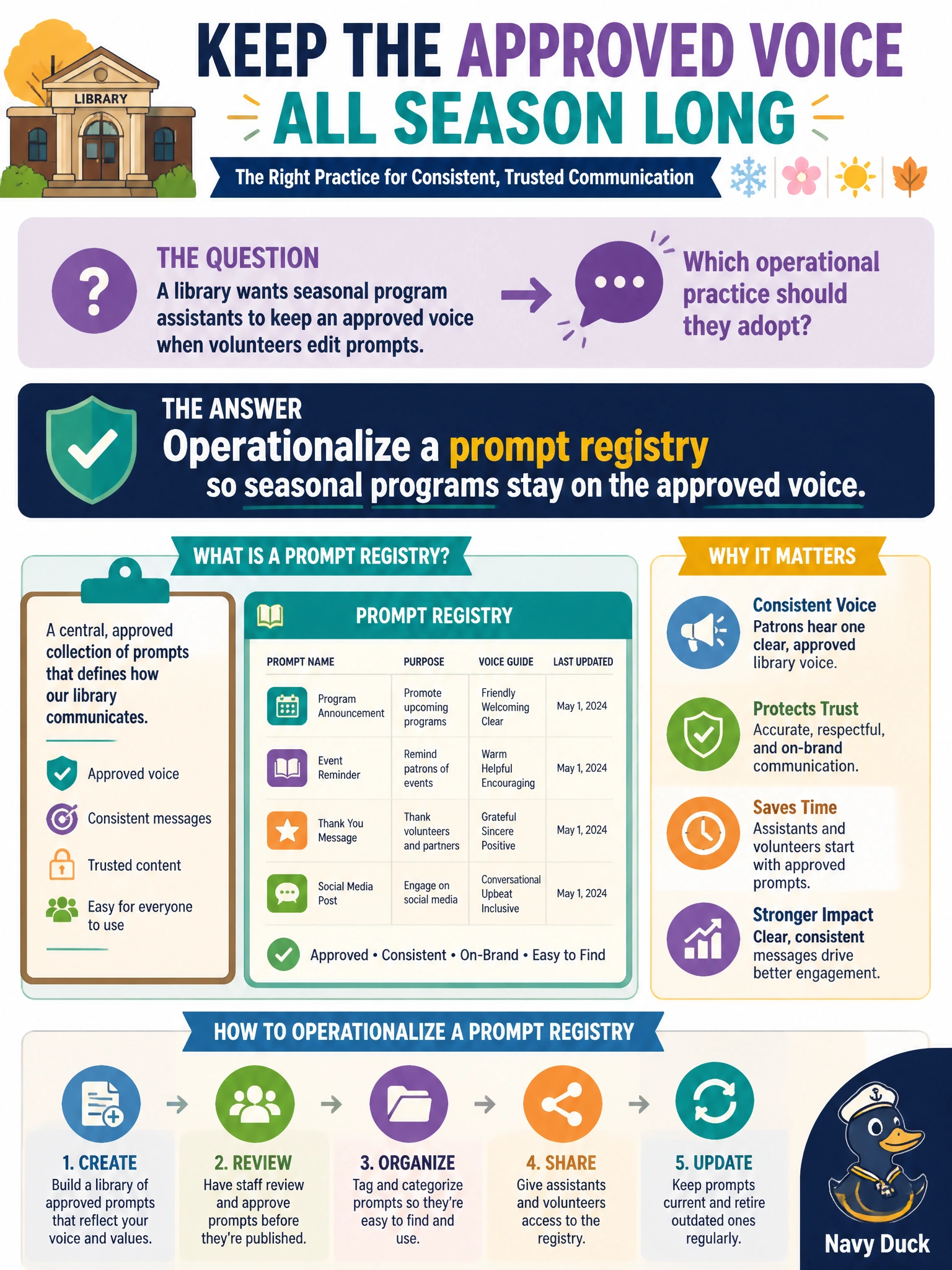
A library wants seasonal program assistants to keep an approved voice when volunteers edit prompts. Which operational practice should they adopt?
Select an answer to reveal the explanation.
Short Explanation
Approved voice is a style guide, not a free-for-all sticky note. Put prompts in a registry so seasonal library programs stay consistent when staff rotate. Evaluation datasets, content filters, and playground testing won't stop voice drift when you rotate volunteers because none of them version or control the approved prompts.
Full Explanation
A library that wants seasonal program assistants to keep an approved voice when volunteers edit prompts should operationalize a prompt registry as the shared source of truth. Seasonal staff turnover and volunteer edits create voice drift if prompts are stored in evaluation datasets to align edits instead of a registry. A registry versions approved system prompts, controls who can change them, and keeps program assistants on the library’s published voice across seasons.
Storing seasonal prompts in evaluation datasets to align edits fails by concept: evaluation datasets score outputs on test cases, they don't version approved prompts or govern volunteer edits, so the live voice still drifts. Applying content filters to seasonal prompts fails because filters block disallowed content—they can't prevent prompt edits, enforce versioning, or keep volunteer wording on the approved voice. Testing seasonal prompts in the playground fails because playground use is ad-hoc experimentation, the opposite of operationalized consistency with review and version control.
Exam caveat: approved civic voice continuity needs a prompt registry with versioning—not evaluation datasets, content filters, or playground testing. Operational check: store seasonal program prompts in the registry, require review for voice-affecting edits, roll out versioned prompts to assistants, and audit samples after volunteer rotations for voice consistency.
Prefer to study offline? Printable PDF study book + test engine ($7.50, unofficial). These questions stay free here.