
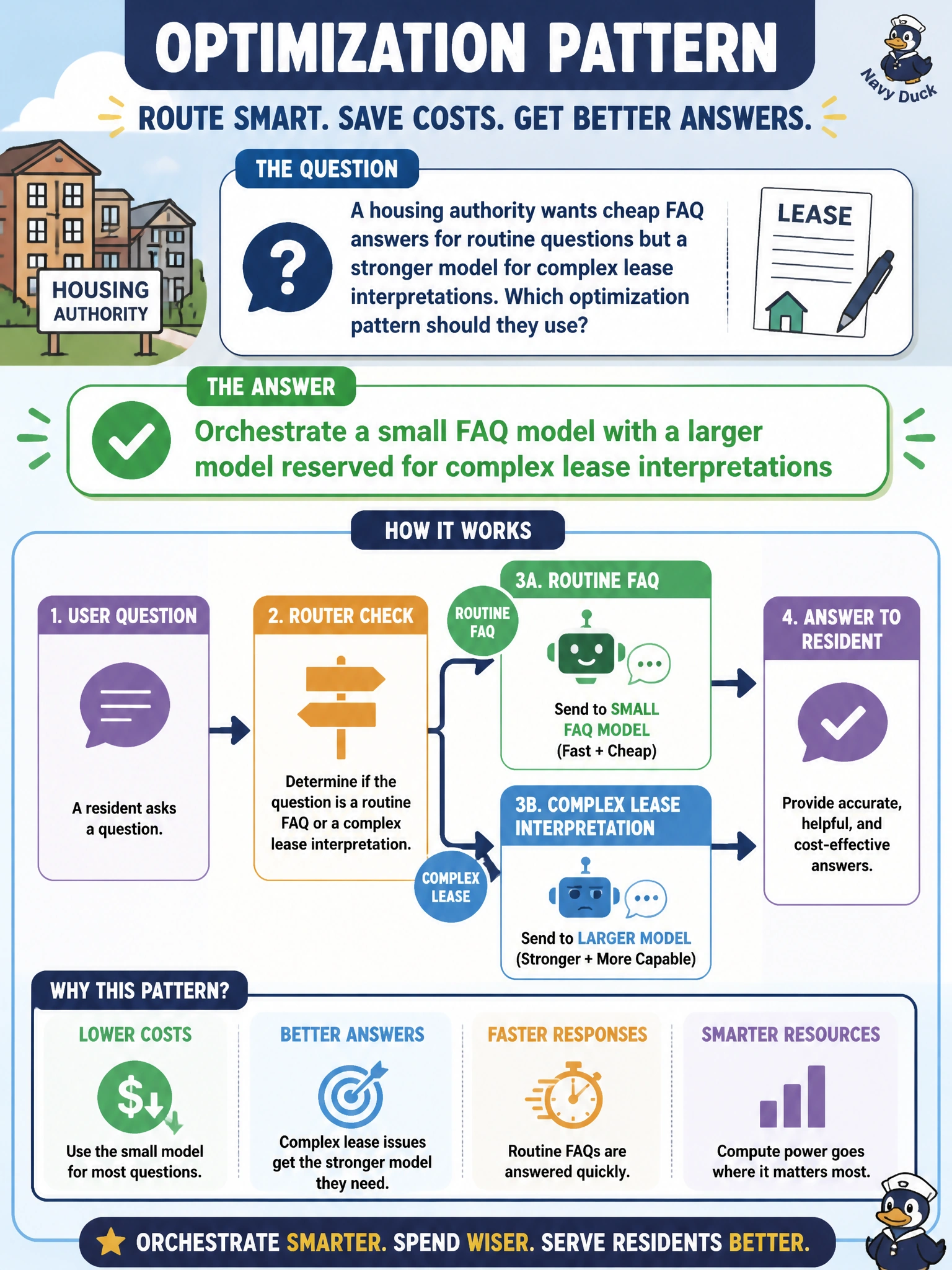
A housing authority wants cheap FAQ answers for routine questions but a stronger model for complex lease interpretations. Which optimization pattern should they use?
Select an answer to reveal the explanation.
Short Explanation
Not every housing question needs the heavy crane—some just need a hand truck. Route simple FAQ hits to a small model and save the larger model for tangled lease language. That multi-model split keeps quality where it matters without burning the budget on "what are office hours."
Full Explanation
A housing authority that wants cheap FAQ answers for routine questions but a stronger model for complex lease interpretations should orchestrate a small FAQ model with a larger model reserved for hard interpretive work. Multi-model routing matches cost to task difficulty: office hours and payment how-tos do not need frontier-scale inference, while multi-clause lease disputes do. Orchestration keeps quality where resident risk is high and budget spend where it is justified, which is the municipal cost/quality pattern the stem asks for.
Orchestrating a small FAQ model with a larger model run in parallel for complex lease interpretations fails on efficiency: it runs expensive inference alongside every request instead of selectively routing only hard lease cases to the larger model, which erases the cost saving the stem asks for. Orchestrating a small FAQ model with a larger model approved by small model for lease interpretations fails by inverted gating: it lets the undersized FAQ model judge high-risk, multi-clause reasoning it cannot reliably evaluate instead of reserving that interpretive authority for the larger model. Orchestrating a small FAQ model with a larger model batched nightly for complex lease interpretations fails on timeliness: it defers dispute answers to a nightly batch instead of reserving on-demand capacity for complex lease interpretations when residents need them.
Exam caveat: multi-model orchestration is selective routing by complexity—not running the larger model in parallel for complex lease interpretations, requiring approval by the small model for lease interpretations, or batching the larger model nightly for complex lease interpretations. Operational check: classify portal intents into FAQ versus lease-interpretation buckets, route FAQs to the small model and disputes to the larger model, measure cost and quality per bucket, and escalate ambiguous cases to the stronger path when confidence is low.
Prefer to study offline? Printable PDF study book + test engine ($7.50, unofficial). These questions stay free here.