
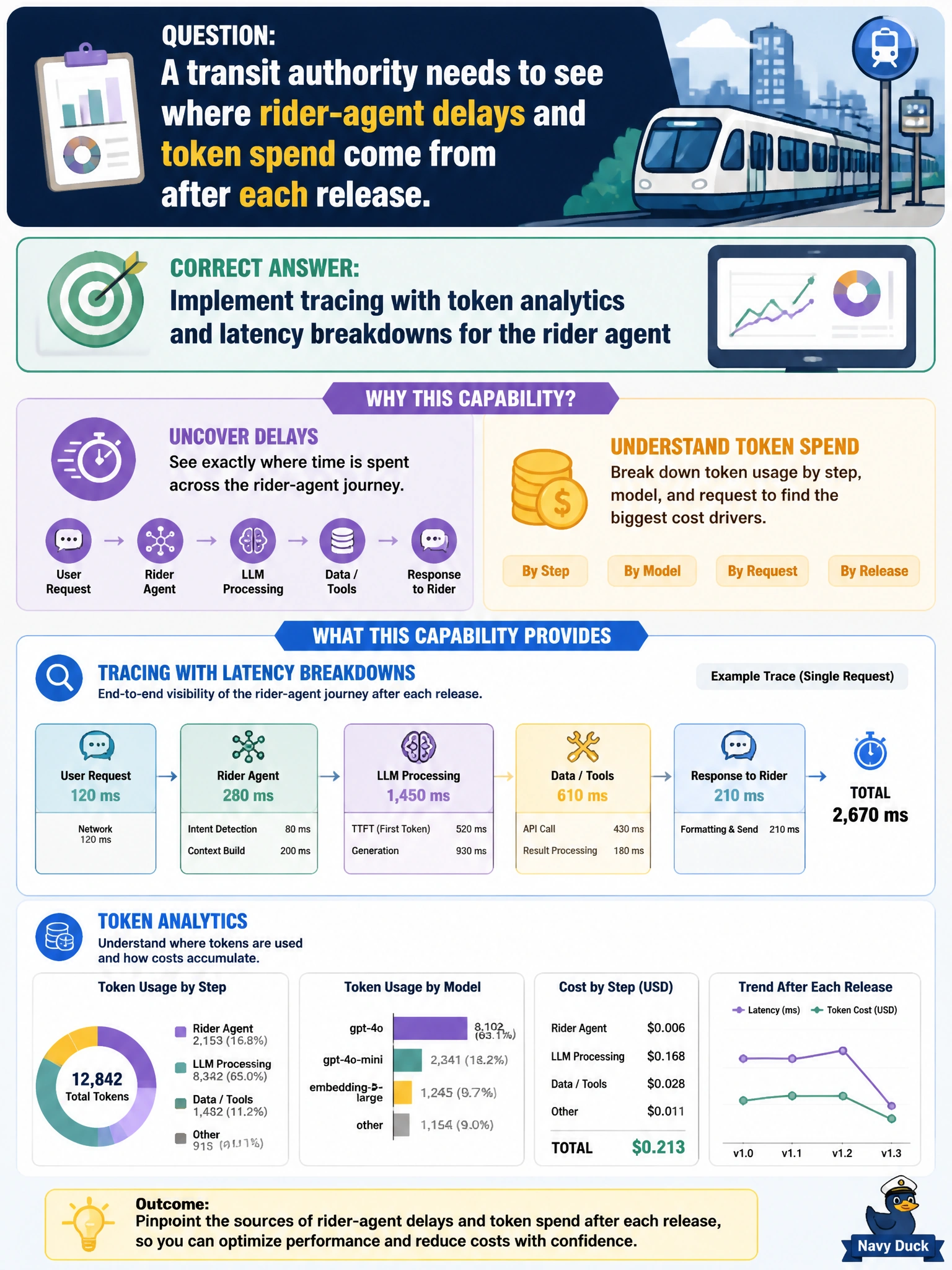
A transit authority needs to see where rider-agent delays and token spend come from after each release. Which capability should the team implement?
Select an answer to reveal the explanation.
Short Explanation
You cannot fix a slow rider agent if you are flying blind—observability is the dashboard in the operations bay. Tracing plus token and latency breakdowns shows whether the delay is retrieval, tools, or the model. You won't attribute delays or spend to retrieval, tools, or model stages with golden-dataset evaluations, live session replay, or billing exports—that's how civic SLAs quietly erode.
Full Explanation
A transit authority that needs to see where rider-agent delays and token spend come from after each release must implement tracing with token analytics and latency breakdowns. Civic agents fail silently on cost and latency unless operators can attribute time and tokens to retrieval, tools, and model stages. Tracing reconstructs the path of a rider request; token analytics show spend drivers; latency breakdowns show which stage regressed. Together they give the operations bay the signals needed to diagnose release regressions and protect rider SLAs without guessing.
Running golden-dataset evaluations with token counts and latency logs fails because offline test runs measure answer quality on curated datasets and do not attribute live rider-agent time and token spend across retrieval, tools, and the model after each release. Enabling live session replay with token timelines and latency heatmaps fails because visualizing individual sessions after the fact does not provide per-release aggregated tracing with token analytics to show which retrieval, tool, or model stage regressed. Pulling billing exports with monthly token totals and latency averages fails because coarse monthly totals and averages cannot show where the rider agent's own retrieval, tool, or model time and token spend come from.
Exam caveat: generative-agent observability for transit riders centers on traces, tokens, and stage latency—not billing exports with monthly token totals and latency averages alone, and not running dark without logs. Operational check: enable end-to-end tracing on the rider agent, emit token and per-stage latency metrics per release, alert on regressions against prior baselines, and review dashboards after each deploy before closing the release checklist.
Prefer to study offline? Printable PDF study book + test engine ($7.50, unofficial). These questions stay free here.