
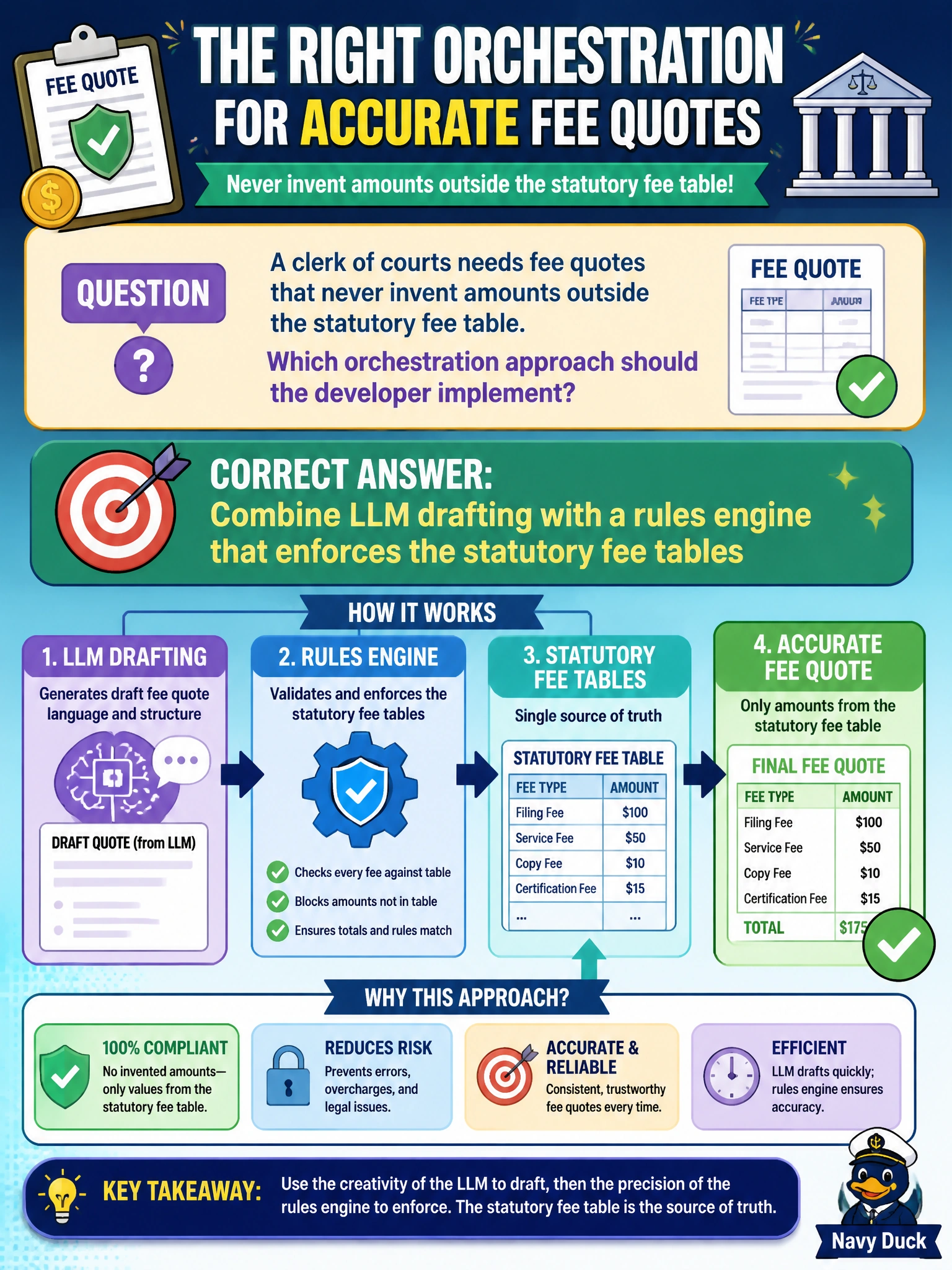
A clerk of courts needs fee quotes that never invent amounts outside the statutory fee table. Which orchestration approach should the developer implement?
Select an answer to reveal the explanation.
Short Explanation
Fees are not creative writing — they’re statute. Let the LLM draft the friendly explanation while a rules engine stamps the real dollar amounts from the table. Grounding with retrieval, fine-tuning for calculations, or adding a review pass to verify amounts still leaves a generative model holding the number, and that's how you'll earn angry callbacks.
Full Explanation
A clerk of courts that needs fee quotes that never invent amounts outside the statutory fee table should combine LLM drafting with a rules engine that enforces those tables. Friendly explanation language can be generative, but dollar amounts are statute-bound. The rules engine (or equivalent deterministic fee service) is authoritative for amounts; the LLM explains process and context around those stamped values. That hybrid orchestration prevents creative fee invention while still giving residents clear, readable quotes.
Grounding LLM drafting with retrieval-augmented generation over fee schedules still lets the LLM compose the final dollar figure from retrieved passages, and a generative model can paraphrase, misread, or extrapolate a number from retrieved text even when the source passage is correct—RAG improves grounding, but it does not guarantee the model never invents an amount the way a deterministic rules engine does. Fine-tuning the LLM on past clerk invoices to align fee quote calculations trains the model to produce outputs that statistically resemble historical fees, but a fine-tuned model is still a probabilistic generator that can extrapolate a plausible-sounding amount outside the current statutory table, especially after the table changes. Adding a second LLM review pass to verify fee quote amounts before court filing may catch some obvious errors, but a second model reviewing another model’s output is still generative-on-generative; it can misread the schedule, approve a plausible-but-wrong amount, or hallucinate confirmation, and neither pass is the deterministic authority the stem requires over the actual statutory numbers.
Exam caveat: for statutory fees, determinism owns the numbers and the LLM owns the prose—never invert that authority, and don’t mistake grounding with RAG, fine-tuning for calculations, or a review pass to verify amounts for the deterministic guarantee only a rules engine provides. Operational check: bind fee quote generation to the statutory table/rules engine, reject or escalate when a fee code has no row, display only engine-stamped amounts in resident quotes, and audit sample quotes against the published fee schedule after each release.
Prefer to study offline? Printable PDF study book + test engine ($7.50, unofficial). These questions stay free here.