
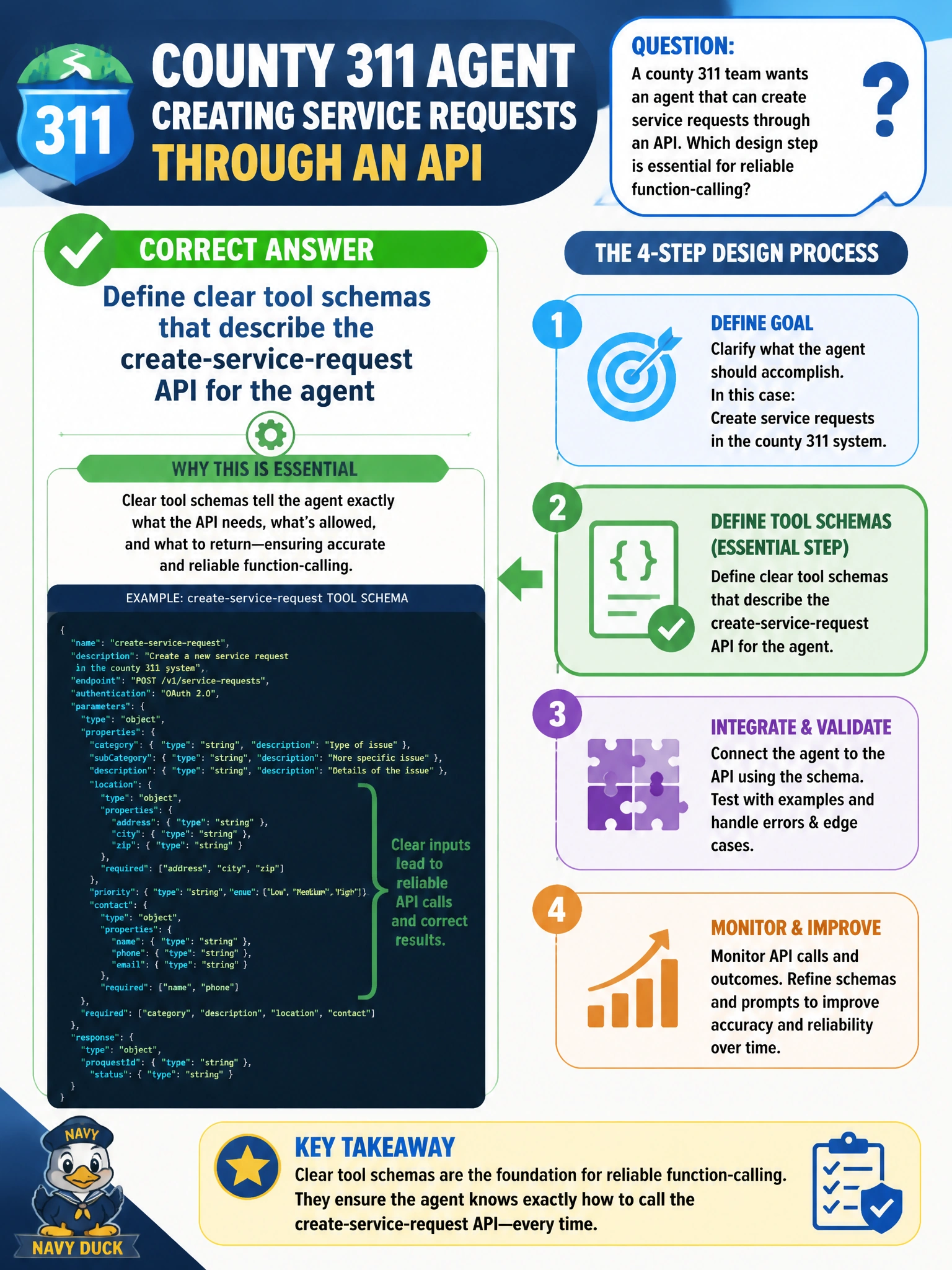
A county 311 team wants an agent that can create service requests through an API. Which design step is essential for reliable function-calling?
Select an answer to reveal the explanation.
Short Explanation
Function-calling without a schema is like handing a work order to a crew with blank fields—everyone guesses what goes where. Clear tool schemas tell the 311 agent exactly how to create a service request via the API. Structure beats improvisation for municipal intake.
Full Explanation
A county 311 agent that creates service requests through an API needs clear tool schemas describing the create-service-request contract so function-calling is reliable. Schemas name the tool, required fields, types, and constraints; the model then emits structured calls instead of free-form prose that backends cannot parse. For municipal intake, that means location, category, description, and contact fields map predictably to the 311 API and failures are attributable to schema or API errors rather than invented field names. Supplying few-shot examples that demonstrate create-service-request dialogues for the agent may illustrate tone, but it does not give the agent a machine-readable contract for the create-service-request API, so the model still cannot reliably produce valid structured payloads. Registering the create-service-request API with detailed response schemas for logging results only describes how to log outputs, but it does not define the input tool schema with required fields, types, and constraints, so the agent still cannot reliably produce valid creation calls. Setting a low sampling temperature to ensure deterministic create-service-request arguments may reduce randomness, but it does not give the agent a machine-readable contract with required fields and types, so the model still cannot reliably produce valid structured payloads. On the exam, reliable function-calling requires explicit tool schemas for the civic API; few-shot examples alone, response-only schemas for logging, and low temperature alone are wrong. Caveat: schemas must stay versioned with the 311 API—stale required fields cause systematic tool failures even when the model is correct. Operational check: publish the create-service-request schema to the agent, invoke a sample 311 creation from chat, verify the API receives typed fields, and reject any path that uses only response schemas for logging instead of a defined input schema.
Prefer to study offline? Printable PDF study book + test engine ($7.50, unofficial). These questions stay free here.