
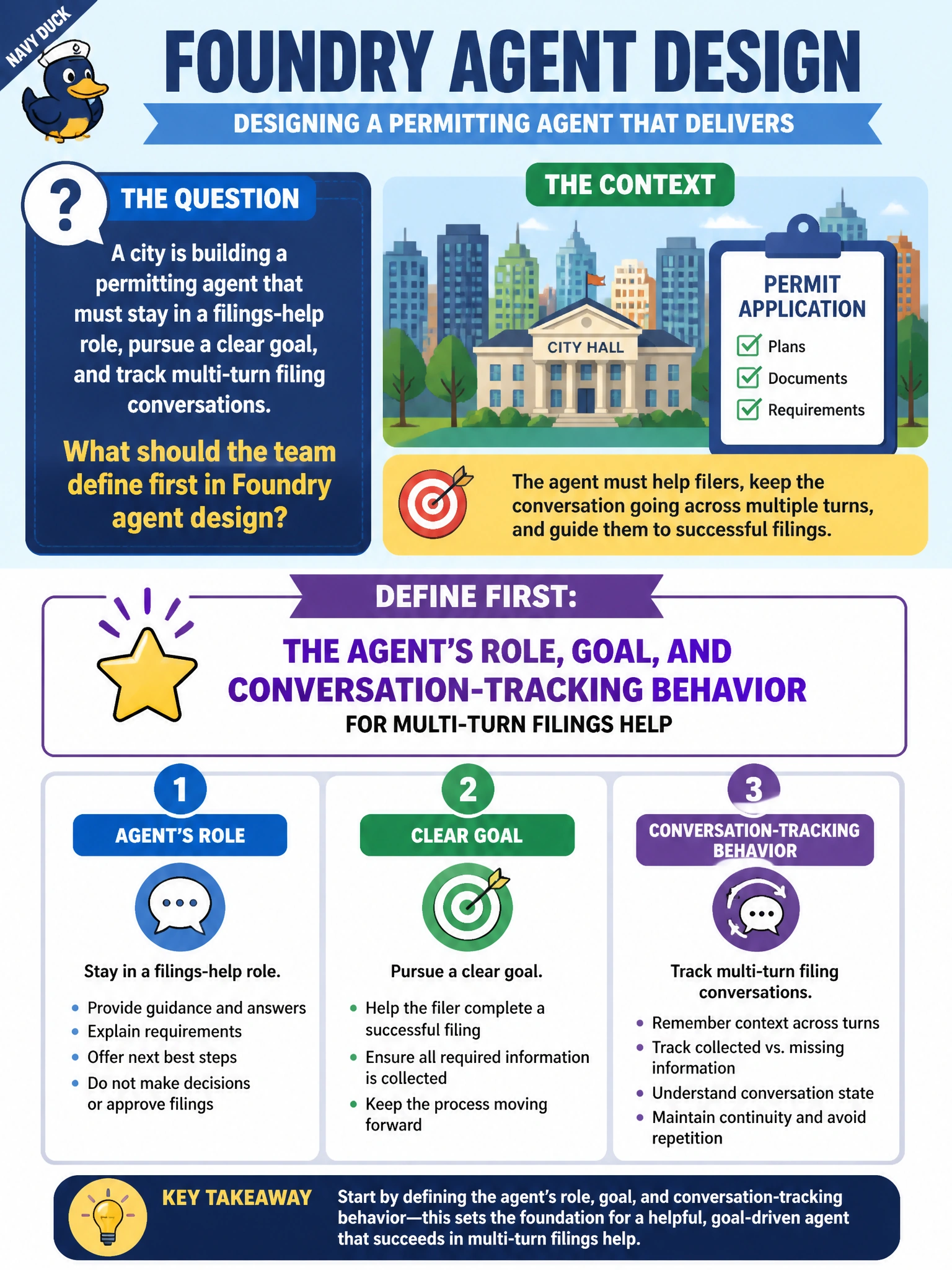
A city is building a permitting agent that must stay in a filings-help role, pursue a clear goal, and track multi-turn filing conversations. What should the team define first in Foundry agent design?
Select an answer to reveal the explanation.
Short Explanation
A good permitting agent is like a well-briefed counter clerk: they know their job, what success looks like, and what you already said three minutes ago. Role, goal, and conversation tracking keep multi-turn filings help coherent. Skip those and the bot wanders or forgets the resident mid-form.
Full Explanation
Foundry agent design for a city permitting helper starts by defining the agent's role, goal, and conversation-tracking behavior so multi-turn filings help stays consistent. Role bounds the agent to filings assistance rather than unilateral approval; goal states what successful help looks like (complete required fields, point to correct forms); conversation tracking preserves prior turns so residents do not re-enter parcel or application details every message. Those three design primitives are the foundation before tools and prompts are refined. The agent’s scoring rubric, test prompts, and accuracy targets for filings help tasks measure performance after design; they do not establish the agent's role, goal, or memory, so starting there skips the foundational step. The agent’s filing lookup tools, data connections, and action permissions for filings help, defined before the agent's role and goal are written, still skip the foundational step of deciding what the agent is for and what success looks like before deciding what it is allowed to call. Choosing the agent’s model version, deployment endpoint, and throughput limits for filings help use before defining role, goal, and conversation tracking optimizes a system whose purpose and behavior are still undefined. On the exam, agent construction begins with role, goal, and conversation tracking; distractors are scoring rubric, test prompts, and accuracy targets, filing lookup tools, data connections, and action permissions, or model version, deployment endpoint, and throughput limits. Caveat: defining role and goal in text does not by itself enforce them—pair with tool permissions and escalation so the agent cannot approve permits even if a prompt is jailbroken. Operational check: specify role/goal/memory for the filings agent, run a multi-turn filing dialogue, verify prior answers are retained, and confirm the agent never exposes an approve-permit action.
Prefer to study offline? Printable PDF study book + test engine ($7.50, unofficial). These questions stay free here.