
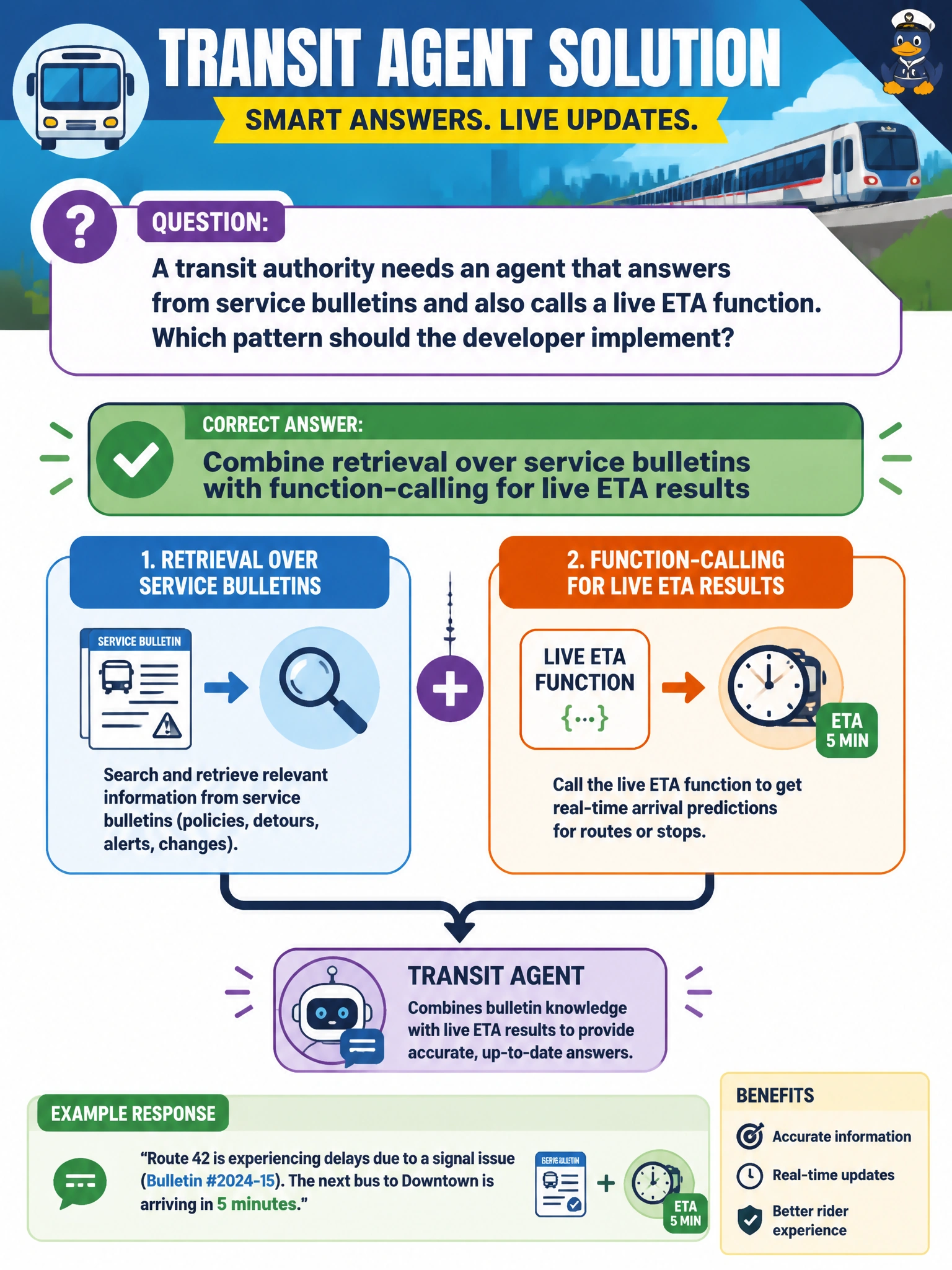
A transit authority needs an agent that answers from service bulletins and also calls a live ETA function. Which pattern should the developer implement?
Select an answer to reveal the explanation.
Short Explanation
Riders want both the official bulletin and the bus that is actually coming—like checking the notice board and the live board at the same stop. Retrieval covers bulletins; function-calling hits the live ETA API. Together they keep transit answers grounded and current.
Full Explanation
A transit authority agent that must answer from service bulletins and also return live ETAs should combine retrieval over those bulletins with function-calling for live ETA results. Retrieval grounds answers in the current disruption and policy text; function-calling fetches operational times that change minute by minute and should never be hallucinated from training data. Together they mirror how riders already use the system: read the bulletin, then check the live board. Fine-tuning the model on service bulletins with function-calling for live ETA results gets the live ETA call right but bakes potentially outdated bulletin text into weights instead of retrieving current bulletins, so service changes can be answered from stale training data. Combining retrieval over live ETA feeds with function-calling for service bulletins swaps the tools, treating rapidly changing arrival times as static retrievable documents and wrapping stable bulletin text as an executable call, which can return stale arrivals and miss grounded policy context instead of retrieving bulletins and calling live ETA. Combining retrieval over service bulletins with function-calling for cached ETA embeddings retrieves the correct bulletin text but calls cached vector similarities instead of live results, so riders get stale embeddings rather than live minute-by-minute arrival times. On the exam, document retrieval plus live function-calling is the hybrid civic pattern; distractors are fine-tuning bulletins while calling ETAs, swapping retrieval to ETAs and function-calling to bulletins, or retrieving bulletins plus calling cached ETA embeddings instead of live results. Caveat: retrieval freshness and ETA API SLAs both matter—stale bulletin indexes or slow ETA tools can still serve wrong rider guidance even with the right architecture. Operational check: index current service bulletins, register the ETA tool schema, ask a disruption-plus-ETA question, and verify the answer cites retrieved bulletin text and a live function result—not model invention.
Prefer to study offline? Printable PDF study book + test engine ($7.50, unofficial). These questions stay free here.