
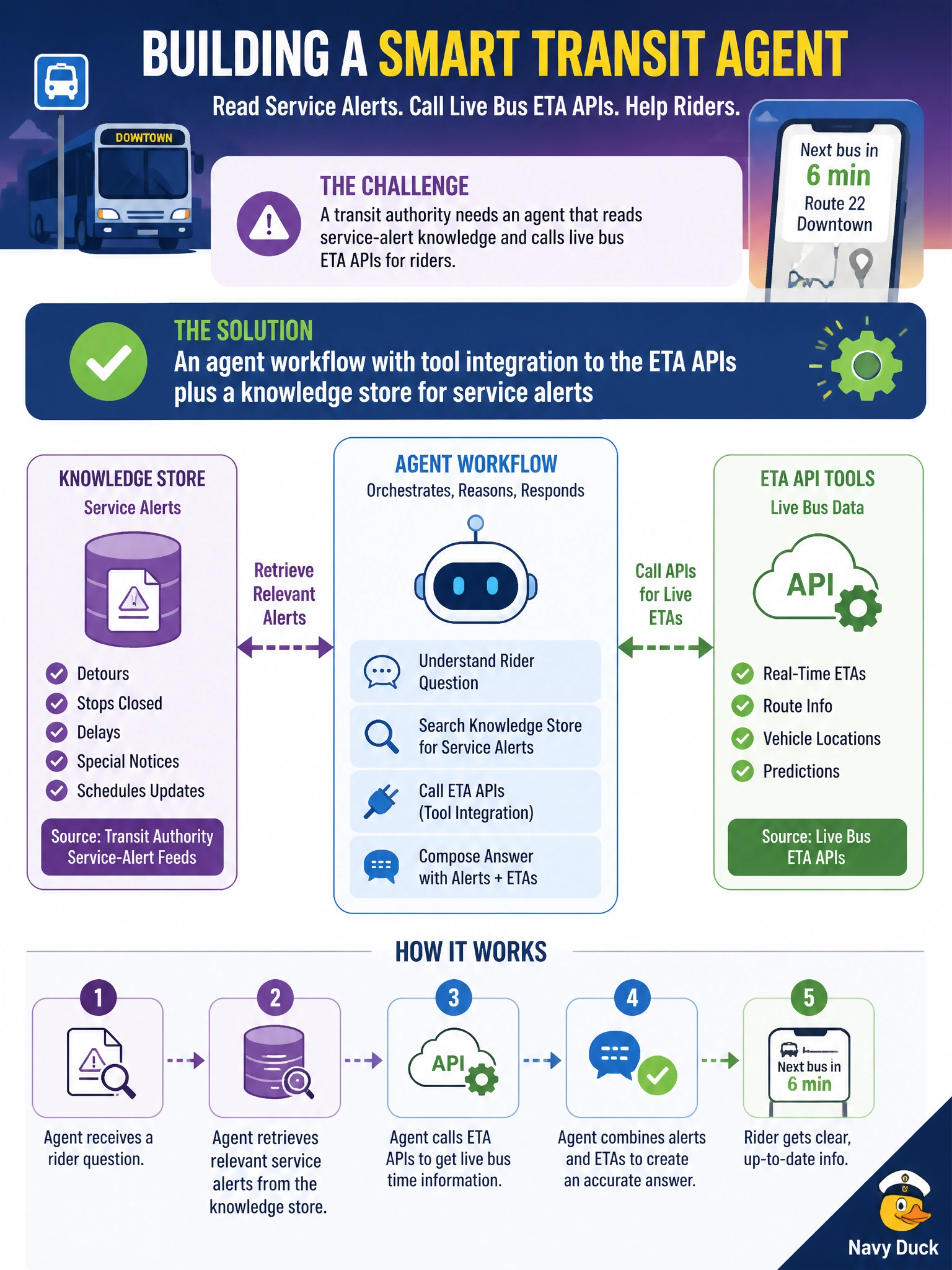
A transit authority needs an agent that reads service-alert knowledge and calls live bus ETA APIs for riders. Which Foundry service mix should the AI developer plan?
Select an answer to reveal the explanation.
Short Explanation
Riders need both the bulletin board and the live arrivals board. You'll want an agent that looks up alerts in a knowledge store and calls the ETA APIs as live tools — not synced ETAs that'll go stale, an agent that fine-tunes on alerts that change too fast to bake in, or a flipped mix that stores ETAs and calls alerts as tools.
Full Explanation
A transit authority agent that must read service-alert knowledge and call live bus ETA APIs needs a Foundry design that combines a knowledge store with tool integration inside an agent workflow. Service alerts are authored, relatively static knowledge that should be retrieved; ETAs are live system state that must be obtained through API tool calls at answer time. Planning that mix up front is how riders get both the bulletin-board context and the arrivals-board truth in one assistant experience.
An agent workflow with scheduled sync of the ETA APIs plus a knowledge store for service alerts fails because scheduled sync creates cached departures that quickly go stale and cannot substitute for live tool calls to the ETA APIs at answer time, so riders would not get current departure information. An agent workflow with tool integration to the ETA APIs plus fine-tuning on service alerts for answers fails because fine-tuning bakes rapidly changing alerts into model weights instead of retrieving them from a knowledge store, so answers become stale and lack grounded bulletin-board context. An agent workflow with tool integration to service alerts plus a knowledge store for the ETA APIs fails because it reverses the correct mix — storing live ETAs in a knowledge store lets them go stale instead of calling them as live tools at answer time, while treating retrievable service alerts as tool calls.
Exam caveat: tool schemas, authentication to transit APIs, and knowledge freshness for alerts are part of the plan; naming 'agent' without those integrations is incomplete. Operational check: exercise the agent with a known alert document and a mocked ETA tool response, verify both sources appear in the final rider answer, and confirm the agent does not fabricate ETAs when the tool call fails.
Prefer to study offline? Printable PDF study book + test engine ($7.50, unofficial). These questions stay free here.