
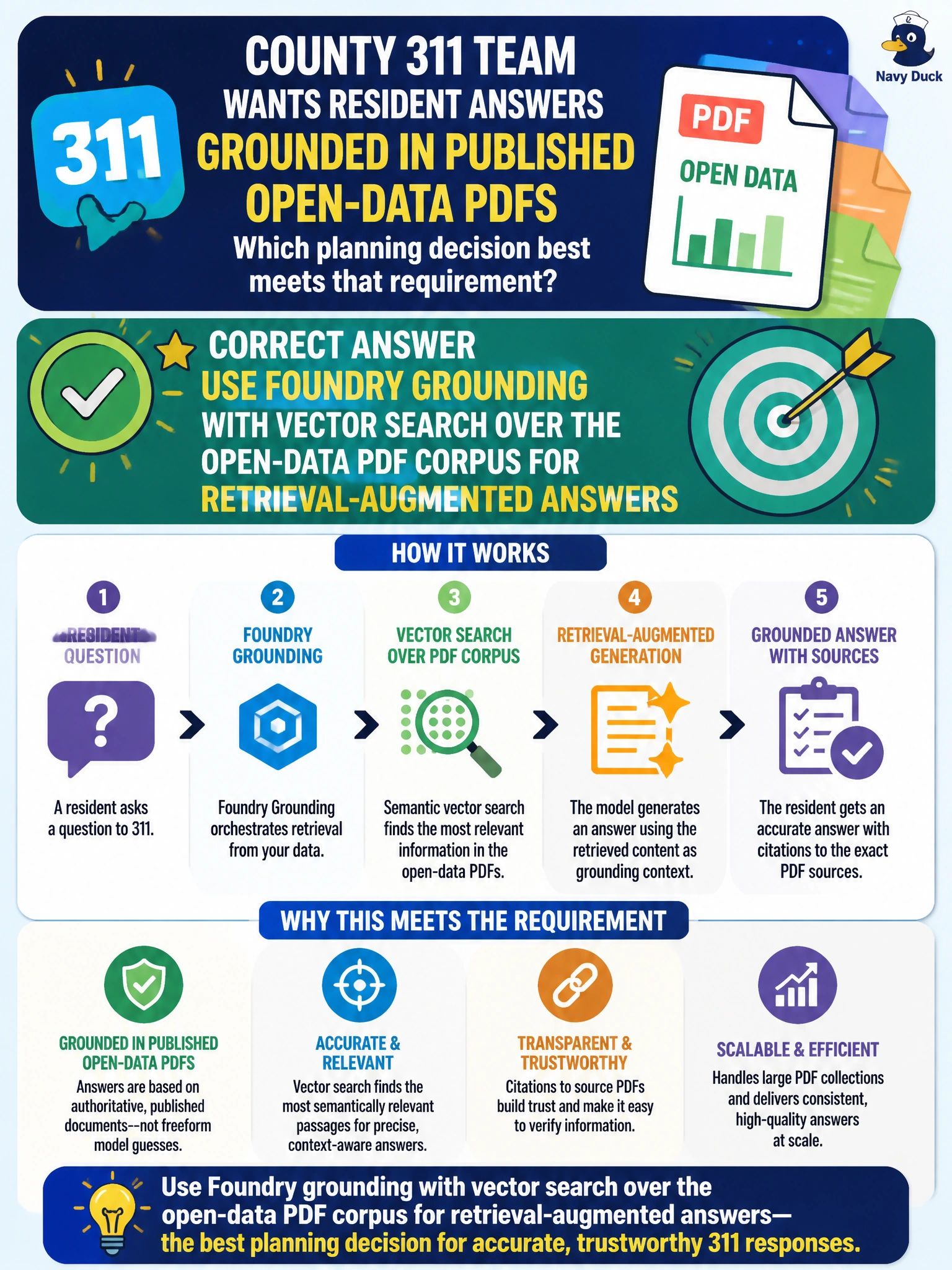
A county 311 team wants resident answers grounded in published open-data PDFs rather than freeform model guesses. Which planning decision best meets that requirement?
Select an answer to reveal the explanation.
Short Explanation
Grounding is like making the bot read the county binder before it speaks. Vector search over those open-data PDFs pulls the right passages into the answer so residents hear policy, not vibes.
Full Explanation
When a county 311 team requires resident answers grounded in published open-data PDFs, the planning decision must make retrieval part of the generative path. Foundry grounding with vector search over that PDF corpus enables retrieval-augmented generation: relevant passages are retrieved, then conditioned into the response so residents hear published policy language rather than unconstrained model guesses. For municipal open-data scenarios, this is the pattern that aligns generative assistants with records that already exist as PDFs on the portal.
Fine-tuning a chat model on the open-data PDF corpus for retrieval-augmented answers in 311 chats fails because it bakes content into weights rather than retrieving passages at answer time; it does not perform vector search over the PDF corpus, so answers can go stale, cannot cite sources, and are not retrieval-augmented. Deploying an Azure AI evaluation pipeline over the open-data PDF corpus for retrieval-augmented answers fails because an evaluation pipeline measures and scores output quality rather than retrieving passages at answer time; it does not perform vector search over the PDFs to condition responses, so it cannot ground answers in published policy. Using Foundry grounding with web search over public county sites for retrieval-augmented answers fails because web search retrieves general public web pages rather than performing vector search over the specific open-data PDF corpus; it cannot ensure answers come from the published PDFs and may return stale or non-authoritative content.
Exam caveat: vector search alone is not a guarantee of correctness—chunking quality, freshness of the PDF index, and citation/display of sources still matter. Operational check: after indexing, ask paraphrased resident questions against known PDF sections, confirm retrieved chunks map to the right open-data files, and require the assistant to refuse or escalate when no supporting passage is found rather than inventing county policy.
Prefer to study offline? Printable PDF study book + test engine ($7.50, unofficial). These questions stay free here.