
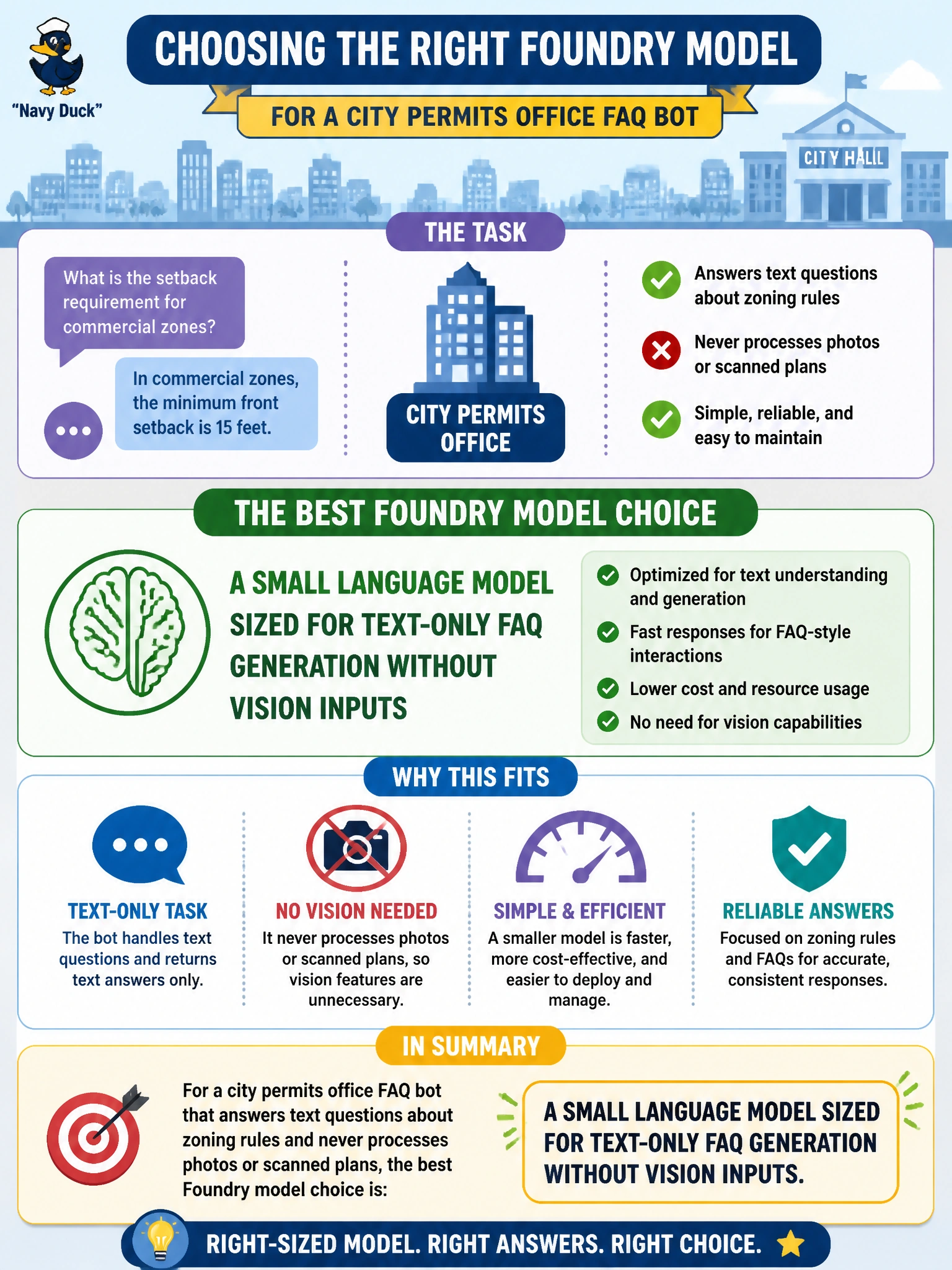
A city permits office needs a simple FAQ bot that answers text questions about zoning rules and never processes photos or scanned plans. Which Foundry model choice best fits that generative task?
Select an answer to reveal the explanation.
Short Explanation
Think of this like picking a compact car for city errands when you'll pay extra for a big SUV to do those same errands. The permits FAQ is text-in, text-out—no photos—so you've got the right-sized small model for FAQs without pulling along a small model tuned for approvals. You don't need an embedding model that can't write answers either, even if it's labeled for FAQs; just answer zoning questions directly.
Full Explanation
For a city permits FAQ that answers zoning questions as text only, the correct Foundry planning choice is a small language model sized for text-only generative work. The permits office explicitly stated that photos and scanned plans are out of scope, so the generative surface is question-in, answer-out language. A compact text model matches that modality, keeps inference cheaper for high-volume FAQ traffic, and avoids paying for vision capacity the bot will never use. On the AI-102/AI-103 planning track, model selection is driven by task modality and operational constraints—not by picking the largest available model by default.
A large language model sized for text-only FAQ generation without vision inputs fails conceptually because unused large-model capacity still adds cost, latency, and configuration surface for simple FAQ text. Even if the model can answer simple questions, routing every zoning FAQ through a large model sized for text-only FAQ generation over-provisions the solution relative to the stated requirement. A compact embedding model sized for text-only FAQ generation without vision inputs fails because embedding models only retrieve or rank text; they do not generate conversational FAQ answers about zoning rules. A small language model sized for text-only approval generation without vision inputs fails because the workload is simple generative FAQ content, not approval generation—defaulting to an approval-writing model adds mismatch without benefit.
Exam caveat: 'small language model' is not always synonymous with 'best quality forever.' If the office later adds scanned plan review or tool-backed permit status lookups, the plan must be revisited. Operational check: confirm the deployed model endpoint rejects or never receives image attachments, measure p95 latency and token cost against FAQ SLAs, and verify answers are still grounded in published zoning policy rather than freeform invention when knowledge retrieval is also in scope.
Prefer to study offline? Printable PDF study book + test engine ($7.50, unofficial). These questions stay free here.