
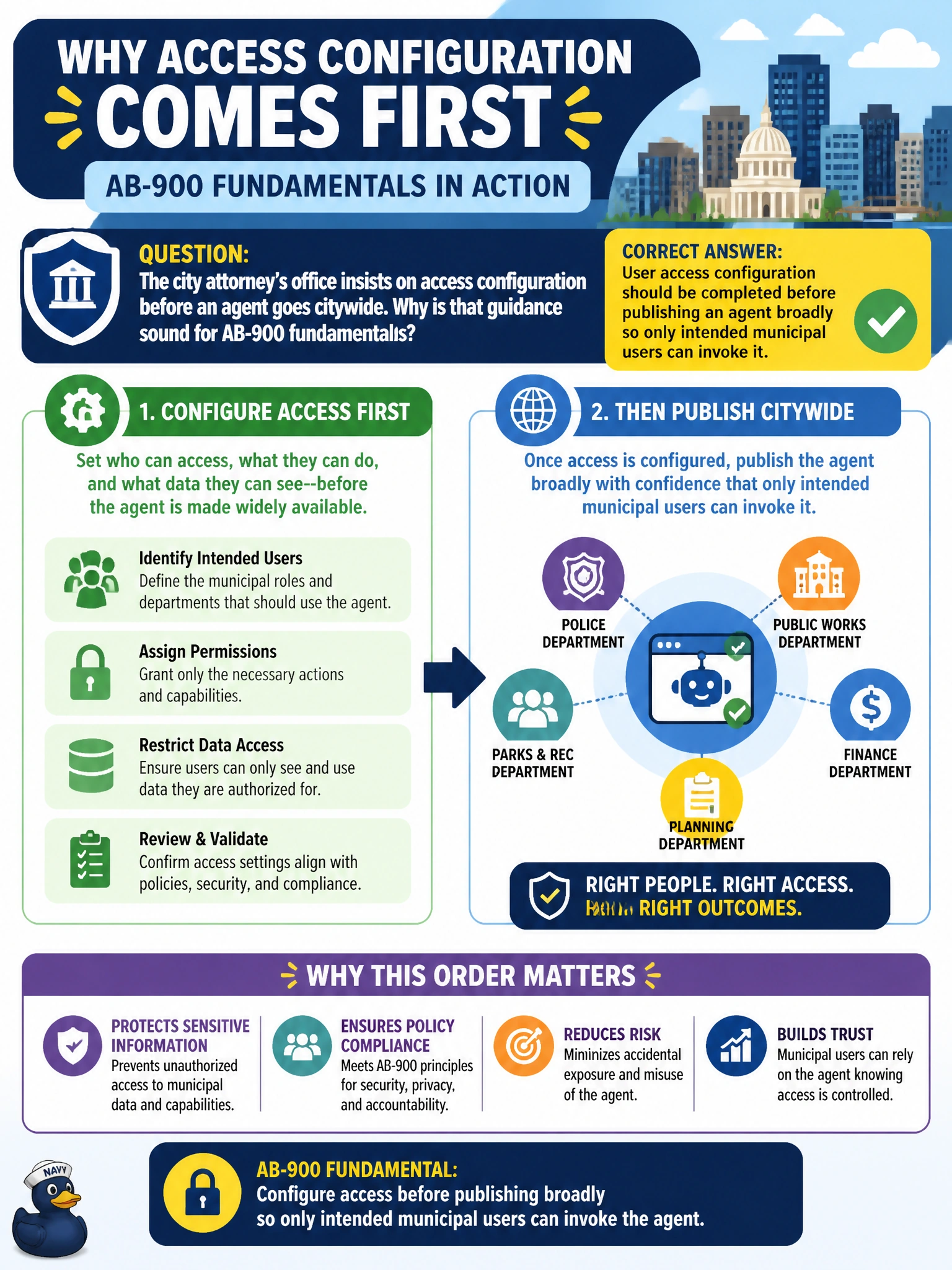
The city attorney's office insists on access configuration before an agent goes citywide. Why is that guidance sound for AB-900 fundamentals?
Select an answer to reveal the explanation.
Short Explanation
Publish first, lock doors later is how lobbies fill with the wrong visitors. The city attorney is right—configure who can use the agent before citywide publish. It's not about grounding sources, maker edit rights, or where you'll host chats.
Full Explanation
User access configuration should be completed before publishing an agent broadly so only intended municipal users can invoke it. That is why the city attorney’s insistence is sound for AB-900 fundamentals: access design is a release gate, and neither data-source grounding, maker-edit controls, nor channel-host selection can substitute for configuring intended municipal users before broad publication. Configuring audience first prevents oversharing of municipal agent capabilities and aligns agent rollout with ordinary identity governance practice.
Completing data source configuration before publishing an agent broadly so only approved municipal records can ground responses fails by concept—citywide release requires configuring intended municipal users before publication, not curating grounding sources, because approved records improve accuracy but do not restrict who can invoke the agent. Completing maker access configuration before publishing an agent broadly so only designated city builders can edit workflows fails because edit control is not access control; Microsoft guidance and AB-900 fundamentals emphasize configuring who can use agents, and restricting who can edit workflows does not restrict invoke permission. Completing channel publication configuration before publishing an agent broadly so only selected service channels can host chats fails the sequencing: channel selection does not configure user access, and invoke controls must exist before citywide release.
Exam caveat: Domain 3 pairs “configure user access” with publishing/approval thinking. Remember the order: define who may use the agent, then publish broadly. Do not memorize a false rule that invoke access can be handled through data-source grounding with approved municipal records rather than by configuring municipal audiences before publication.
Operational check: Before citywide release, document intended audiences with the city attorney and business owner, apply group-based access on the agent, validate negative tests (users outside the audience cannot invoke), record the access baseline, and only then proceed with broad publication communications to municipal staff.
Prefer to study offline? Printable PDF study book + test engine ($7.50, unofficial). These questions stay free here.