
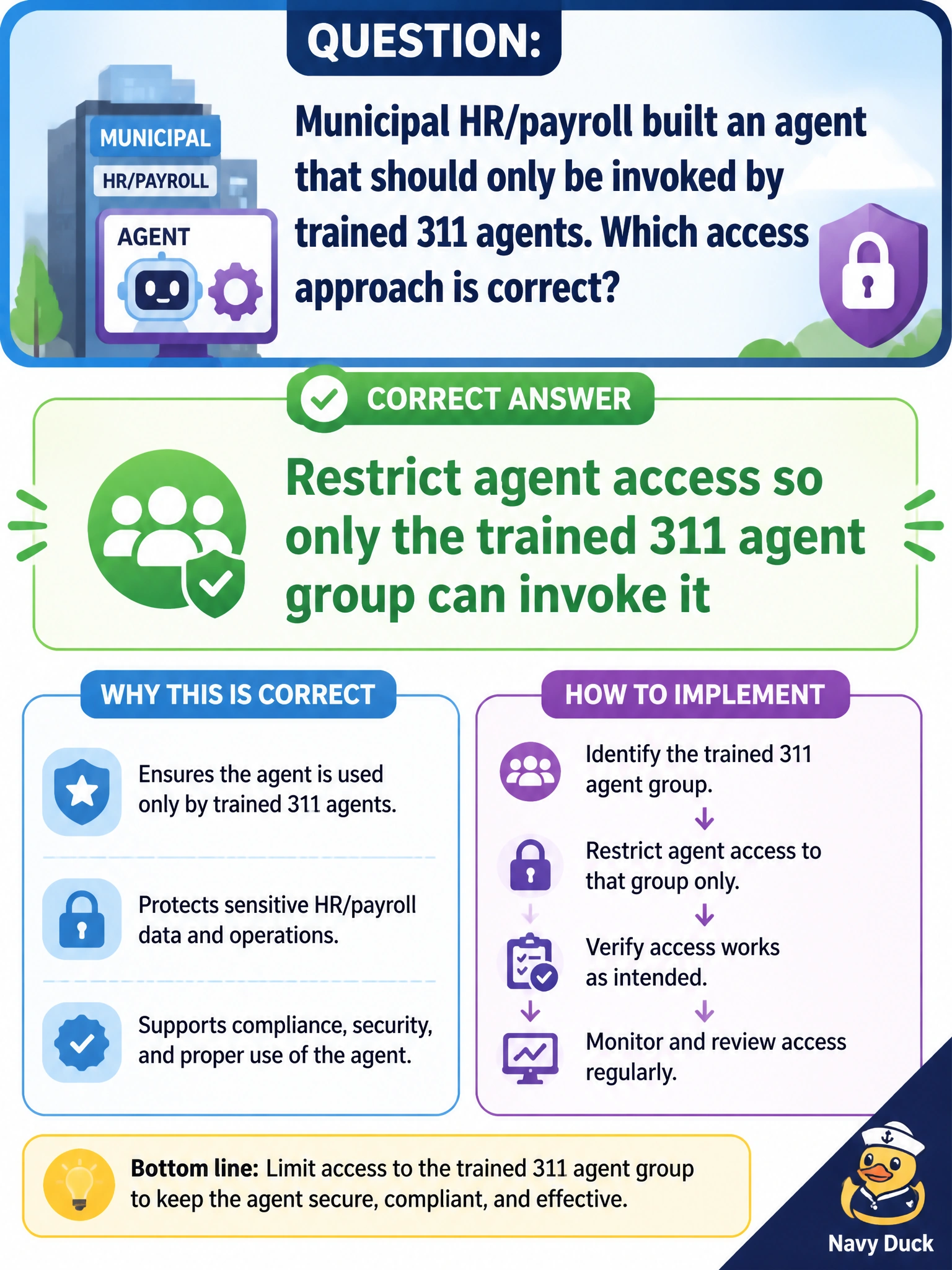
Municipal HR/payroll built an agent that should only be invoked by trained 311 agents. Which access approach is correct?
Select an answer to reveal the explanation.
Short Explanation
Trained 311 staff only — think badge access, not an open lobby. You'll need to restrict who can invoke it to that trained group, and limiting who can edit flows or who can open the HR tables won't do that. Hiding it from catalog search doesn't block invoking either, so don't confuse visibility with invoke rights.
Full Explanation
Municipal HR/payroll should restrict agent access so only the trained 311 agent group can invoke it. That access approach matches least-privilege administration for an agent that should not be a general staff toy: only trained 311 agents need invoke rights for the HR/payroll scenario. Restricting to the trained group reduces mistaken invocations, protects sensitive payroll-adjacent workflows, and matches how municipal service desks separate qualified operators from casual users.
Limiting agent maker rights so only the trained 311 agent group can edit flows fails by concept because it controls who can modify flows, not who can invoke the agent; restricting edit rights alone still leaves invoke access unenforced unless invocation itself is separately scoped to the trained 311 group. Restricting HR data tables so only the trained 311 agent group can open them addresses table-level data access, which is a different control from who can invoke the agent; locking the tables alone still leaves invoke access open to anyone unless invocation itself is separately scoped to the trained 311 group. Hiding the Teams catalog entry so only the trained 311 agent group can search it fails the requirement because catalog search visibility only controls discovery, not enforcement; it does not prevent others from invoking the agent if invoke access itself is not separately scoped to the trained 311 group.
Exam caveat: AB-900 Domain 3 emphasizes configuring which users or groups can use an agent. The correct mental model is scoped invoke rights for the intended municipal audience—not maker rights to edit flows, not HR table access, and not catalog search visibility.
Operational check: Create or reuse a security group for trained 311 agents, assign only that group to the HR/payroll agent, remove broader staff or guest audiences, test invoke allow/deny with sample accounts, and review membership whenever seasonal staff turn over so untrained staff never inherit invoke rights by accident.
Prefer to study offline? Printable PDF study book + test engine ($7.50, unofficial). These questions stay free here.