
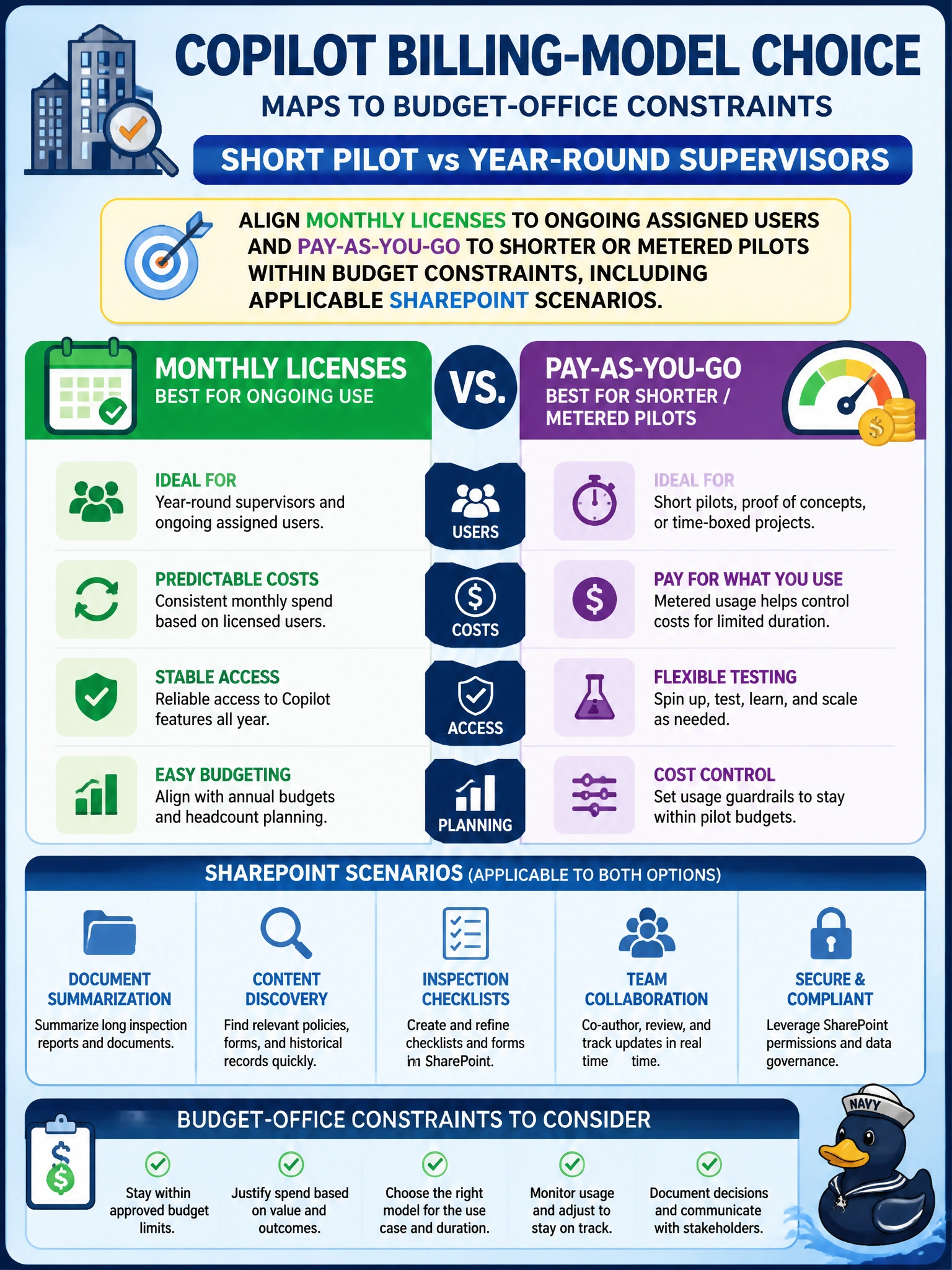
A building inspections unit maps Copilot billing-model choice to budget-office constraints for a short pilot versus year-round supervisors. What should the comparison emphasize?
Select an answer to reveal the explanation.
Short Explanation
Budget office cares whether you buy steady seats or a meter. Year-round supervisors often fit monthly licenses; a short pilot can fit pay-as-you-go—including SharePoint scenarios where it applies. Don't assign annual seats to the short pilot and pay-as-you-go to year-round supervisors just to consolidate renewal dates.
Full Explanation
Building-inspections billing choices should map Copilot monthly licenses to ongoing assigned users such as year-round supervisors and map pay-as-you-go to shorter or metered pilots within budget-office constraints, including applicable SharePoint scenarios. That comparison keeps finance able to distinguish predictable seat spend from variable meter spend, supports a time-boxed pilot without buying year-round seats for temporary inspectors, and still allows SharePoint-grounded Copilot work under the meter when that model applies. Assigning annual seat licenses to the short pilot group and metered pay-as-you-go to year-round supervisors to consolidate renewal dates fails because it inverts the right cost model: temporary pilot users should not carry annual seat commitments while ongoing supervisors face variable meter spend, which undermines budget predictability and the pilot's time-boxed nature. Channeling pilot and supervisor prompts through Copilot Studio capacity packs with metered messages to track department chargeback fails because it substitutes capacity-pack chargeback mechanics for the core billing-model decision and does not align license type to user duration or budget constraints. Tying license duration to Microsoft Entra group membership for inspectors and supervisors to automate provisioning through the pilot lifecycle and SharePoint site access reviews fails because it addresses provisioning automation, not the choice between monthly seats and pay-as-you-go that the budget office requires. Exam caveat: Domain 3 compares monthly versus pay-as-you-go at fundamentals depth; exam items emphasize alignment to usage and budget, not swapping seat and meter assignments by cohort, routing prompts through Copilot Studio capacity packs for chargeback, or using Entra group provisioning as the billing decision. SharePoint applicability of metered options is conceptual—verify product and licensing notes for the tenant's actual offer. Operational check: With the budget office, document which building-inspections cohorts are year-round supervisors versus short-pilot staff, propose monthly seats for the former and PAYG for the latter, and record the expected meter guardrails before the pilot starts.
Prefer to study offline? Printable PDF study book + test engine ($7.50, unofficial). These questions stay free here.