
An animal control admin explains when a city might prefer monthly Copilot subscription licenses over metered pay-as-you-go. Which rationale fits?
Select an answer to reveal the explanation.
Short Explanation
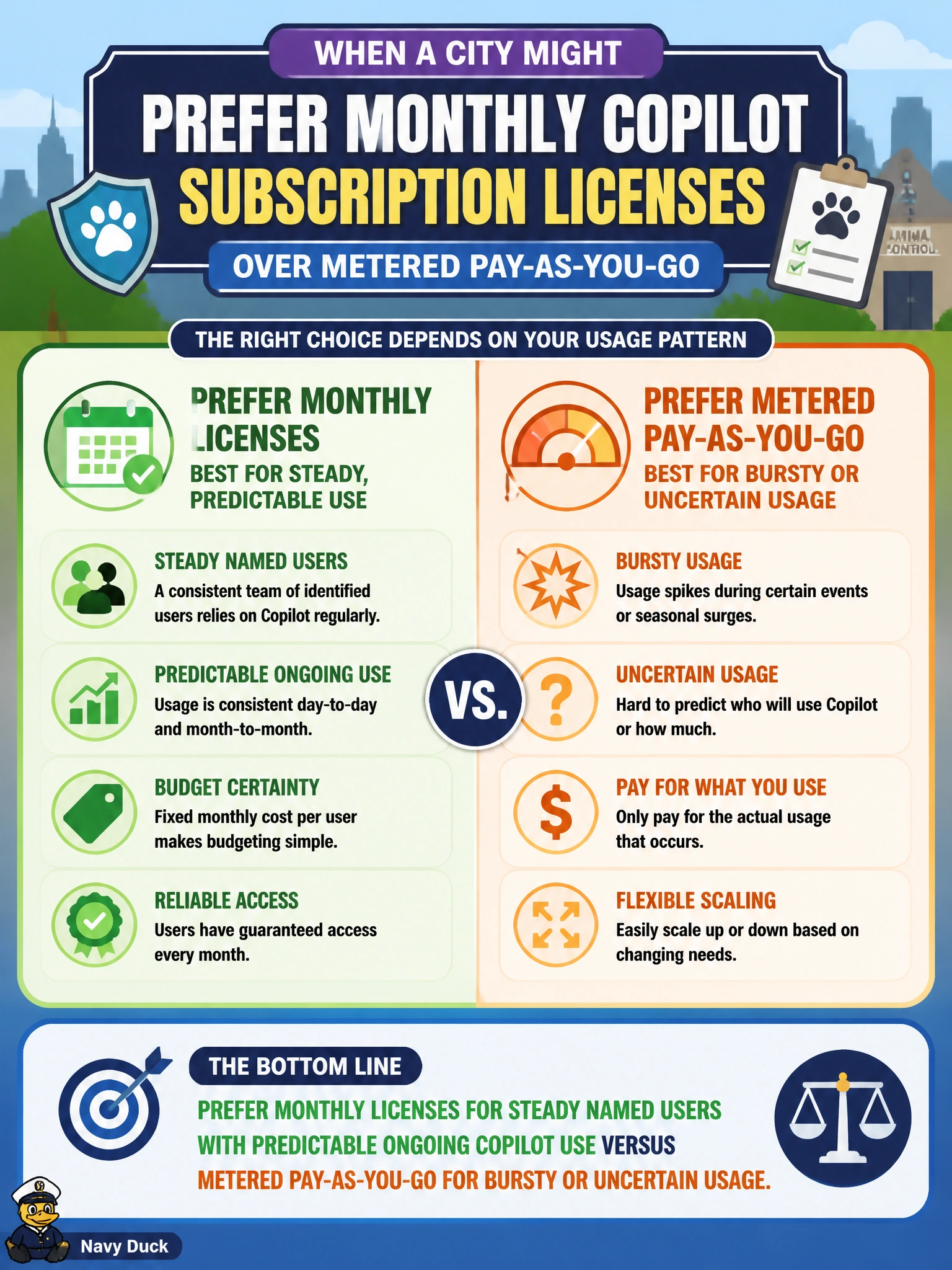
If you've got steady named users on Copilot every week, you'll usually find monthly seats simpler than guessing a meter. Don't buy monthly seats billed per message via Azure or assign them to shared kiosks while you put named daily staff on metered. You'll mismatch costs if you use monthly for overages while steady core staff stay on pay-as-you-go, so match billing to steady versus bursty use.
Full Explanation
Monthly Copilot subscription licenses are the better fit when animal-control staff are steady named users with predictable, ongoing Copilot use. Seat-based monthly assignment gives finance a clear per-user cost, aligns to rostered officers and admins who open Word, Excel, or Outlook with Copilot every week, and avoids meter surprises when usage is habitual rather than seasonal. Pay-as-you-go remains appropriate for bursty or uncertain periods when demand is unpredictable, but it is not the economical fit for habitual daily use by the same named staff. Preferring monthly licenses for steady named users with predictable Copilot use billed per message via Azure versus metered pay-as-you-go for steady daily use fails because it reverses the billing models: monthly licenses are seat-based per user, not billed per message via Azure, and metered pay-as-you-go for steady daily use is backwards since steady daily use fits monthly seats while bursty or uncertain use fits pay-as-you-go. Preferring monthly licenses for steady shared kiosk accounts with predictable Copilot use versus metered pay-as-you-go for named staff with daily workflows fails because monthly licenses require steady named users and cannot be assigned to shared kiosk accounts, while named staff with daily workflows are exactly the predictable ongoing pattern that fits monthly seats rather than metered consumption. Preferring monthly licenses for steady named users with predictable Copilot Studio message overages versus metered pay-as-you-go for steady core staff daily use fails because message overages are metered consumption that fits pay-as-you-go, while steady core staff with daily use are the textbook case for monthly licenses, so both halves misapply the usage pattern. Exam caveat: AB-900 expects you to compare monthly versus pay-as-you-go by usage pattern of steady predictable use versus bursty or uncertain use; it does not require memorizing SKU prices or inventing municipal exclusivity rules. Always confirm current Microsoft licensing guidance and city procurement constraints before purchase. Operational check: Inventory animal-control named users who use Copilot weekly, map them to monthly seats, and separately flag shared kiosk use and Copilot Studio overage risk for PAYG evaluation; confirm with finance that the chosen model matches forecasted steady versus bursty demand before assigning licenses.
Prefer to study offline? Printable PDF study book + test engine ($7.50, unofficial). These questions stay free here.