
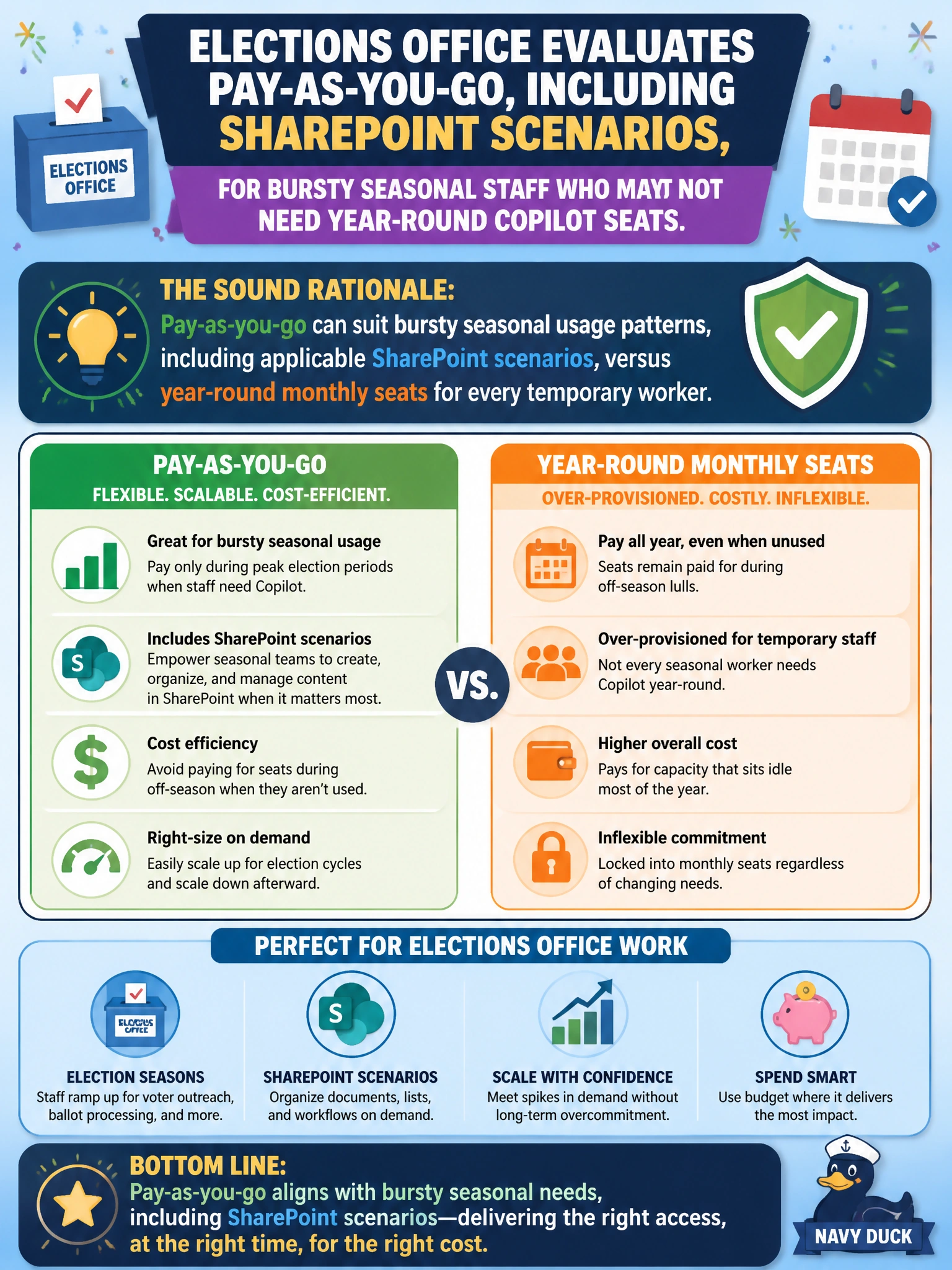
An elections office evaluates pay-as-you-go, including SharePoint scenarios, for bursty seasonal staff who may not need year-round Copilot seats. Which rationale is sound?
Select an answer to reveal the explanation.
Short Explanation
Election season is bursty—pay-as-you-go (including SharePoint scenarios) can fit temporary workers better than buying year-round seats for everyone. Don't assume your monthly seats will cover metered SharePoint agent use for seasonal coverage. Match meters to the season.
Full Explanation
An elections office evaluating pay-as-you-go—including SharePoint scenarios—for bursty seasonal staff is sound when temporary workers do not need year-round Copilot seats. Pay-as-you-go can align cost with seasonal spikes, whereas assigning monthly licenses to every temporary worker for a short election window often over-provisions. The rationale matches metered use for bursty patterns versus standing seats for continuous users.
Assigning monthly Microsoft 365 Copilot seats for seasonal election coverage over-provisions for temporary bursty usage, and metered SharePoint agent usage does not draw from seat allocation but requires separate pay-as-you-go consumption metering. Pay-as-you-go is available in tenants that include SharePoint; funding seasonal SharePoint agent bursts with prepaid Copilot Studio capacity licensed per temporary worker is incorrect because prepaid capacity is pooled capacity, not a per-worker license, and does not replace pay-as-you-go consumption metering for bursty use. Existing Microsoft 365 E3 assignments do not automatically enable metered Copilot chat for seasonal intake, including SharePoint-assisted voter service, which requires separate pay-as-you-go billing setup. Those options fail by assigning monthly seats on the mistaken premise that metered SharePoint agent usage can draw from seat allocation, misapplying prepaid capacity as a per-worker license instead of consumption metering, or assuming current licenses cover metered seasonal use.
Exam caveat: Map billing to workforce pattern: bursty seasonal (and applicable SharePoint scenarios) → consider pay-as-you-go; year-round assigned staff → monthly seats. Do not "solve" Copilot cost by assigning monthly Microsoft 365 Copilot seats for seasonal election coverage on the premise that metered SharePoint agent usage can draw from seat allocation. AB-900 focuses on that conceptual fit for municipal seasonal operations.
Operational check: Identify seasonal election roles and expected usage windows, enable pay-as-you-go with budget alerts for the elections project (including applicable SharePoint scenarios), avoid monthly seats for workers who leave after certification night, revoke any standing AI access when the season ends, and do not assume monthly Microsoft 365 Copilot seats for seasonal election coverage allow metered SharePoint agent usage to draw from seat allocation.
Prefer to study offline? Printable PDF study book + test engine ($7.50, unofficial). These questions stay free here.