
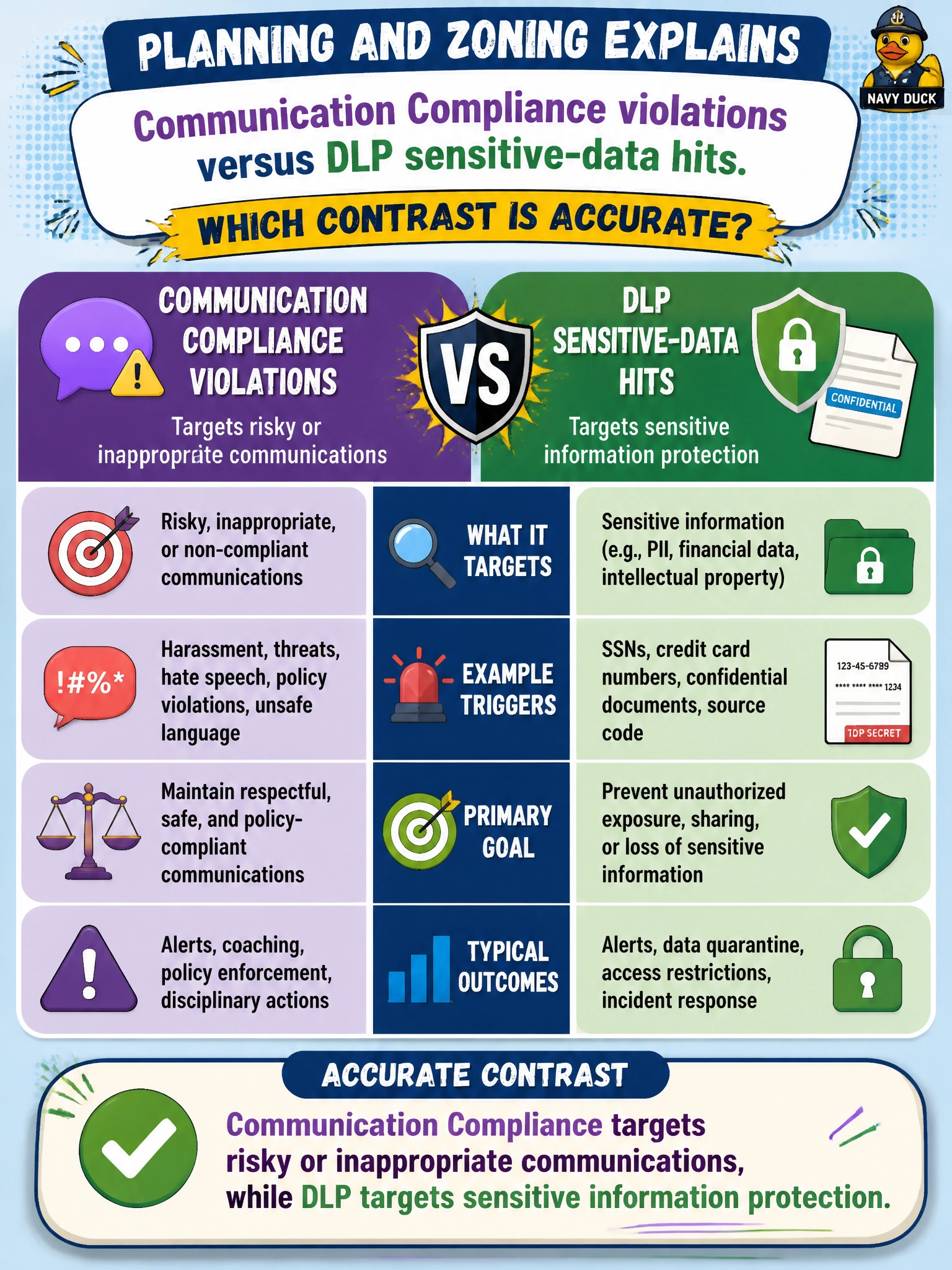
Planning and zoning explains Communication Compliance violations versus DLP sensitive-data hits. Which contrast is accurate?
Select an answer to reveal the explanation.
Short Explanation
Simple contrast: Communication Compliance watches risky talk; DLP watches sensitive data leaving or matching policy. Don't swap their purposes, assign insider-risk aggregation or eDiscovery holds to Communication Compliance, or give DLP sensitivity-label and retention duties. Different risks, different alerts.
Full Explanation
Planning and zoning should teach that Communication Compliance targets risky or inappropriate communications, while DLP targets sensitive information protection matches. The contrast prevents mis-triage: a zoning clerk pasting parcel-owner SSNs into email is a DLP-shaped problem; a clerk sending harassing language in Teams is a Communication Compliance-shaped problem. Both matter for municipal governance; they are not the same control.
Claiming Communication Compliance targets sensitive information protection matches, while DLP targets risky or inappropriate communications fails differentiation: it reverses the correct contrast and swaps the tools’ purposes. Claiming Communication Compliance aggregates insider risk signals across apps, while DLP manages eDiscovery holds for legal zoning appeal cases fails purpose: Communication Compliance reviews communications conduct, and DLP does not manage eDiscovery holds. Claiming Communication Compliance auto-applies sensitivity labels to site plans, while DLP sets retention periods for Teams conversations fails purpose: Communication Compliance does not auto-apply sensitivity labels, and DLP does not set retention periods.
Exam caveat: AB-900 repeatedly tests this exact contrast. If the stem says “versus” or “distinguishes,” lead with Communications Compliance = risky/inappropriate communications and DLP = sensitive information matches. Do not reverse the tools’ duties, assign insider-risk aggregation or eDiscovery holds to the wrong tool, or invent sensitivity-label and retention responsibilities for either.
Operational check: Build a one-page planning/zoning cheat sheet with one example of each alert type, route DLP matches to data-protection responders and Communication Compliance matches to HR/authorized reviewers, and quiz staff on which queue a sample scenario would take.
Prefer to study offline? Printable PDF study book + test engine ($7.50, unofficial). These questions stay free here.