
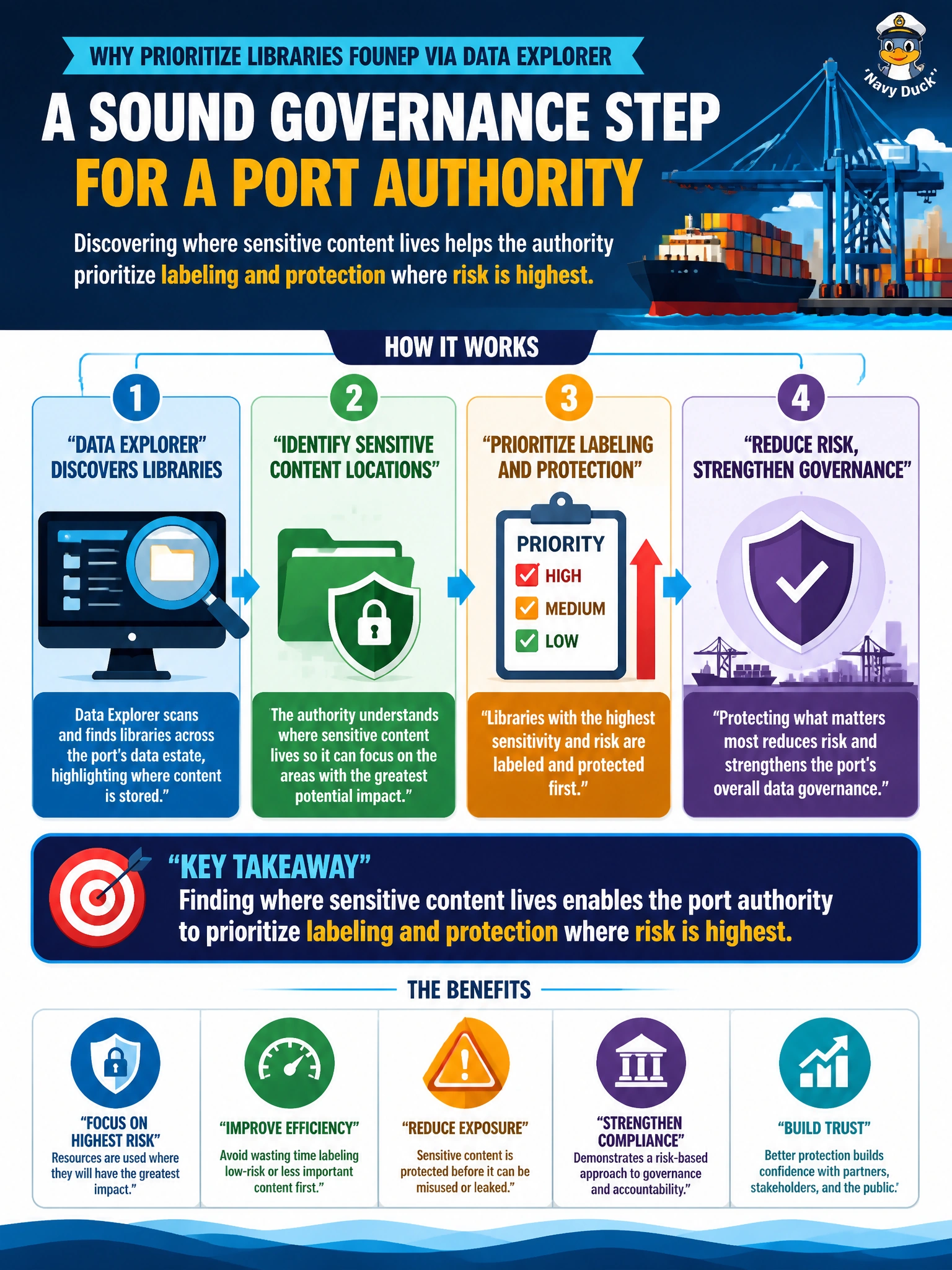
A port authority prioritizes libraries found via Data Explorer for labeling first. Why is that a sound governance step?
Select an answer to reveal the explanation.
Short Explanation
If Data Explorer shows juicy sensitive libraries, label those first—risk triage, not assuming just viewing them auto-applies labels. Don't expect reviewing inventory to lift your Compliance Manager score; discovery finds risk, it doesn't implement the controls. Protect where the data actually lives.
Full Explanation
A port authority that prioritizes libraries found via Data Explorer for labeling first is taking a sound governance step because discovering where sensitive content lives helps prioritize labeling and protection where risk is highest. Labels and protection controls are finite operational effort; applying them first to repositories that actually contain sensitive municipal content reduces exposure faster than labeling empty or low-risk sites. Viewing content distribution in Data Explorer does not automatically apply sensitivity labels for the authority across those libraries: Data Explorer is a discovery and inventory tool, not an auto-labeling enforcement mechanism. Reviewing Data Explorer inventory results does not increase the Compliance Manager score for the authority after discovery alone: inventory findings identify where to act, but Compliance Manager scores reflect implemented control progress, not discovery output. Mapping high-risk libraries in Data Explorer does not enforce data loss prevention policies for the authority across those sites: mapping identifies locations, while data loss prevention is a separate protection policy that must be configured independently.
Exam caveat: AB-900 links discovery to prioritization of labeling and protection. You need the governance rationale, not a full port-authority taxonomy design. Related exam items may cover auto-labeling mechanics; this stem is about why discovered high-risk locations go first.
Operational check: From Data Explorer output, select the highest-hit port libraries, apply or verify sensitivity labels and access reviews there first, then expand labeling to lower-risk sites—and record that prioritization order for audit.
Prefer to study offline? Printable PDF study book + test engine ($7.50, unofficial). These questions stay free here.