
County IT shared services explains Data Explorer as a discovery lens for sensitive content. What should that explanation emphasize?
Select an answer to reveal the explanation.
Short Explanation
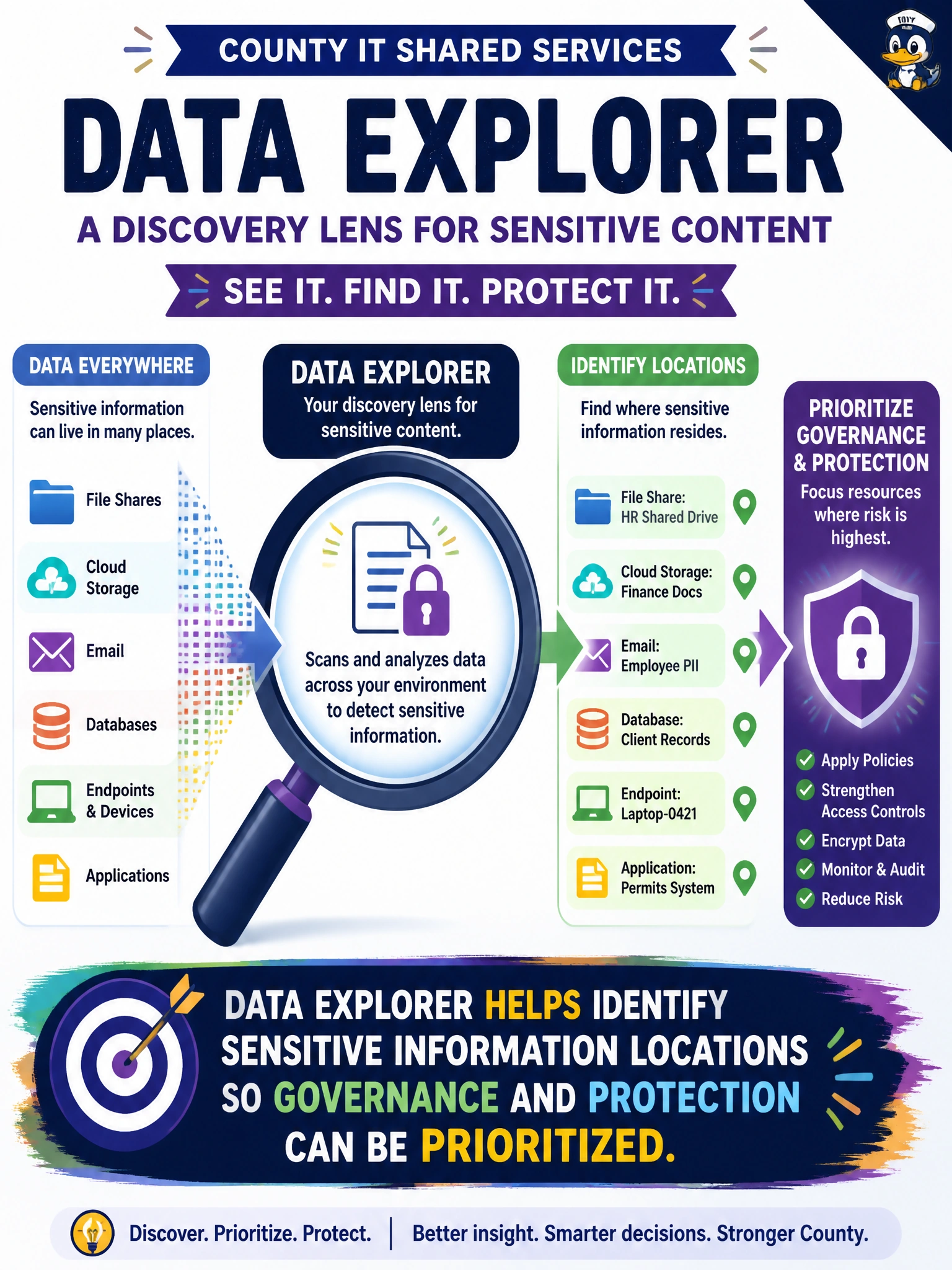
Data Explorer is a discovery lens: you find sensitive content, then prioritize protection. It doesn't enforce DLP blocks, apply sensitivity labels, or track user activity for audits. County IT should sell it as find-then-fix.
Full Explanation
County IT shared services should explain that Data Explorer helps identify sensitive information locations so governance and protection can be prioritized. Discovery without follow-through is incomplete: the municipal value of Data Explorer is knowing where sensitive content concentrates so labeling, DLP, access reviews, and Copilot grounding boundaries can be applied where risk is highest.
Claiming Data Explorer enforces data loss prevention policies to block external sharing of sensitive items fails access-control concepts: Data Explorer discovers sensitive content; it does not enforce DLP blocks or block external sharing. Claiming it applies sensitivity labels to documents containing sensitive information types across workspaces fails the product purpose: Data Explorer discovers and surfaces sensitive content locations; it does not apply sensitivity labels. Calling it a tool that tracks user activity around labeled content to support audit review and incident investigation fails the product purpose: Data Explorer is a discovery experience for locating sensitive content, not an activity-tracking or audit tool.
Exam caveat: AB-900 tests the identify-level purpose of Data Explorer—locate sensitive information to inform governance—not every remediation control that follows. Do not confuse discovery with enforcement; DLP and labels protect, Data Explorer finds.
Operational check: After a Data Explorer review, produce a short prioritization list (top repositories by sensitive hits), assign labeling/DLP owners, and confirm Data Explorer is not applying sensitivity labels across workspaces—discovery finds, it does not label.
Prefer to study offline? Printable PDF study book + test engine ($7.50, unofficial). These questions stay free here.