
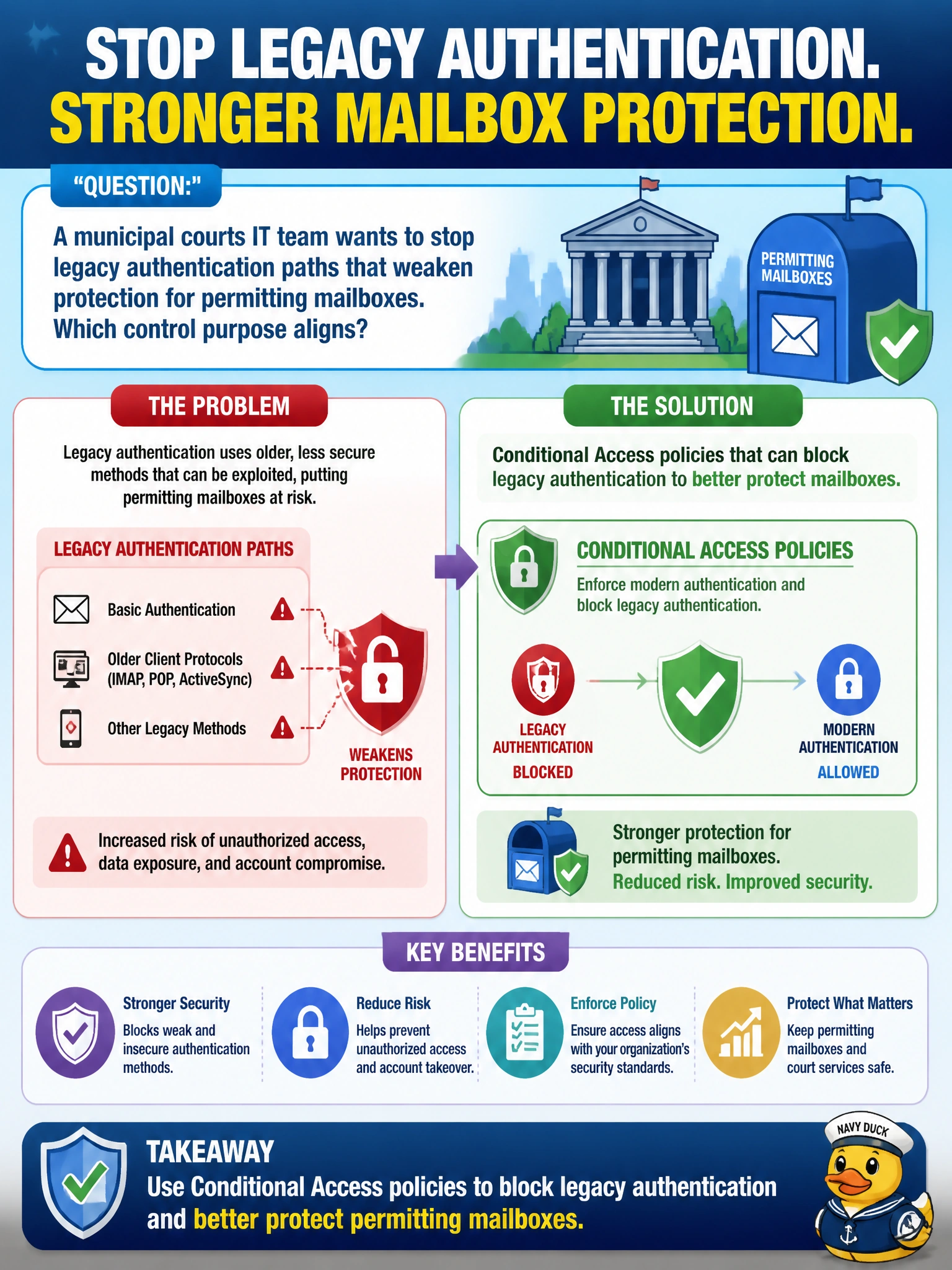
A municipal courts IT team wants to stop legacy authentication paths that weaken protection for permitting mailboxes. Which control purpose aligns?
Select an answer to reveal the explanation.
Short Explanation
Legacy auth is the old side door that skips modern locks—you don't need that door for courts and permitting mailboxes. Conditional Access can shut it. Authentication methods policies, Exchange ActiveSync policies, and Identity Protection risk policies won't close that legacy-auth gap either.
Full Explanation
Legacy authentication protocols often cannot enforce modern controls such as MFA, which weakens protection for permitting mailboxes used by municipal courts workloads. Conditional Access policies can block legacy authentication so clients must use modern auth paths that support stronger identity controls. That control purpose—closing weak sign-in protocols—aligns with stopping legacy auth that undermines mailbox protection.
Authentication methods policies that can block legacy authentication to strengthen MFA registrations fail by concept because they manage authentication methods and MFA registration options rather than blocking legacy authentication paths for mailboxes. Exchange ActiveSync policies that can block legacy authentication to better protect mobile access fail by concept because they manage mobile access settings rather than blocking legacy authentication protocols for mailboxes. Identity Protection risk policies that can block legacy authentication to mitigate risky sign-ins fail by concept because they respond to detected risk for sign-ins rather than blocking legacy authentication paths.
Exam caveat: AB-900 connects Conditional Access purpose to reducing weak sign-in paths at fundamentals depth; it does not require authoring every authentication method policy detail. Municipal courts and permitting mailboxes still need modern auth plus appropriate MFA or Conditional Access grants. Authentication methods policies, Exchange ActiveSync policies, and Identity Protection risk policies are not substitutes for blocking legacy auth.
Operational check: Identify legacy auth attempt signals for permitting mailboxes, enable Conditional Access (or equivalent modern-auth enforcement) to block legacy protocols, validate that modern clients still succeed, and confirm outdated clients fail cleanly. Ensure authentication methods policies, Exchange ActiveSync policies, and Identity Protection risk policies were not used as the "fix."
Prefer to study offline? Printable PDF study book + test engine ($7.50, unofficial). These questions stay free here.