
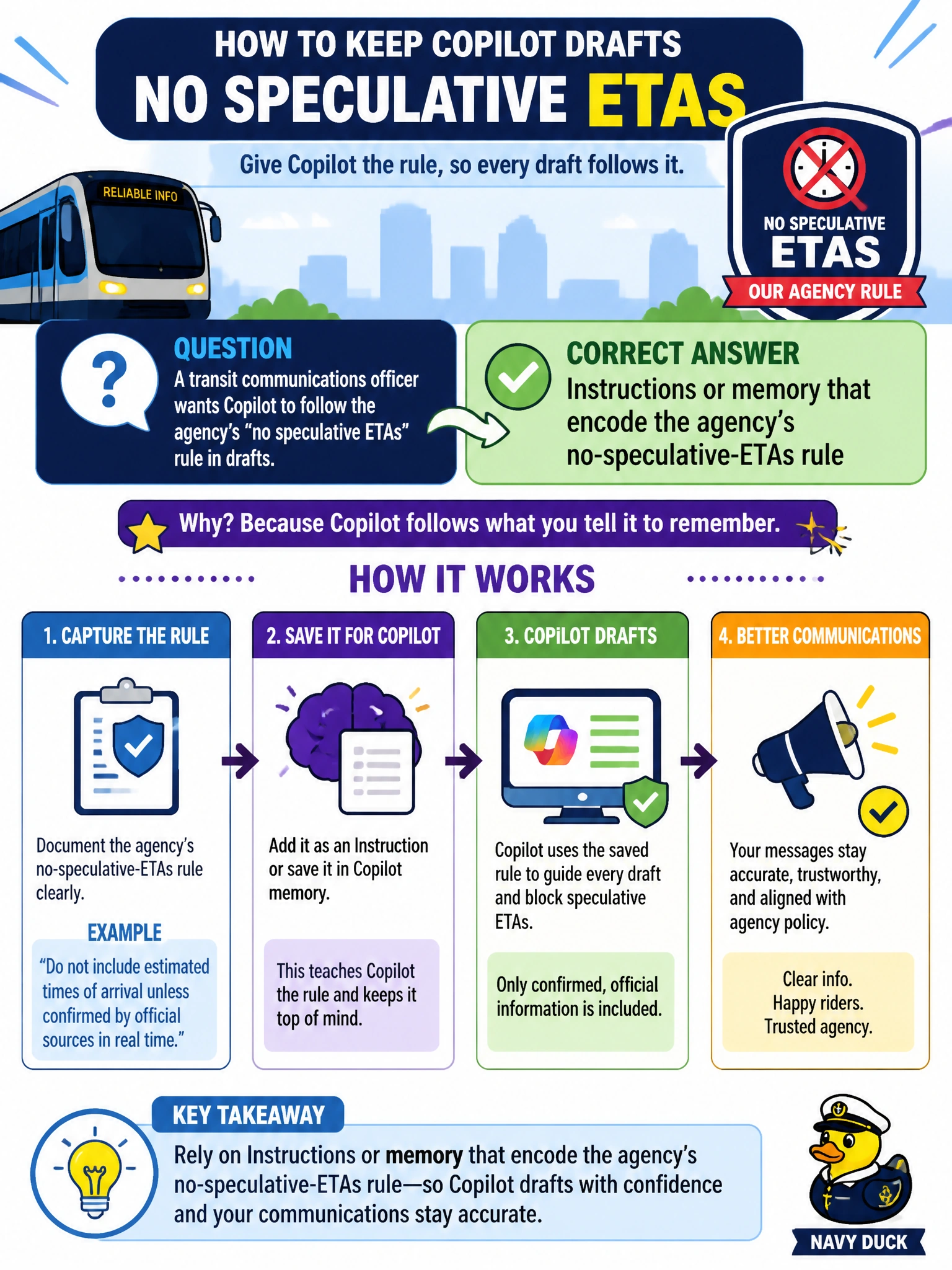
A transit communications officer wants Copilot to follow the agency’s “no speculative ETAs” rule in drafts. What should they rely on?
Select an answer to reveal the explanation.
Short Explanation
“No speculative ETAs” only sticks if Copilot is told—set it via instructions or memory. Policy-like preferences need to live in guidance, not wishful thinking.
Full Explanation
Transit agencies often prohibit speculative arrival or restoration times because inaccurate ETAs drive complaints and unsafe rider decisions. Relying on instructions or memory that encode the agency’s no-speculative-ETAs rule is correct because those features make the policy stick across drafts instead of depending on wishful prompting. Municipal transit communications should only publish times grounded in operations sources.
Hoping Copilot guesses the policy without any memory or instructions fails enforceability; unspoken rules are inconsistently followed. Asking Copilot to invent precise arrival times with no operational source directly violates the anti-speculation principle and manufactures false certainty. Posting unverified ETAs to riders before ops confirms restoration windows fails operational clearance and can strand riders who plan around invented times.
Exam caveat: encoding the rule in instructions or memory constrains drafting style but does not replace live ops confirmation when a verified window finally exists and is cleared for public release. Operational check: store the no-speculative-ETAs rule in instructions or memory, test a draft outage message to ensure invented times do not appear, and only add ETAs after operations confirms and communications clears them.