
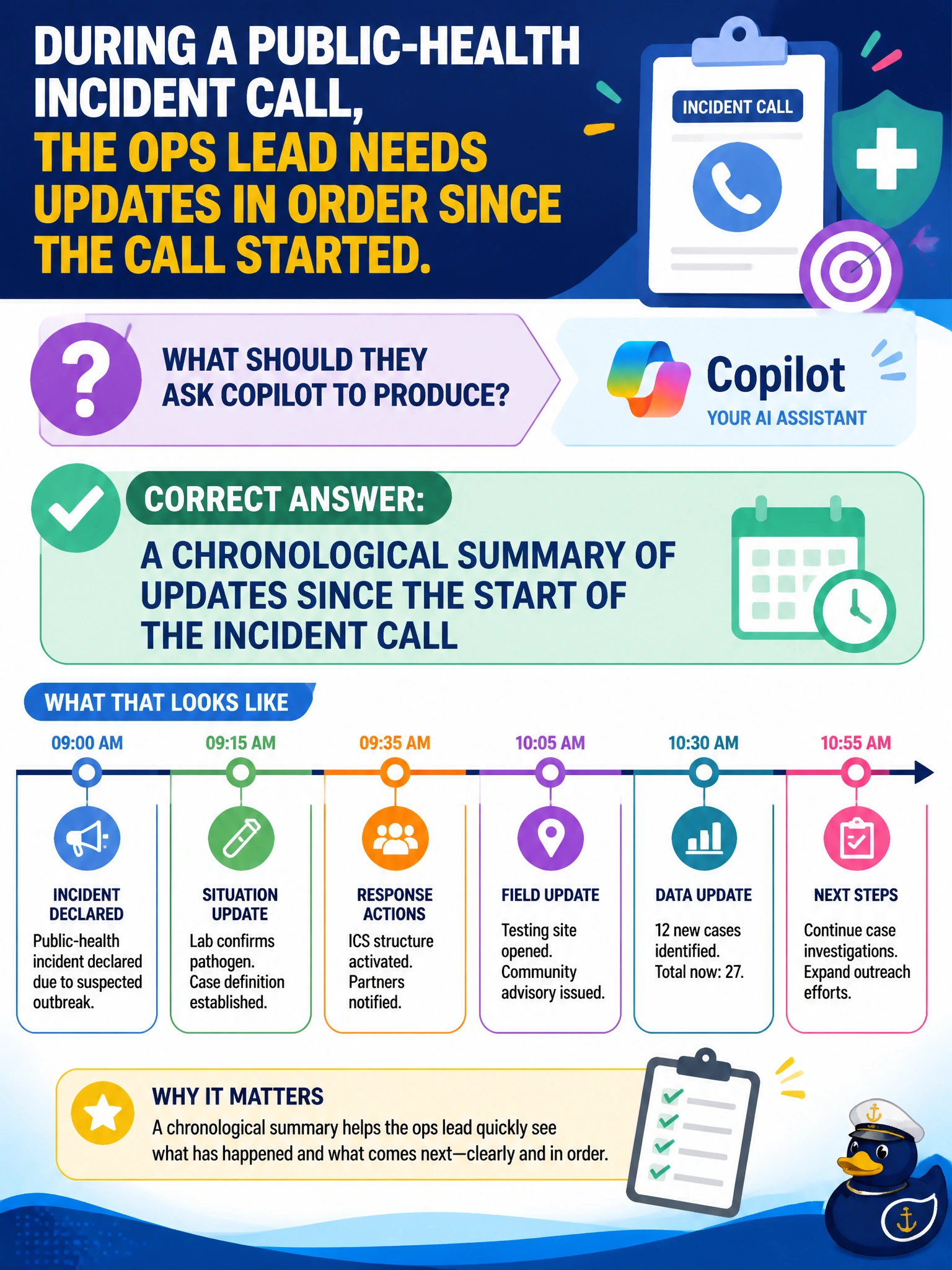
During a public-health incident call, the ops lead needs updates in order since the call started. What should they ask Copilot to produce?
Select an answer to reveal the explanation.
Short Explanation
Incident calls jump around—ask Copilot for a chronological summary of updates since the public-health call started. Timeline order turns chaos into a usable brief.
Full Explanation
Public-health incident calls are noisy, interrupt-driven, and time-critical; ops leads need updates in the order events actually unfolded. Asking Copilot to produce a chronological summary of updates since the start of the incident call is correct because timeline-ordered synthesis restores sequence for decisions about staffing, messaging, and escalation. Chronology helps distinguish what was known at each hour, which directives superseded earlier ones, and where handoffs occurred across epidemiology, clinics, and emergency management.
A random scramble of topics with no regard to when updates were given fails situational awareness. Out-of-order briefs cause teams to act on stale assumptions or miss that a later update already resolved an earlier worry. A list of private patient names from the call for public release fails confidentiality and public-communications rules; patient identity is not an incident status product. An instruction to stop capturing any further updates for the rest of the incident fails continuity. Incidents evolve; stopping capture blinds the after-action and live ops picture.
Exam caveat: chronological summaries still require human validation because Copilot may mis-order nearly simultaneous updates or omit a critical radio or bridge comment that was unclear in audio. Operational check: compare the timeline against the incident log or bridge notes, remove any patient-identifying details before wider distribution, and keep capture running so later updates can extend the same chronological brief.