
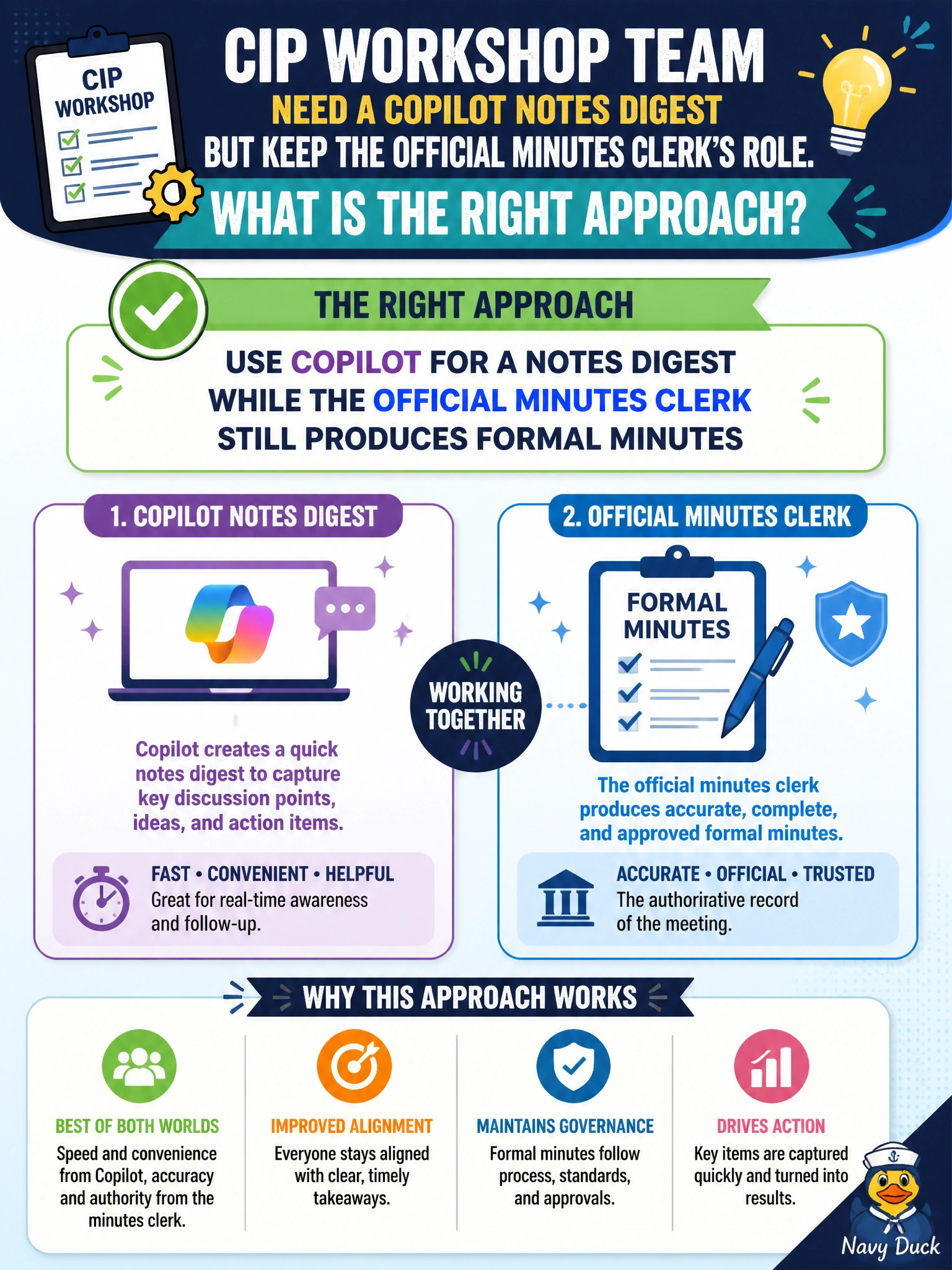
A CIP workshop team wants a Copilot notes digest but must keep the official minutes clerk’s role. What is the right approach?
Select an answer to reveal the explanation.
Short Explanation
You can use Copilot for a CIP workshop notes digest and still keep the official minutes clerk in their formal role. Think of the digest as a helper for staff, while the clerk continues to produce the official minutes.
Full Explanation
Capital Improvement Program workshops generate substantial working discussion that can benefit from a digest, while formal municipal minutes remain a distinct legal and clerical function. Using Copilot for a notes digest while the official minutes clerk still produces formal minutes is right because it separates assistive capture from the authoritative record. Copilot can help CIP staff understand themes, options, and parking-lot items; the clerk continues to meet ordinance, charter, or policy requirements for minutes that may be adopted, posted, or relied on in later proceedings. Replacing the clerk entirely and treating Copilot output as the legal record fails role and reliability boundaries: a generative digest may omit motions, misstate votes, or invent phrasing, and is not automatically official. Discarding all workshop notes so only hallway rumors remain undermines institutional memory and auditability. Asking Copilot to adjust workshop bid figures before review, then having the clerk rely on them, compromises integrity; unreviewed procurement-related changes can mislead evaluators and create compliance risk. Exam caveat: even a strong digest must be labeled as working notes, not minutes, wherever the jurisdiction requires clerk-produced or council-approved official minutes. Practical check: route the digest to project staff for day-to-day use, leave the clerk’s formal-minutes workflow unchanged, label Copilot output as unofficial, and do not let Copilot rewrite bid figures or motion text without human approval.