
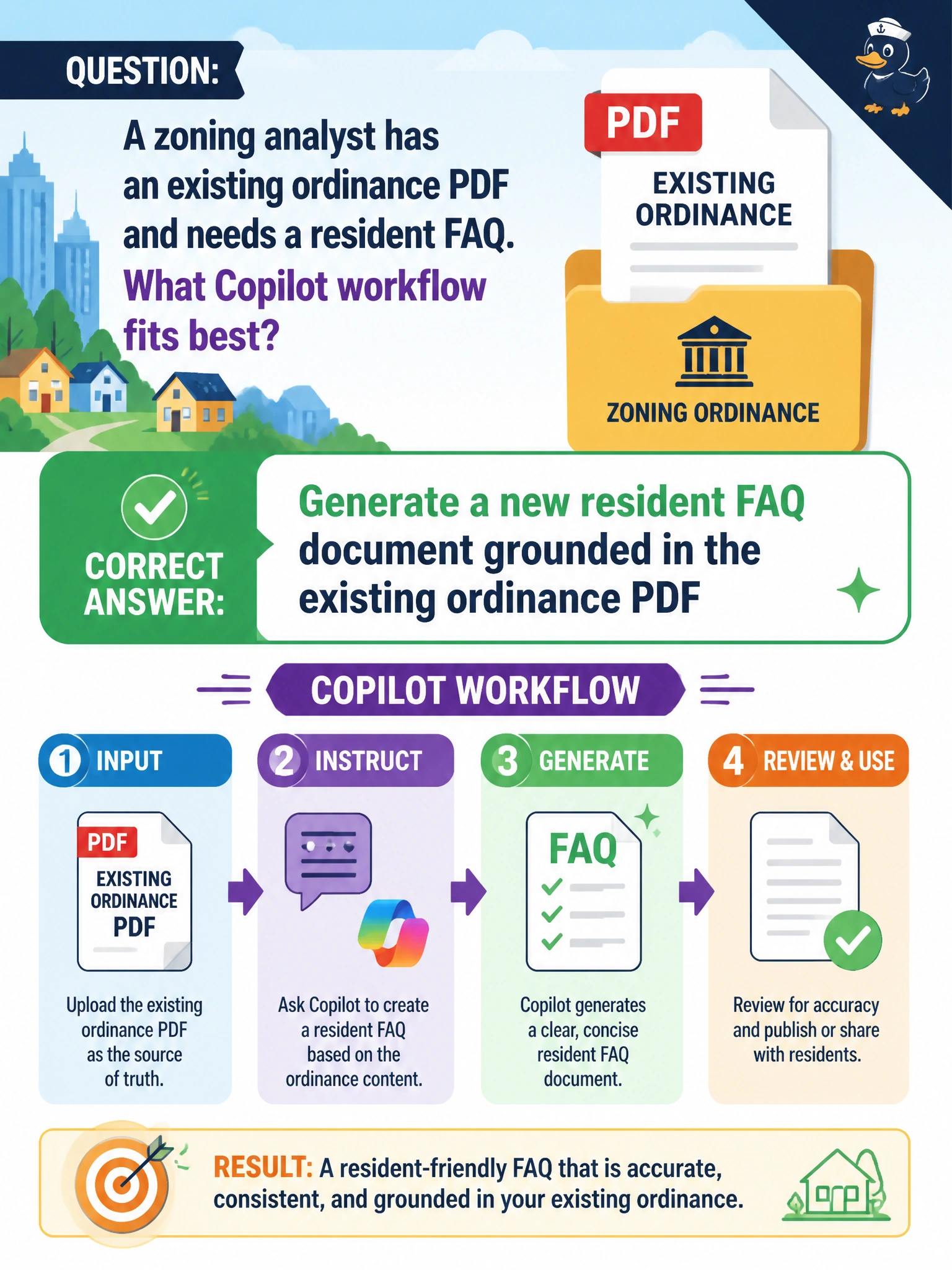
A zoning analyst has an existing ordinance PDF and needs a resident FAQ. What Copilot workflow fits best?
Select an answer to reveal the explanation.
Short Explanation
Got the ordinance PDF already? Use it—generate a resident FAQ grounded in that existing document. Don’t freestyle zoning rules from thin air.
Full Explanation
Generating a new resident FAQ document grounded in the existing ordinance PDF is the Copilot workflow that fits best when a zoning analyst already has the source file. Generating from an existing document lets Copilot ground new municipal content in the ordinance rather than inventing zoning rules. The FAQ becomes a resident-friendly layer on top of controlling text, with humans still responsible for legal accuracy before publication.
Ignoring the ordinance PDF and inventing FAQ answers with no source document fails because ungrounded FAQs can misstate setbacks, uses, or process and mislead residents who then file wrong applications.
Deleting the ordinance PDF before asking Copilot any FAQ questions fails by destroying the grounding source required for this workflow. Without the PDF, the agent cannot cite the ordinance reliably.
Asking Copilot to replace the ordinance text in the official code library automatically fails as an unauthorized change to the code of ordinances. FAQs are explanatory; they do not auto-edit the official library.
Exam caveat: AB-730’s generate-from-existing-document skill keeps the source file in play and produces a new derivative (here, a resident FAQ)—it does not delete or overwrite the official ordinance corpus.
Operational check: Open or attach the ordinance PDF, prompt for a resident FAQ grounded in that file, verify each Q&A against the PDF sections, and publish only after zoning review—leaving the official code library unchanged.