
A grants writer has a successful prior narrative and a different new NOFO. What should they ask Copilot to do?
Select an answer to reveal the explanation.
Short Explanation
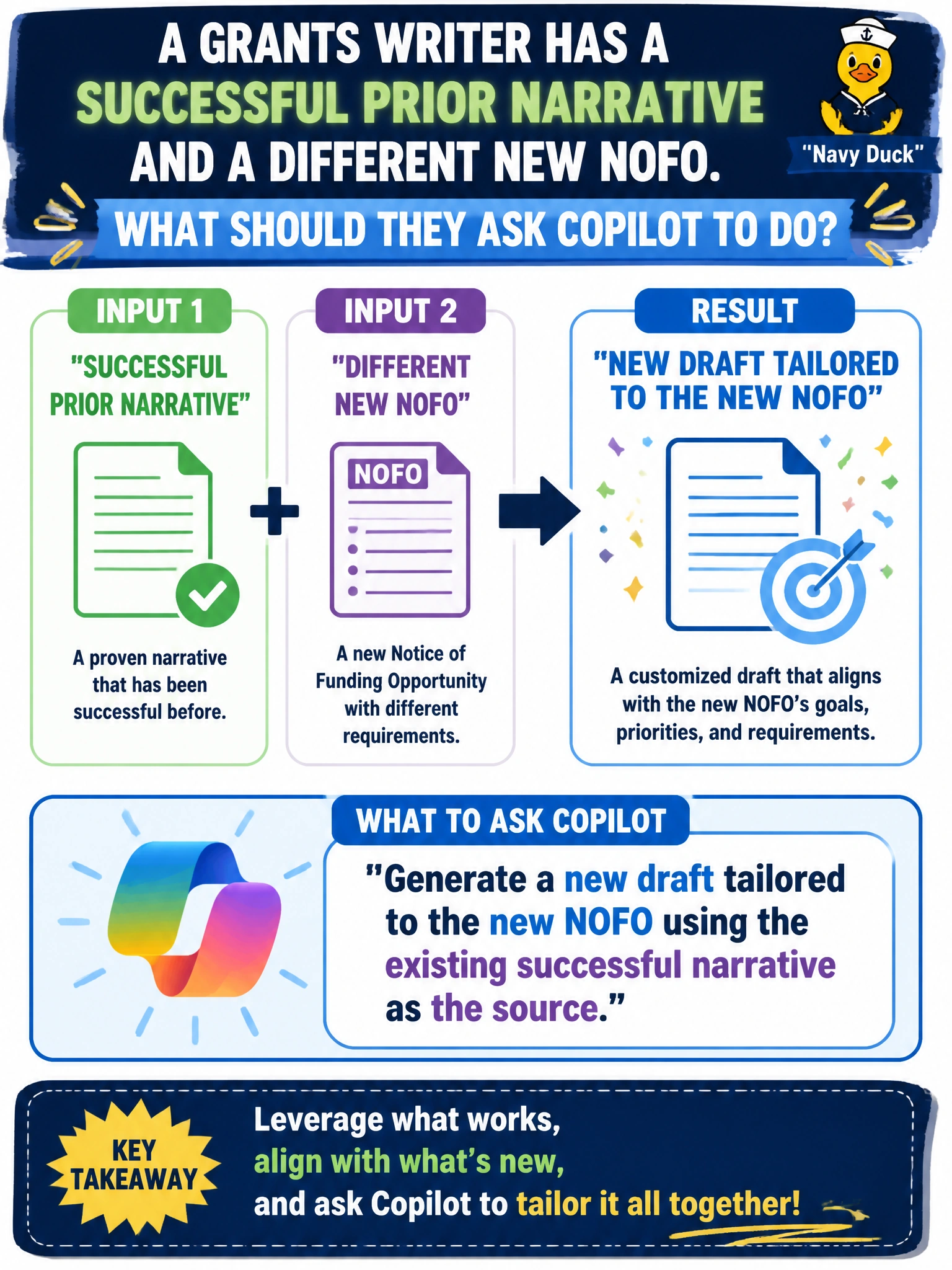
Old win, new NOFO—feed Copilot the successful narrative and ask for a draft tailored to the new requirements. Adapt the source; don’t photocopy last year’s submission.
Full Explanation
Generating a new draft tailored to the new NOFO using the existing successful narrative as the source is the correct Copilot ask for a grants writer with a prior win and a different notice of funding opportunity. Generate-from-existing-document supports adaptation: reuse structure, evidence, and voice from the successful narrative while retargeting sections, metrics, and requirements to the new NOFO. That preserves institutional knowledge without photocopying an outdated submission.
Submitting the old narrative unchanged without reading the new NOFO requirements fails because different NOFOs change eligibility, priorities, and scoring. An unchanged prior narrative often misses mandatory new elements and can be rejected on compliance.
Discarding the successful narrative and inventing an entirely unsupported storyline fails by throwing away proven content and inviting unsupported claims. Invention without the prior narrative or the NOFO grounding weakens competitiveness and accuracy.
Asking Copilot to forge award letters claiming the new grant is already funded fails as fraud-adjacent fabrication. Award letters are official instruments; Copilot must not create false funding claims.
Exam caveat: Adapting an existing successful municipal narrative to a new NOFO is the generate-from-existing pattern—tailor to new requirements; do not submit stale copy unchanged or forge awards.
Operational check: Provide the successful narrative and the new NOFO as sources, generate a tailored draft, map each NOFO requirement to a draft section in a compliance checklist, and have grants leadership review before submission—never treating Copilot output as an award letter.