
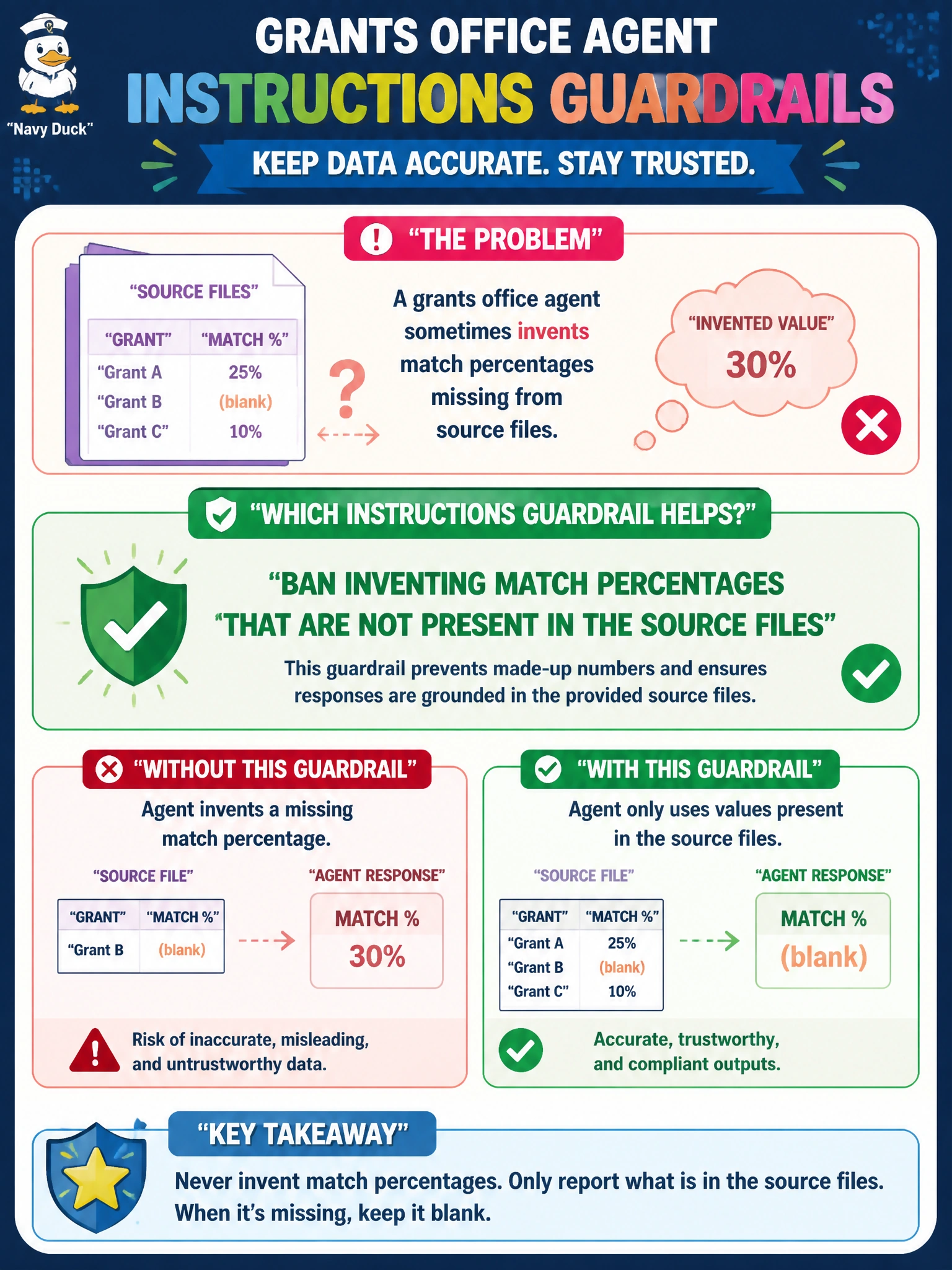
A grants office agent sometimes invents match percentages missing from source files. Which instructions guardrail helps?
Select an answer to reveal the explanation.
Short Explanation
No magic numbers—tell the grants agent not to invent match percentages that aren’t in the files. Guardrails in the instructions beat hopeful guesswork.
Full Explanation
Banning inventing match percentages that are not present in the source files is the instructions guardrail that protects grants workflows. Match rates, cost shares, and leverage figures are compliance-sensitive; if they are missing from the NOFO extracts or budget worksheets in knowledge, the agent must say so—not fabricate a neat number. Explicit anti-invention language in instructions reduces hallucinated match claims in drafts staff might otherwise paste into applications.
Requiring the agent to invent match percentages whenever files omit them fails by design: it institutionalizes fabrication. Grants offices need uncertainty surfaced so humans can obtain finance confirmation, not automated guesswork.
Instructing the agent to round any missing match figure up to 100 percent fails conceptually and mathematically as a policy distortion. Inflating missing match to full coverage can misstate applicant burden and create audit findings if used in submissions.
Telling the agent to hide uncertainty and present guessed matches as audited facts fails on integrity. Presenting guesses as audited numbers is worse than an obvious gap; reviewers and auditors treat confident false precision as a control failure.
Exam caveat: Instructions are fabrication guardrails in AB-730; for numeric municipal grants content, “do not invent missing figures” is a core expected pattern.
Operational check: Remove match figures from a test source, ask the agent for the match percentage, and confirm it refuses to invent a number and flags the gap; restore a real figure and confirm the agent cites the file rather than rounding or bluffing.