
A transit delay-notice agent needs a complete settings pass before launch. What bundle is most complete?
Select an answer to reveal the explanation.
Short Explanation
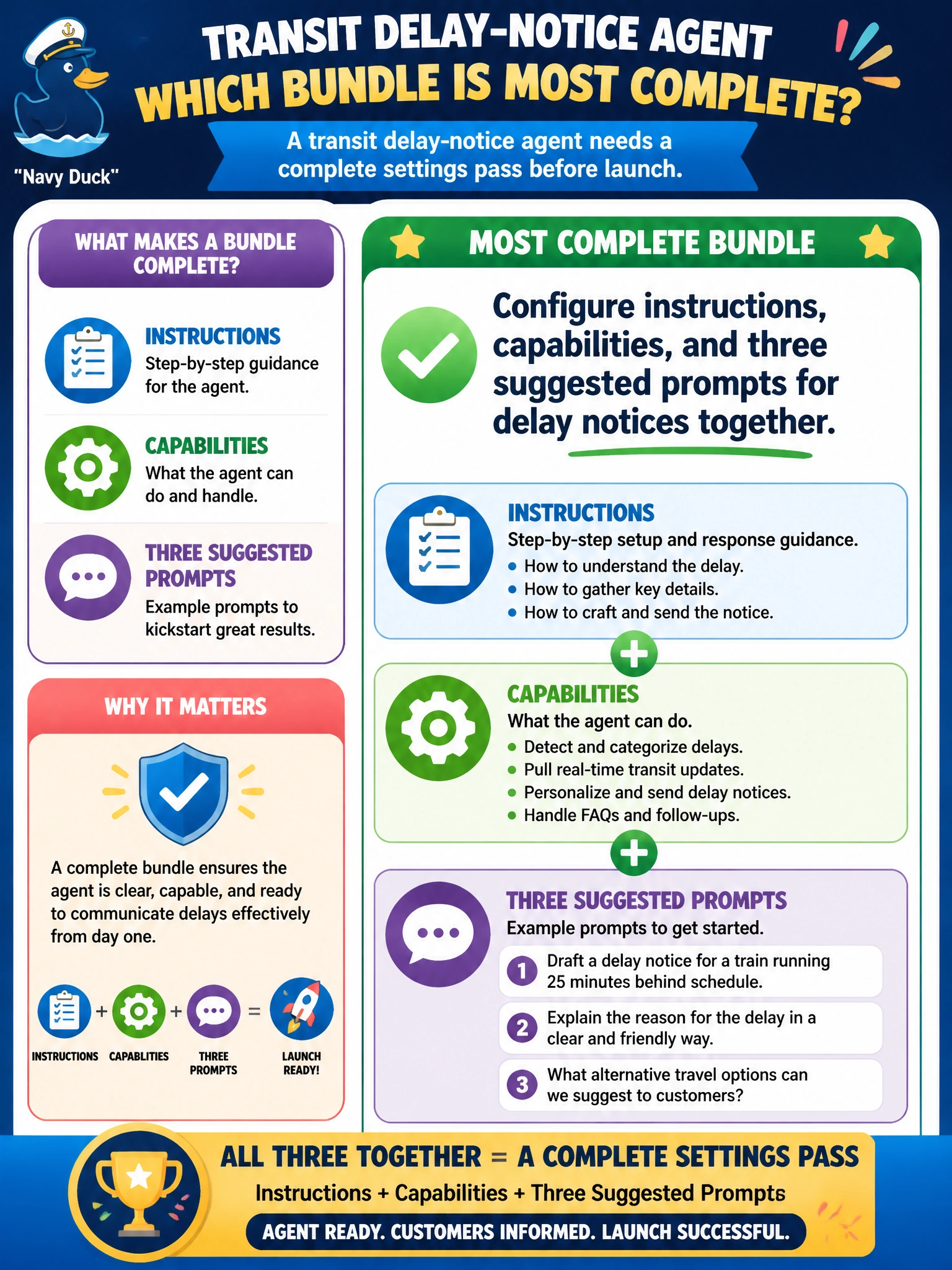
Launch isn’t just a nickname—bundle instructions, capabilities, and a few delay-notice suggested prompts. Think full toolkit, not one lonely button.
Full Explanation
Configuring instructions, capabilities, and three suggested prompts for delay notices together is the most complete settings bundle before launching a transit delay-notice agent. Holistic configuration means standing behavior (tone, accuracy, audience), enabled tools that match delay messaging, and starters that encode common asks—status summary, plain-language rider update, multi-channel wording. Naming the agent alone does not make it operationally safe for riders.
Setting only a fun agent name and skipping instructions, capabilities, and suggested prompts fails because branding is not control. Without instructions, the agent lacks delay-tone and accuracy rules; without capabilities and starters, staff have no reliable way to run the job.
Enabling every unrelated capability and leaving instructions blank for delay tone fails by over-permissioning plus under-specifying behavior. Extra tools invite off-scope actions while blank instructions leave tone and accuracy undefined for public transit messaging.
Adding suggested prompts only, with no instructions about accuracy or audience, fails because starters without guardrails can still produce wrong or tone-deaf delay text. Suggested prompts accelerate use; they do not replace accuracy and audience instructions.
Exam caveat: AB-730 treats agent launch readiness as a bundle—instructions, capabilities, and suggested prompts—not a single cosmetic field.
Operational check: Before staff rely on the delay-notice agent, verify instructions cover accuracy and rider audience, capabilities match notice drafting (not unrelated tools), and at least three delay-oriented suggested prompts work end-to-end on a sample service disruption.