
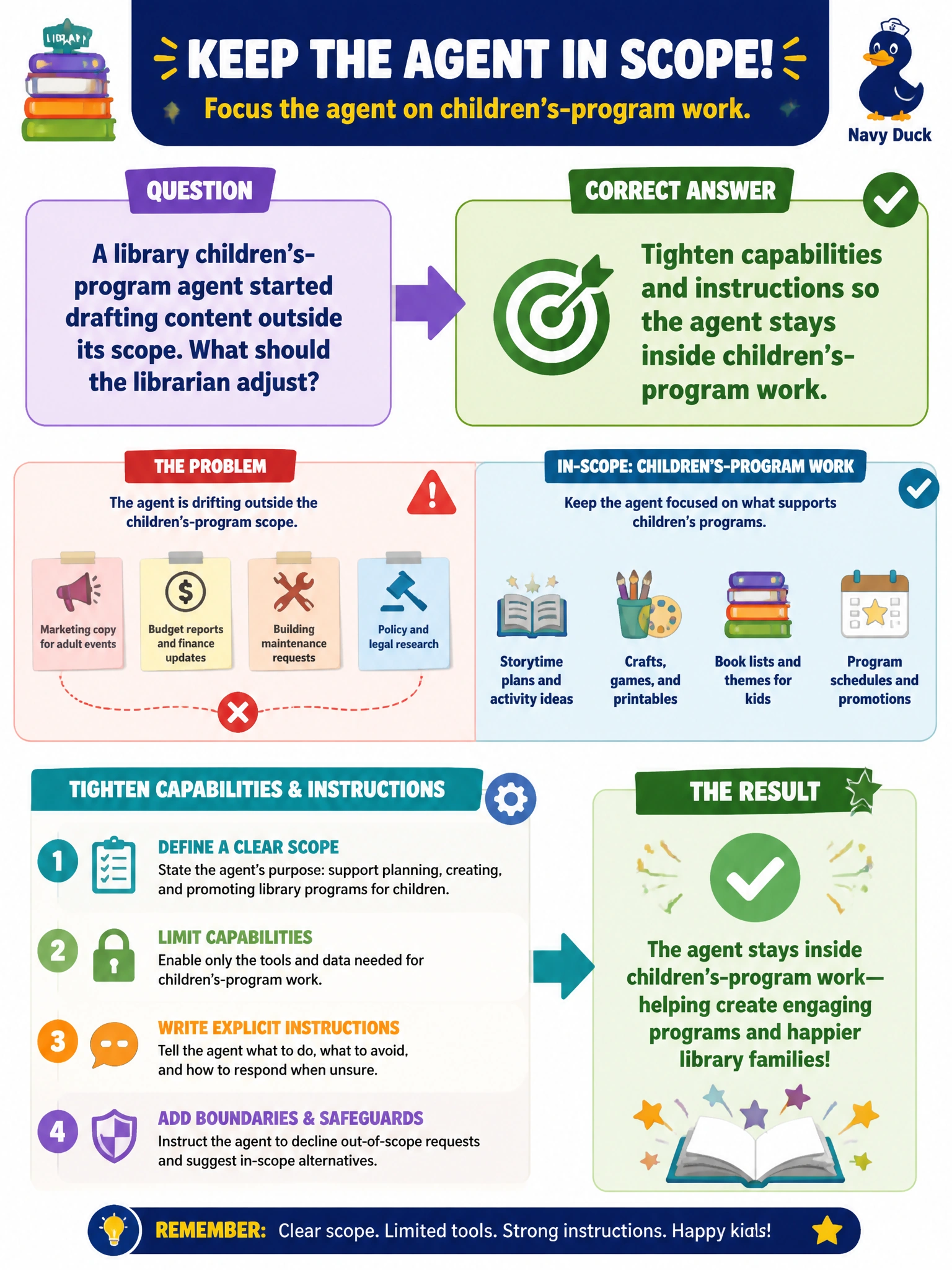
A library children’s-program agent started drafting content outside its scope. What should the librarian adjust?
Select an answer to reveal the explanation.
Short Explanation
When the helper wanders off the kids’ section, tighten the leash—capabilities and instructions back to children’s-program work. Scope drift is a settings problem, not a mystery.
Full Explanation
Tightening capabilities and instructions so the agent stays inside children’s-program work is the correct adjustment when a library children’s-program agent drifts off scope. Scope drift is a settings problem: capabilities that allow broad drafting plus loose instructions invite content outside youth programming. Narrowing tools and rewriting instructions to children’s events, age-appropriate copy, and program logistics restores the municipal purpose of the helper.
Expanding capabilities to rewrite adult criminal-case filings by default fails by widening the wrong aperture. Criminal filings are a different confidentiality and expertise domain; enabling that work for a children’s agent multiplies risk and confusion.
Deleting the children’s knowledge library and leaving unrestricted open-web drafting fails because it removes approved program sources while enabling unbounded generation. The agent then invents program details from the open web instead of library-approved materials.
Instructing the agent to ignore program scope whenever a volunteer asks fails conceptually: volunteers should not redefine bureau policy through chat. Instructions must hold scope even when users push for off-topic drafts.
Exam caveat: When municipal agents wander, AB-730 looks for corrective configuration—tighten capabilities and instructions—not for expanding into unrelated legal work or abandoning knowledge.
Operational check: After tightening, request a children’s-program flyer and confirm a solid draft; then ask for adult criminal-case rewriting and confirm refusal or redirection, with children’s knowledge still attached and web drafting constrained as designed.