
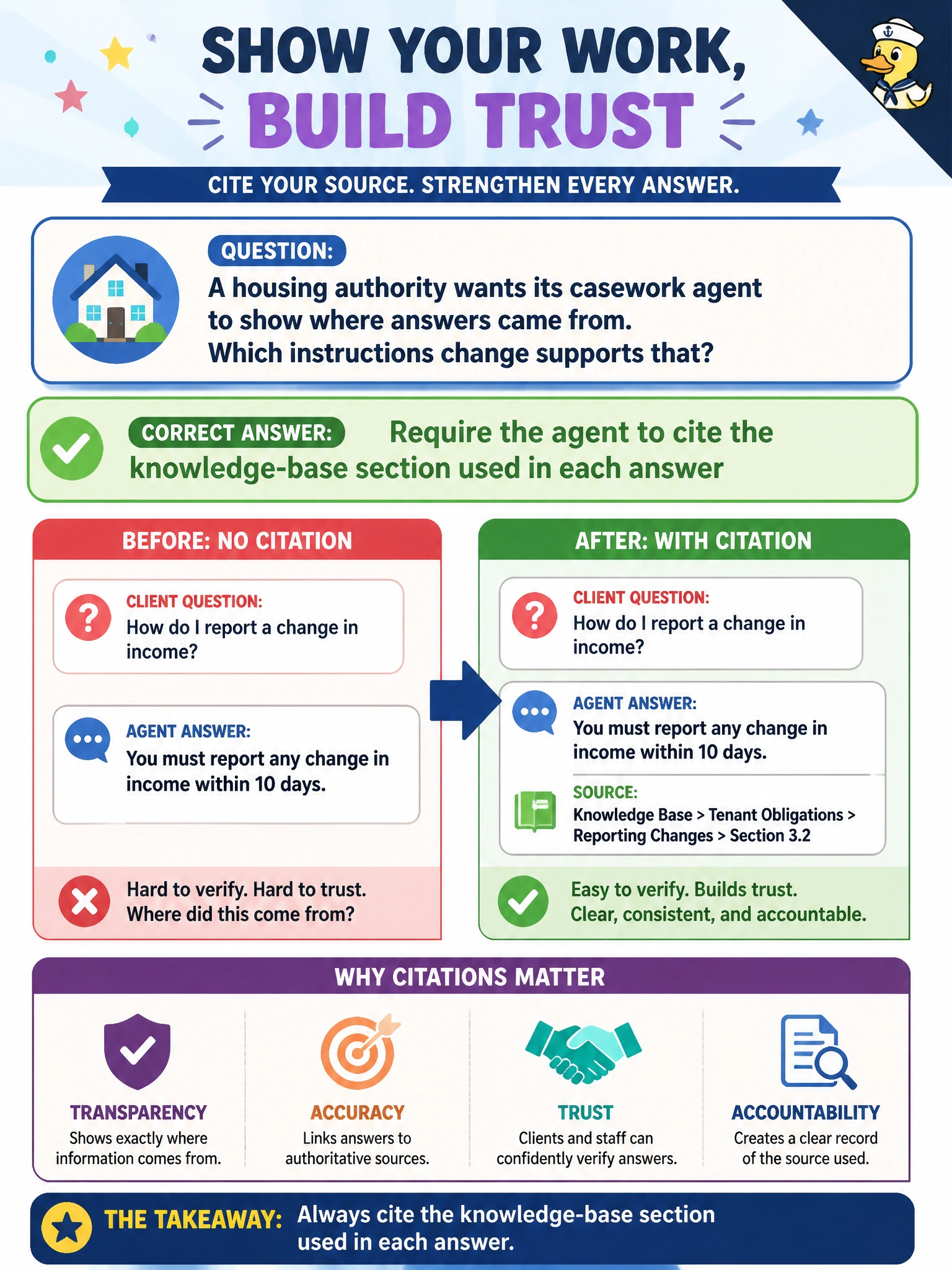
A housing authority wants its casework agent to show where answers came from. Which instructions change supports that?
Select an answer to reveal the explanation.
Short Explanation
If residents and supervisors ask “where’d that come from?”, bake citation into the instructions. Pointing at the knowledge-base section is like labeling the shelf you pulled the binder from.
Full Explanation
Requiring the housing agent to cite the knowledge-base section used in each answer is the instructions change that supports transparent casework. Housing authority answers often affect waitlists, eligibility, and resident trust; supervisors and residents reasonably ask where a statement came from. Baking citation into instructions makes grounding visible—section labels, binder titles, or policy headings—so staff can verify and correct quickly.
Instructing the agent never to mention sources so replies look shorter fails because brevity without provenance hides errors. Short unsourced answers are harder to audit when a resident challenges a rule or a supervisor reviews case notes.
Banning references to the knowledge base and preferring unsourced opinions fails conceptually: casework should reflect adopted housing policy, not model opinion. That instruction actively pushes the agent away from the curated corpus the authority deployed.
Telling the agent to invent section numbers when the knowledge base is silent fails as a fabrication guardrail violation. Fake section cites create a false paper trail and can send staff hunting for policy that does not exist.
Exam caveat: For AB-730 municipal agents, instructions can enforce citation and grounding behavior; transparency is a configuration choice, not only a post-hoc review habit.
Operational check: Ask the casework agent a policy question with a known section in knowledge and confirm the reply names that section; ask a question outside knowledge and confirm the agent admits uncertainty instead of inventing section numbers.