
A CIP planning agent must stay trustworthy for council briefings. How should knowledge be bounded?
Select an answer to reveal the explanation.
Short Explanation
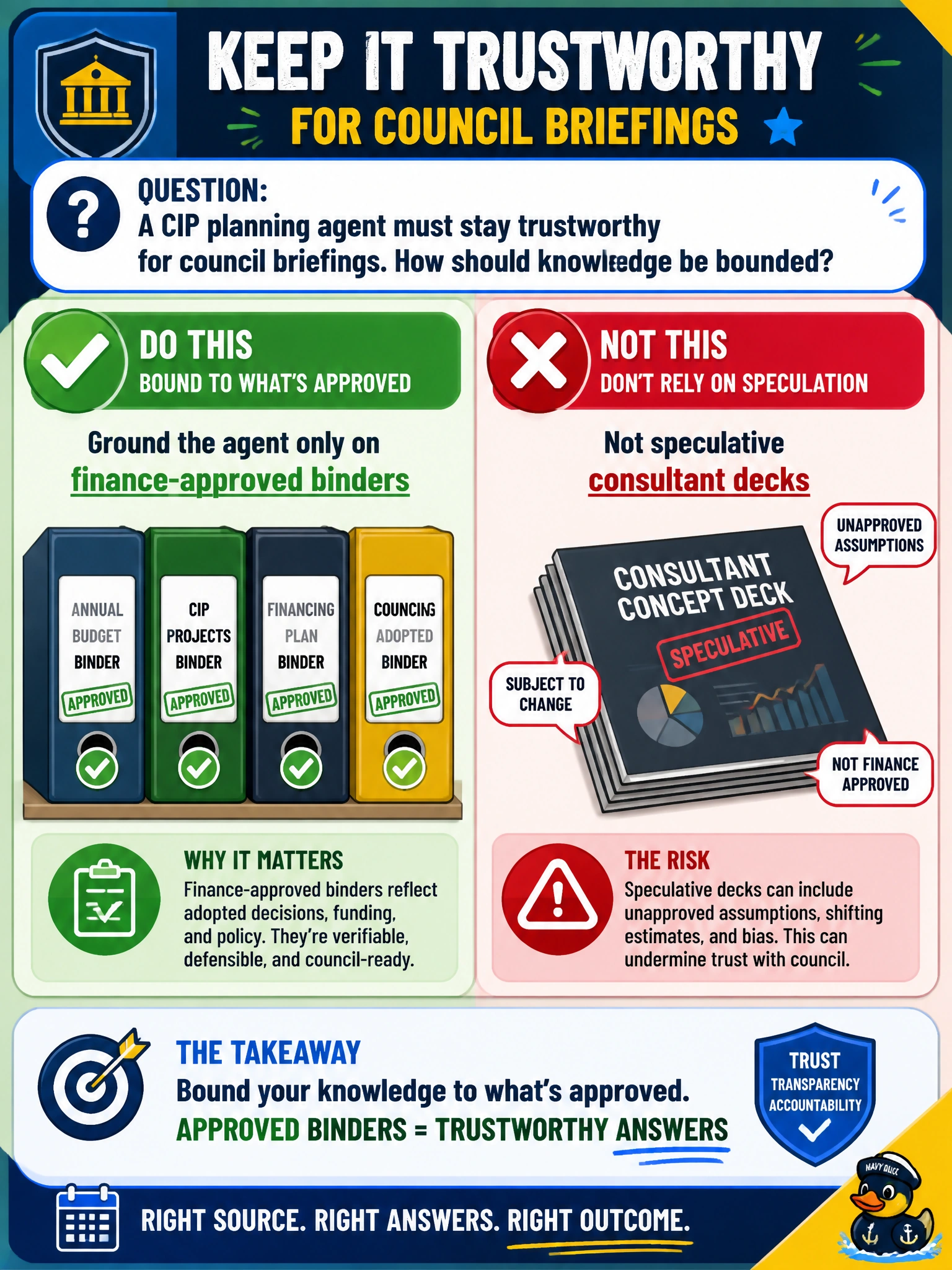
Think locked evidence locker, not rummage sale—give the CIP agent only finance-approved binders. Speculative decks are great brainstorming, bad grounding.
Full Explanation
Grounding the CIP planning agent only on finance-approved binders—not speculative consultant decks—is the correct knowledge boundary for council briefings. Capital Improvement Program materials that finance has vetted carry cost assumptions, prioritization logic, and adopted figures that leadership expects. Constraining knowledge to those binders keeps answers aligned with what staff can defend in open session. Speculative decks and informal pastes may be useful for brainstorming, but they are not briefing-grade grounding.
Pointing knowledge at every speculative consultant deck and informal chat paste fails because that boundary treats rumor and proposal as equal to approved finance evidence. The agent can then mix aspirational cost curves or unendorsed project lists into answers that sound authoritative to council.
Allowing any public blog as equal grounding alongside approved CIP binders fails by concept: external commentary is not municipal finance source of truth. Blogs may misstate millage impacts, confuse funding sources, or push advocacy frames that do not match the city’s adopted CIP package.
Removing all finance binders so the agent answers from general model guesses fails because it strips the only authoritative corpus. Without binders, the agent invents plausible-sounding capital narratives that cannot be traced to finance-approved numbers.
Exam caveat: Trustworthy municipal agents are defined as much by what they exclude as by what they include; AB-730 expects deliberate knowledge boundaries for high-stakes briefings.
Operational check: Before a council dry-run, sample CIP questions and verify citations point only to finance-approved binders; if a consultant deck or blog appears in grounding, remove it and retest until briefings stay inside the approved corpus.