
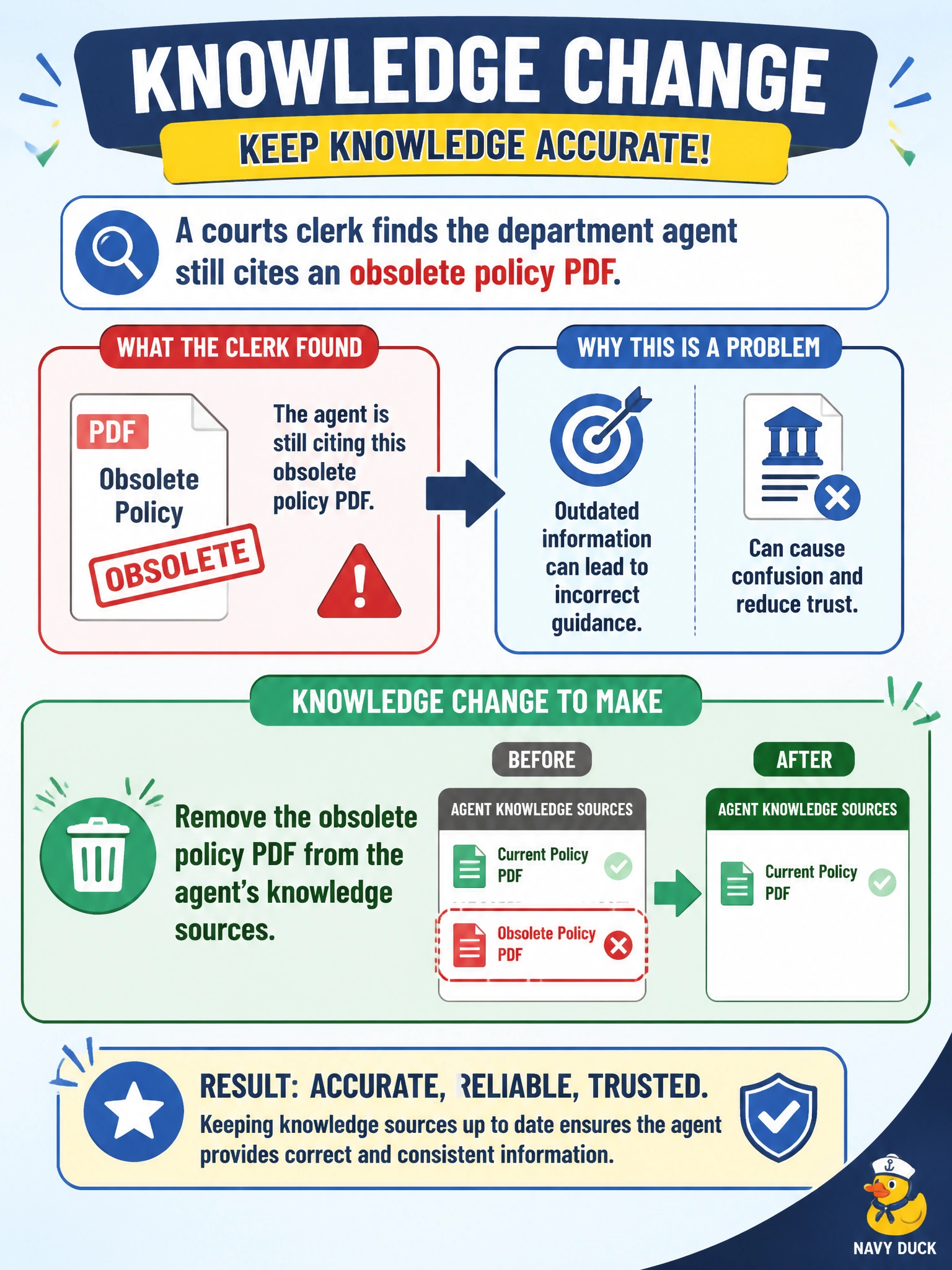
A courts clerk finds the department agent still cites an obsolete policy PDF. What knowledge change should the clerk make?
Select an answer to reveal the explanation.
Short Explanation
Old policy PDFs are like expired maps—take them out of the agent’s knowledge so it stops citing yesterday’s rules. Fresh sources beat nostalgic clutter.
Full Explanation
Removing an obsolete policy PDF from the courts agent’s knowledge sources is the correct knowledge-hygiene action because grounding quality depends on what the agent can retrieve. When a clerk discovers the department helper still cites an outdated policy, the obsolete file remains a first-class source: the model can quote revoked timelines, superseded filing fees, or retired docket rules as if they were current. Deleting or disconnecting that PDF from the knowledge set stops wrong citations at the source rather than asking staff to notice and ignore them after the fact. Fresh, adopted policy documents should remain; the stale PDF should not.
Adding every outdated draft from personal email fails conceptually because volume is not accuracy. Personal inboxes mix unofficial drafts, redlines, and superseded versions that were never promulgated. Stuffing those into knowledge amplifies contradiction and makes the agent more likely to present historical clutter as controlling guidance for litigants and clerks.
Leaving the obsolete PDF in place and hoping staff ignore wrong citations fails because hope is not a control. Courts staff under queue will often trust a confident citation; residual stale knowledge creates predictable misinformation risk for filings, calendars, and public-facing answers.
Disabling all knowledge sources and forcing the agent to invent policy language fails for the opposite reason: it removes grounding entirely. Without authorized PDFs, the agent falls back to general model guesses that may sound formal but are not the court’s adopted rules.
Exam caveat: AB-730 treats knowledge configuration as active curation—add current sources and remove sources that produce incorrect citations—not as a one-time dump of every file ever emailed to the bureau.
Operational check: After removal, ask the agent the same policy question that previously returned the obsolete citation; confirm answers reference only current documents and that the retired PDF no longer appears in source attributions before returning the agent to the clerk desk.