
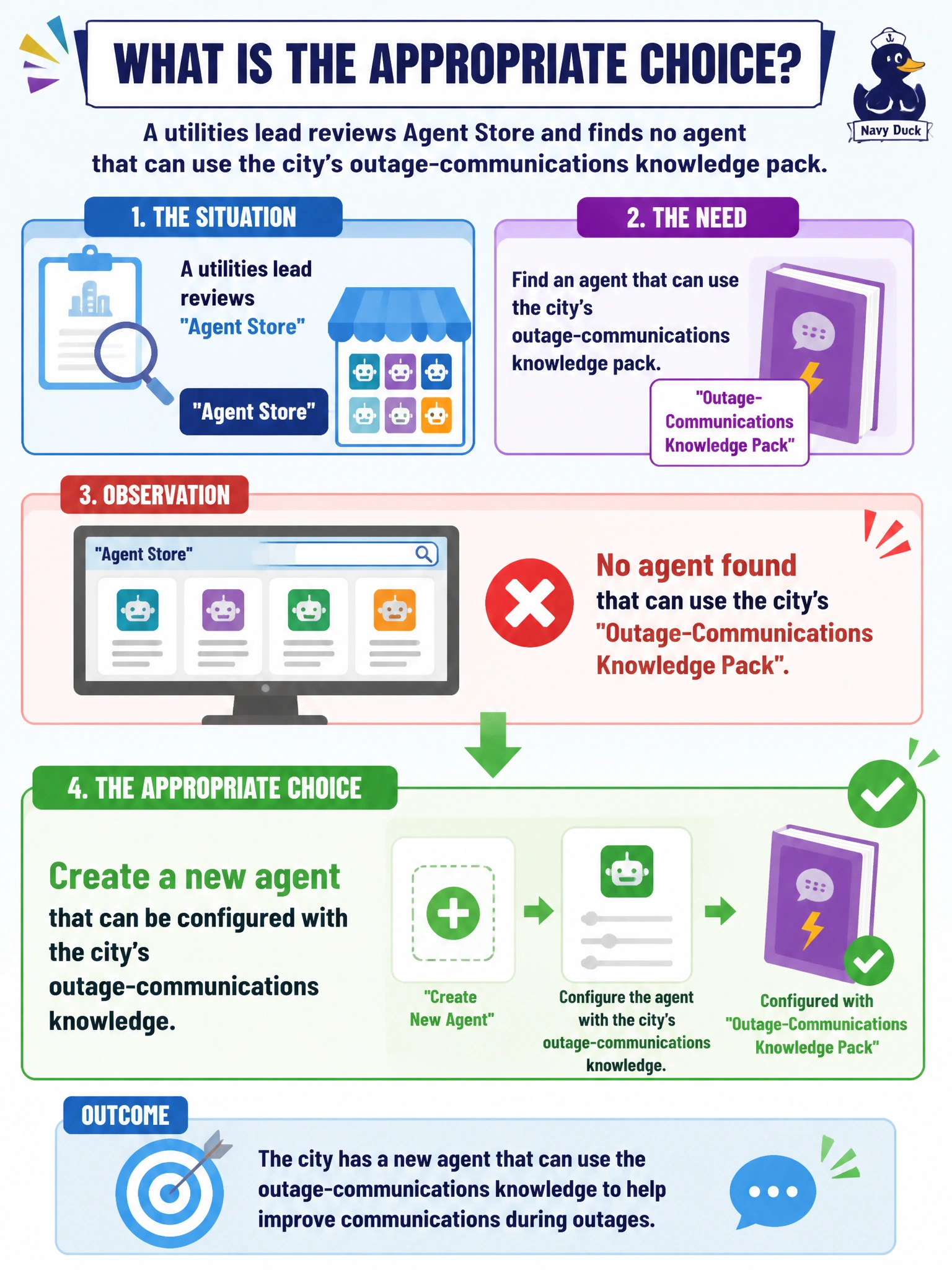
A utilities lead reviews Agent Store and finds no agent that can use the city’s outage-communications knowledge pack. What is the appropriate choice?
Select an answer to reveal the explanation.
Short Explanation
Store doesn’t cover the city’s outage playbook? Then build a new agent and wire in that knowledge. Off-the-shelf is great—until the shelf is empty for your use case.
Full Explanation
Store-first does not mean Store-only. When a utilities lead finds no Agent Store option that can use the city’s outage-communications knowledge pack, the appropriate choice is to create a new agent that can be configured with that municipal knowledge. Custom creation is justified when catalog agents cannot ground on the city’s required outage-communications materials, so staff can still deliver accurate resident messaging through Copilot agents.
Forcing staff to use an unrelated Store agent that cannot access outage-communications materials fails grounding: the wrong agent will answer without the city’s playbook. Abandoning Copilot agents entirely because Store lacked a perfect match fails unnecessarily—custom agents exist for exactly this gap. Renaming an existing Store agent in the catalog without creating or configuring a city-specific agent fails by concept: a cosmetic catalog rename does not attach the city’s knowledge pack or produce a configured municipal agent.
Exam caveat: create-when-needed still implies governance—approve the new agent’s purpose, knowledge sources, and owners. Do not interpret this as permission to spawn unmanaged agents outside city IT/policy processes.
Operational check: create the new utilities agent, add the outage-communications knowledge pack, test a sample outage FAQ against the playbook, and document why Store options were insufficient so future reviewers understand the custom-agent decision.