
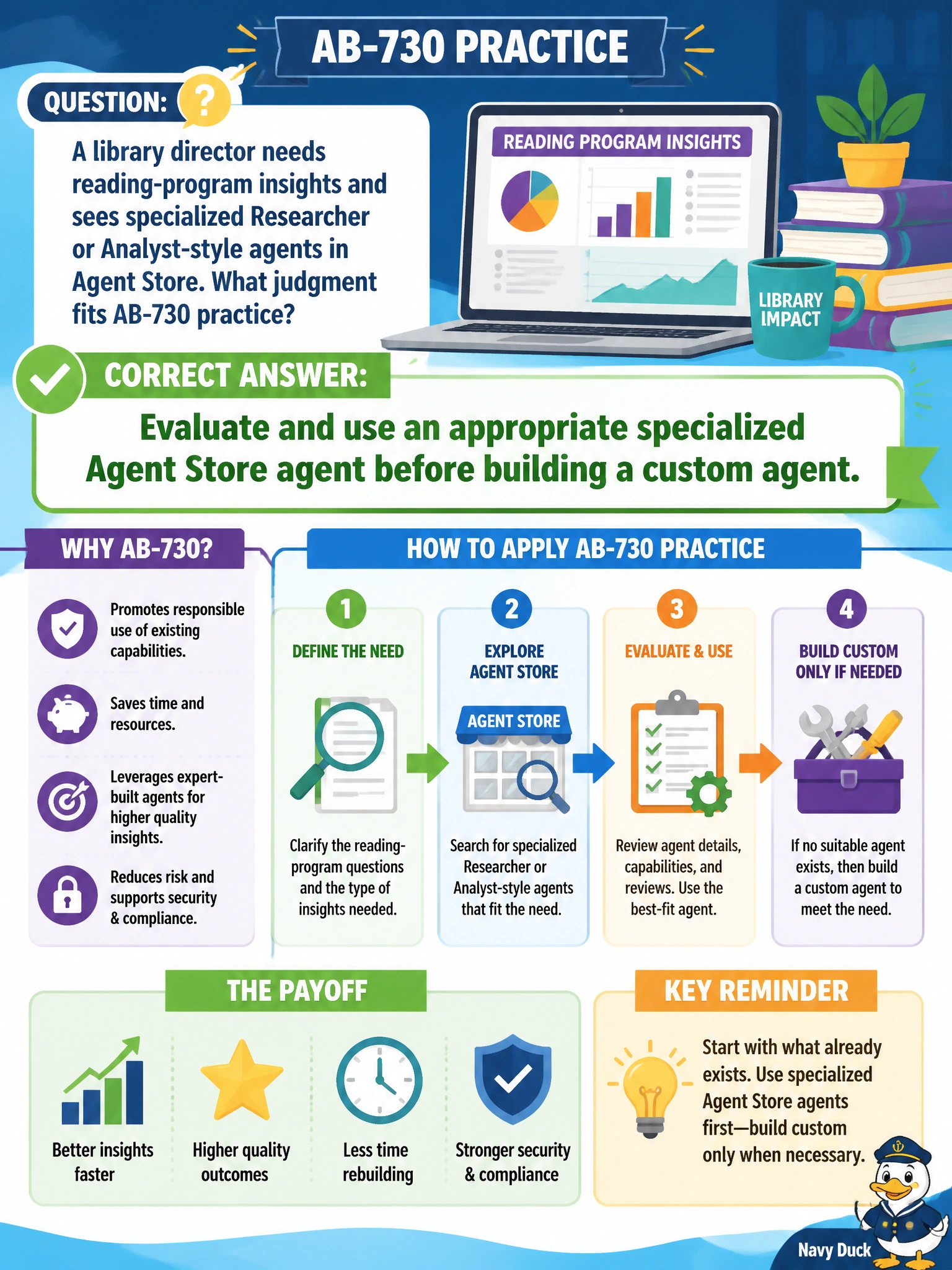
A library director needs reading-program insights and sees specialized Researcher or Analyst-style agents in Agent Store. What judgment fits AB-730 practice?
Select an answer to reveal the explanation.
Short Explanation
Need reading-program insights and Store already has specialized helpers? Try those first. Using what’s on the shelf beats reinventing the reference desk.
Full Explanation
Specialized Agent Store experiences—such as Researcher or Analyst-style agents—should be evaluated and used when they fit municipal insight needs before staff invest in custom builds. A library director seeking reading-program insights should try an appropriate specialized Store agent first. That judgment matches AB-730 practice: leverage purpose-built Store capabilities for analysis and research tasks when they address the municipal use case.
Always skipping specialized Store agents to code a new Azure service fails proportionate selection—custom cloud coding may be warranted later, but not as the default when Store already offers specialized helpers. Banning Researcher and Analyst-style agents so every insight is typed manually fails productivity and ignores available Copilot agent patterns. Creating duplicate custom agents that copy Store features without reviewing Store first fails reuse discipline and wastes library IT and staff time.
Exam caveat: “evaluate and use” includes confirming data access, privacy, and whether the specialized agent’s outputs are suitable for library decision-making. Specialized does not mean unsupervised publication of insights to the public.
Operational check: identify the Researcher/Analyst-style Store agent that fits reading-program analysis, run a bounded pilot on non-sensitive program metrics, compare usefulness to manual reporting, and escalate to custom development only if Store capabilities remain insufficient.