
A permitting supervisor saves a well-tested deficiency-letter prompt for reuse each week. What Copilot practice does this demonstrate?
Select an answer to reveal the explanation.
Short Explanation
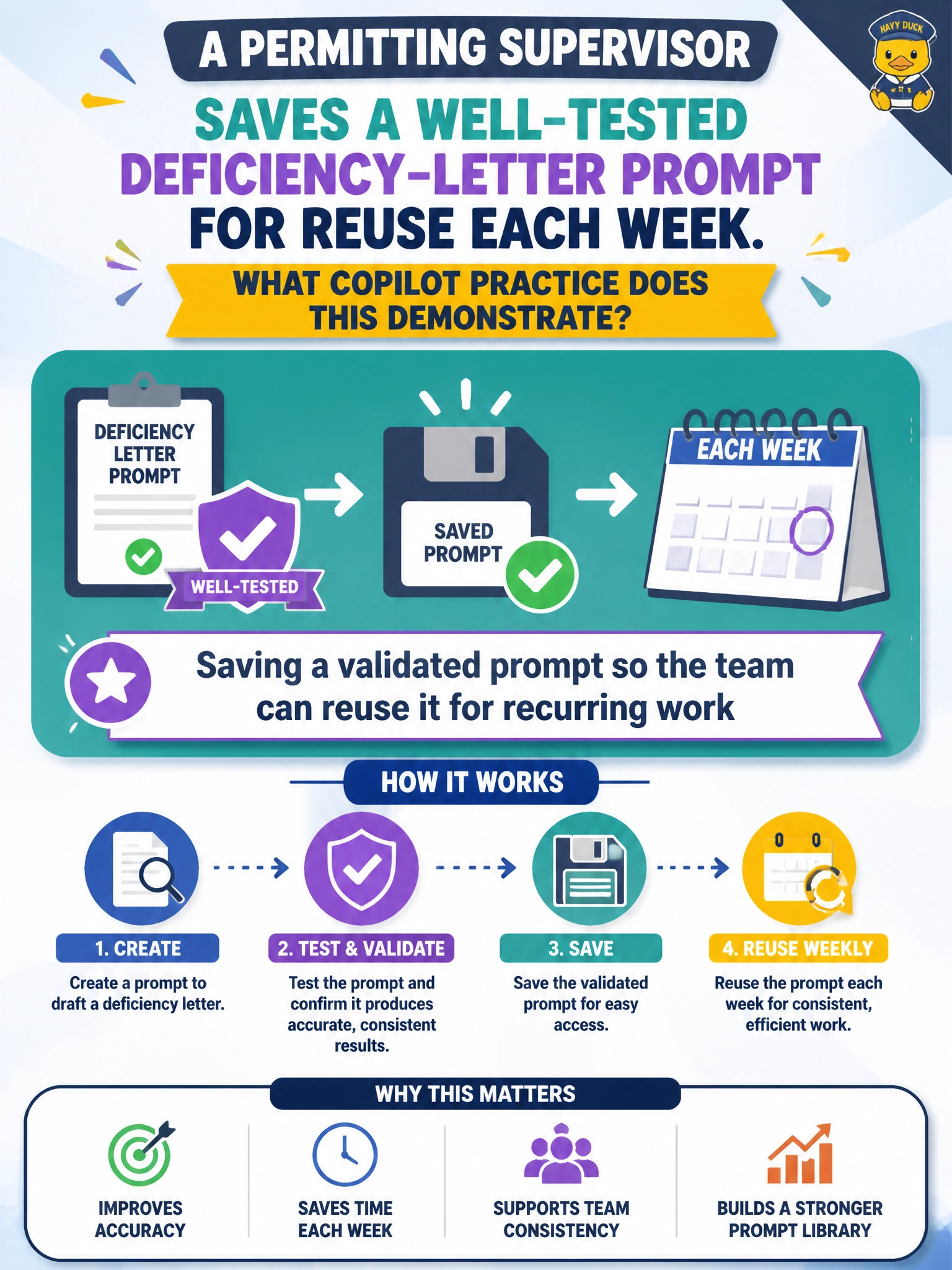
When a deficiency-letter prompt finally sings, hit save. Next week’s stack shouldn’t mean reinventing the instructions. Saved prompts are reusable tools for recurring municipal work.
Full Explanation
Saving a validated prompt so the team can reuse it for recurring work is the Copilot practice demonstrated when a permitting supervisor keeps a well-tested deficiency-letter prompt for weekly use. Recurring municipal correspondence benefits from stable instructions that already encode goal, tone, and required sections. The correct practice works because reuse reduces rewrite time and keeps counter staff aligned to the same effective pattern instead of reinventing prompts under lobby pressure.
Deleting every effective prompt so staff rewrite instructions from scratch fails because it discards proven guidance and injects unnecessary variability into deficiency letters. Publishing resident SSNs inside saved prompts for faster letters fails conceptually: saved prompts multiply whatever they contain, so embedding SSNs creates recurring sensitive-data exposure. Scheduling sealed personnel reviews through Agent Store without saving prompts fails because that scenario confuses agent scheduling and sealed HR workflows with the simple skill of saving a validated prompt for reuse.
Exam caveat: saved prompts drift when fee schedules or letter policy change—reuse requires periodic revalidation, not blind forever-trust. Operational check: after the prompt produces an approved sample letter, save it with a clear municipal name, share it with counter staff who need it, run one quarterly test against the current fee schedule and checklist, and update the saved wording when policy changes.