
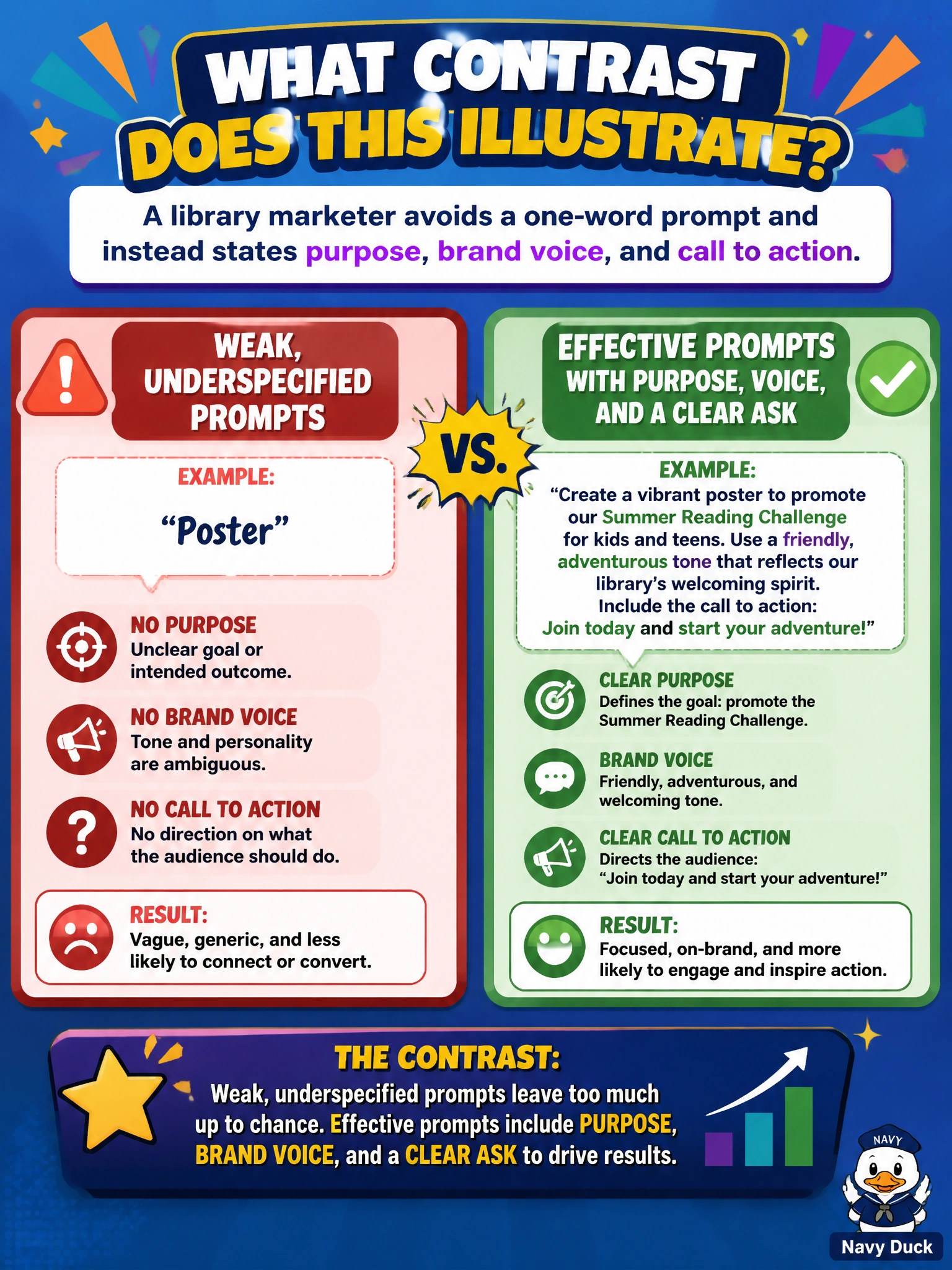
A library marketer avoids a one-word prompt and instead states purpose, brand voice, and call to action. What contrast does this illustrate?
Select an answer to reveal the explanation.
Short Explanation
“Advertise!” is a shrug; purpose, brand voice, and a call to action are a brief. Effective prompts beat one-word wishes when the library needs copy that sounds like the library.
Full Explanation
Avoiding a one-word prompt and instead stating purpose, brand voice, and call to action illustrates the contrast between weak underspecified prompts and effective prompts with purpose, voice, and a clear ask. Library marketers need civic campaign copy that sounds like the library and ends with a resident action such as registering for a program. The correct contrast works because generative models fill missing intent with generic marketing language, while a brief that names purpose, voice, and ask steers the draft toward usable municipal communications.
Believing one-word prompts always outperform brand-voice guidance fails because a single word supplies neither audience nor action, so Copilot cannot reliably match civic brand standards. Treating agent creation as the only allowed way to draft library marketing copy fails conceptually: effective prompting in chat or document Copilot is a core skill and does not require creating an agent for every flyer. Deleting chats after every marketing draft to improve brand voice fails because deletion manages conversation hygiene; it does not encode purpose, voice, or a call to action into the prompt itself.
Exam caveat: a strong prompt brief still needs human review against the real program calendar—voice-perfect copy with a wrong date remains an operational failure. Operational check: write a prompt that states purpose (promote summer reading), voice (friendly, inclusive, plain language), and CTA (register by the posted date), attach the approved program fact sheet, and reject any draft whose deadline or location is not on that sheet.