
A clerk specifies “use only the attached fee schedule; say if missing” when prompting Copilot. What does this grounding instruction help reduce?
Select an answer to reveal the explanation.
Short Explanation
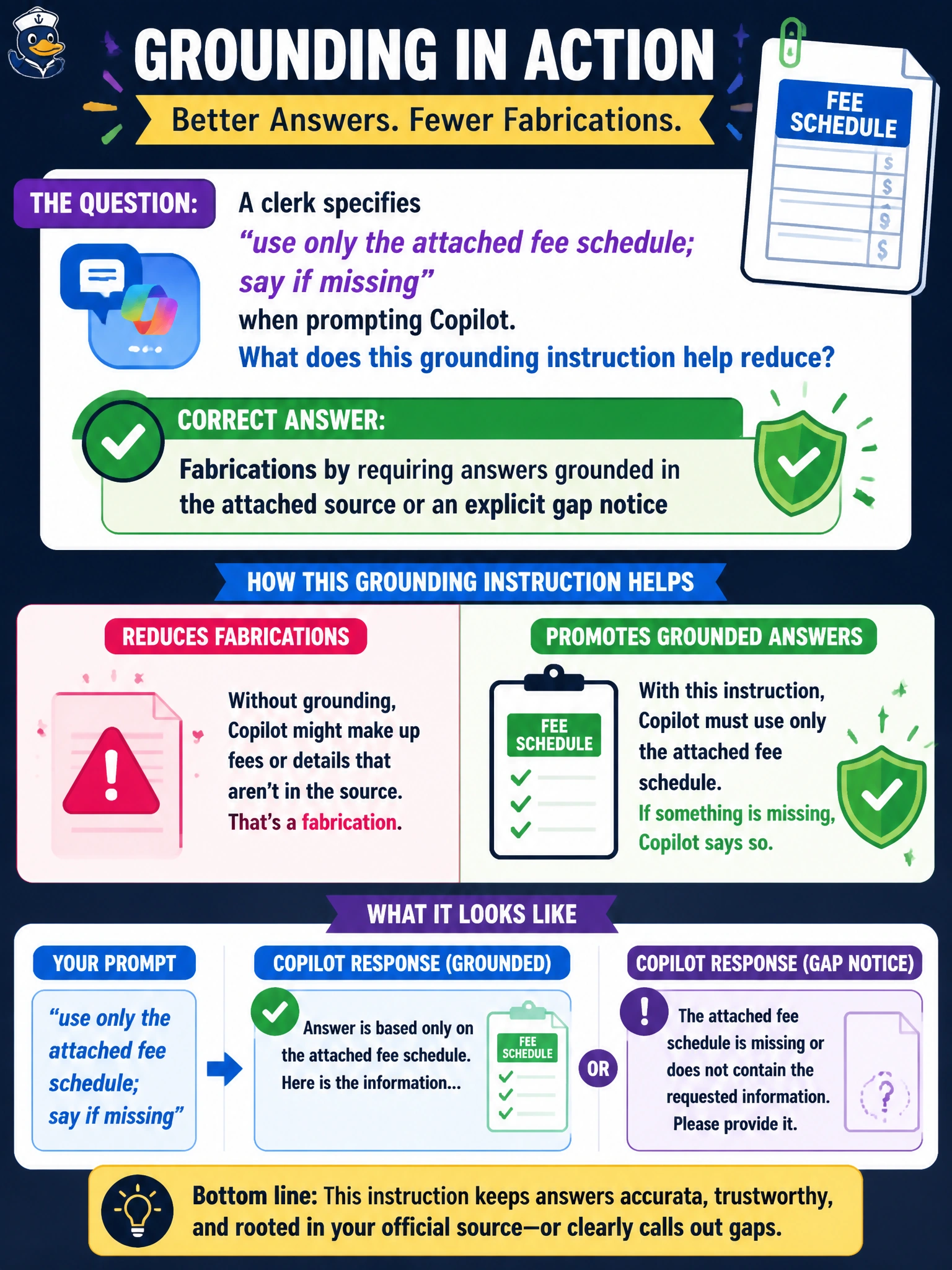
“Use only this fee schedule—and say if it’s missing” is honesty training for Copilot. Grounding instructions cut down on made-up fees. If the source doesn’t say it, you want a gap—not a guess.
Full Explanation
Grounding instructions that require answers from the attached source—or an explicit gap notice—help reduce fabrications, which is what a clerk achieves by specifying “use only the attached fee schedule; say if missing.” Fee amounts and codes are exact municipal facts; unconstrained Copilot answers may invent plausible fees. The correct instruction works by narrowing allowed evidence and forcing honesty about gaps instead of silent guessing.
Claiming the instruction removes the need to attach any municipal fee schedule fails because the constraint only works when the authoritative schedule is actually provided as grounding. Saying the instruction reduces DLP policies that protect resident payment methods fails conceptually: grounding constraints address fabrication, not DLP scope. Asserting it reduces saved prompts that share fee language across departments fails because saved prompts are a reuse mechanism; they are unrelated to whether fabrications are constrained in a single grounded ask.
Exam caveat: “say if missing” only helps if staff actually read the gap notice—ignoring “not in schedule” and filling fees from memory reintroduces error. Operational check: attach the current fee schedule PDF, include the use-only-and-disclose-gaps instruction, ask for a fee that is deliberately absent as a test, confirm Copilot reports the gap instead of inventing an amount, then proceed with real permitting questions the same way.