
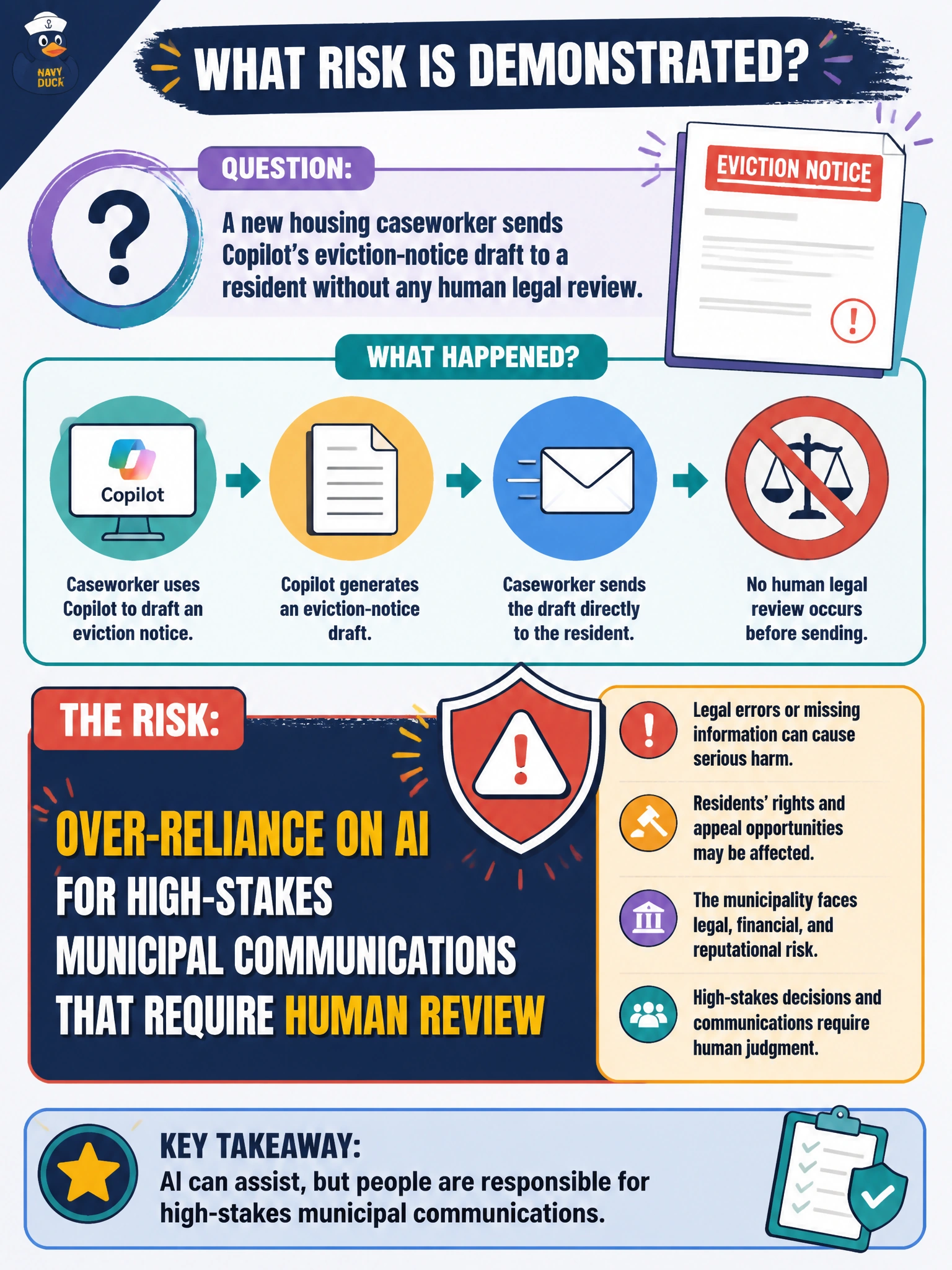
A new housing caseworker sends Copilot’s eviction-notice draft to a resident without any human legal review. What risk does this demonstrate?
Select an answer to reveal the explanation.
Short Explanation
Eviction language isn’t a casual rewrite job. Shipping Copilot’s first draft straight to a resident is over-reliance — like mailing a form letter you never read. High-stakes housing notices need human legal eyes first.
Full Explanation
Sending Copilot’s eviction-notice draft to a resident without any human legal review demonstrates over-reliance on AI for high-stakes municipal communications that require human review. Eviction-related language carries legal and resident-impact risk. Generative drafts can sound formal while being incomplete, outdated, or wrong relative to housing rules; shipping without counsel or supervisor review is the over-reliance failure mode.
Prompt injection that only occurs when eviction notices are drafted in PowerPoint mislabels the risk and invents an app-only constraint. The stem describes skipping human review, not an injection attack limited to PowerPoint.
Successful verification because Copilot drafts never need counsel or supervisor checks is the opposite of responsible practice for legal housing notices.
A privacy success proving Copilot auto-filed the notice with the housing court invents an automated filing outcome unrelated to the over-reliance issue.
Exam caveat: high-stakes resident legal communications map to over-reliance when humans skip review—do not re-tag that as injection or privacy success.
Operational check: treat Copilot eviction drafts as drafts only; run citation and policy checks against adopted housing rules, obtain counsel or supervisor sign-off, then send—never “ship as-is” to a resident.