
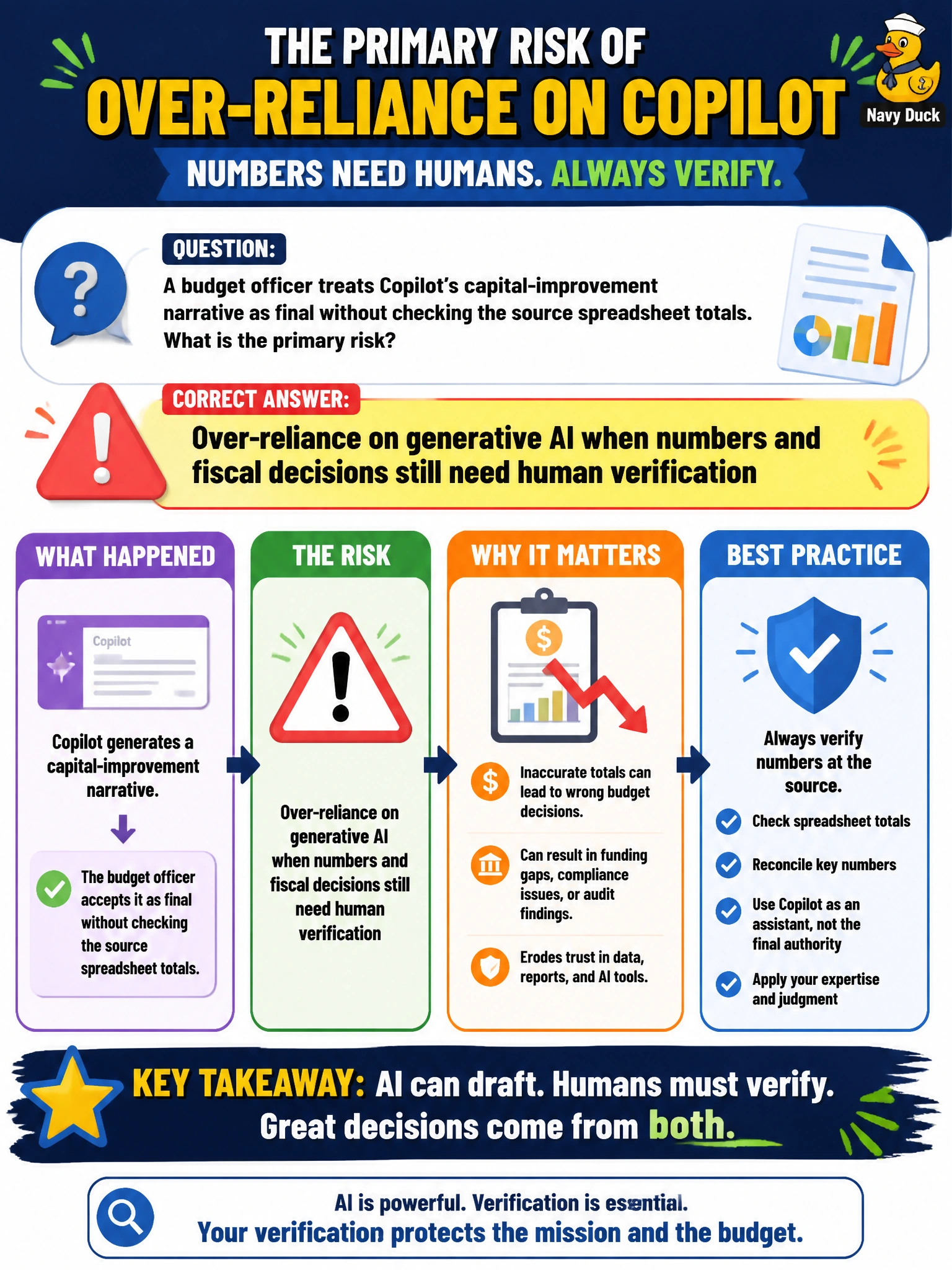
A budget officer treats Copilot’s capital-improvement narrative as final without checking the source spreadsheet totals. What is the primary risk?
Select an answer to reveal the explanation.
Short Explanation
Pretty CIP prose doesn’t balance the books. If nobody checks the spreadsheet totals, that’s over-reliance on the storyteller. Let Copilot draft, then let a human verify the numbers.
Full Explanation
A budget officer who treats Copilot’s capital-improvement narrative as final without checking source spreadsheet totals shows over-reliance on generative AI when numbers and fiscal decisions still need human verification. Narrative fluency does not certify arithmetic. Municipal CIP storytelling must reconcile to workbook totals before council packets or public materials use the text.
Prompt injection from the spreadsheet that forces Copilot to increase every CIP line item is unsupported by the stem, which describes skipping verification of totals—not injected instructions raising amounts.
Fabrication that only appears when Teams Copilot writes budget narratives invents an app-only boundary. Over-reliance on unverified generative narrative is the primary risk here regardless of whether fabrication also occurs.
Data protection blocking that incorrectly requires officers to skip spreadsheet checks misuses DLP concepts. Data protection does not justify skipping numeric reconciliation.
Exam caveat: when the stem emphasizes accepting AI output without checking source numbers, choose over-reliance/verification—not injection or DLP distractors.
Operational check: before locking a CIP narrative, reconcile every cited total to the capital-improvement workbook, have a second fiscal reviewer spot-check line items, and only then treat the Copilot prose as packet-ready.