
A 311 team wants new hires to get answers grounded in the approved knowledge base instead of informal chat lore. What does this primarily justify?
Select an answer to reveal the explanation.
Short Explanation
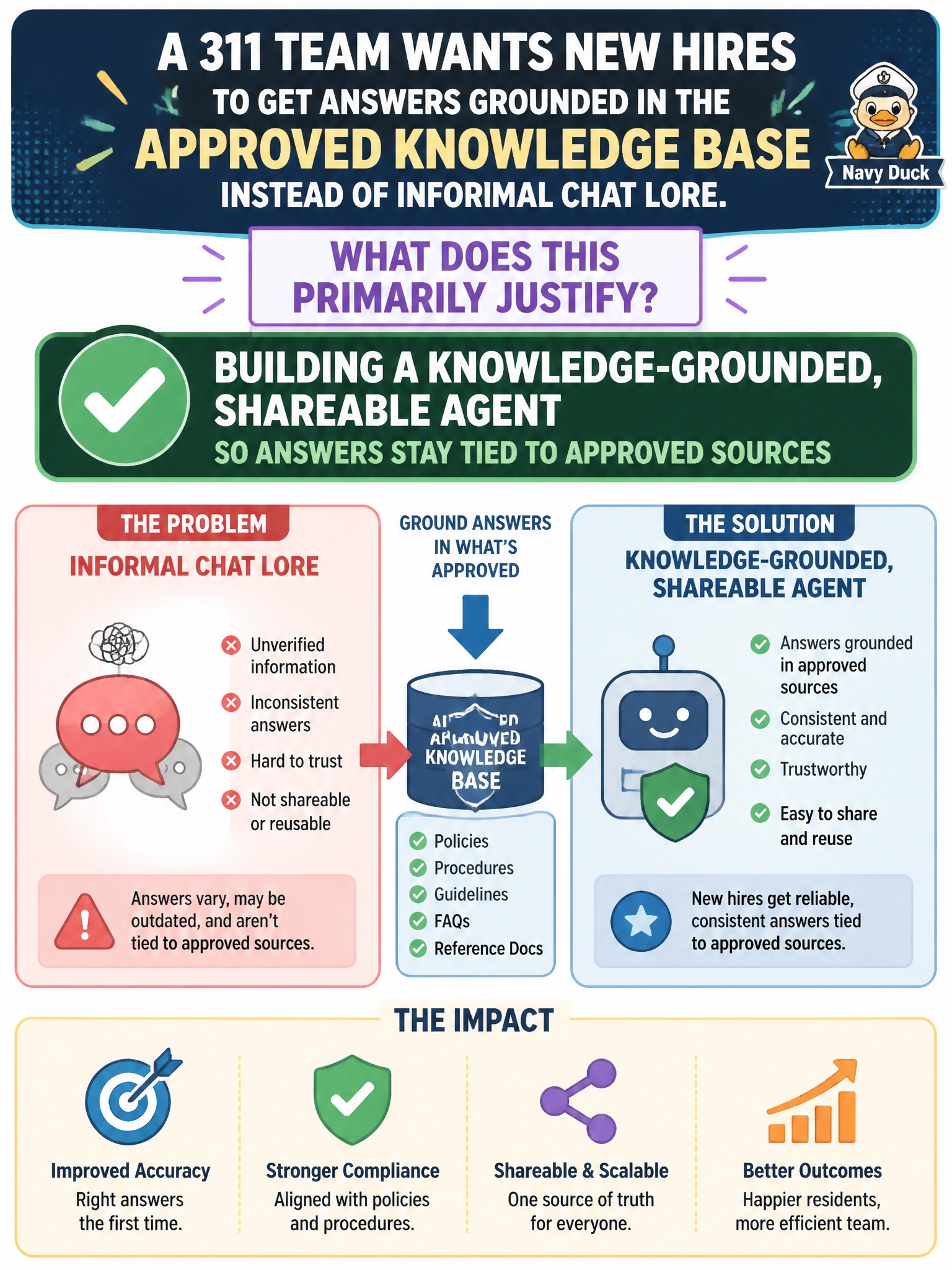
You can help new hires avoid relying on informal chat lore by giving them a knowledge-grounded, shareable agent. It keeps answers tied to the approved city knowledge base, so everyone can follow the same playbook.
Full Explanation
A knowledge-grounded, shareable agent helps new hires receive consistent, source-tied answers rather than informal hallway lore. For a 311 team, this primarily justifies building an agent grounded in approved municipal sources, so onboarding answers stay tied to the knowledge base. The agent becomes a controlled front door to approved information instead of tribal knowledge passed chat-to-chat. Blocking all new hires from Microsoft 365 until they memorize every FAQ verbally is an extreme access ban that slows service without solving consistency. Relying on hallway guidance because agents cannot retrieve answers from approved knowledge bases fails because hallway lore is unreliable and agents can be grounded on knowledge bases. Publishing every resident complaint into a public model shared outside the city is a privacy and scope error unrelated to training new hires on approved answers. Exam caveat: Knowledge grounding is only as good as knowledge-base hygiene; duplicate, conflicting, or outdated 311 articles will be faithfully served to new hires at scale. Practical check: Curate the approved 311 knowledge base, connect it to a shared agent, grant new hires access to that agent rather than every raw complaint mailbox, and audit sample answers weekly against the source articles.