
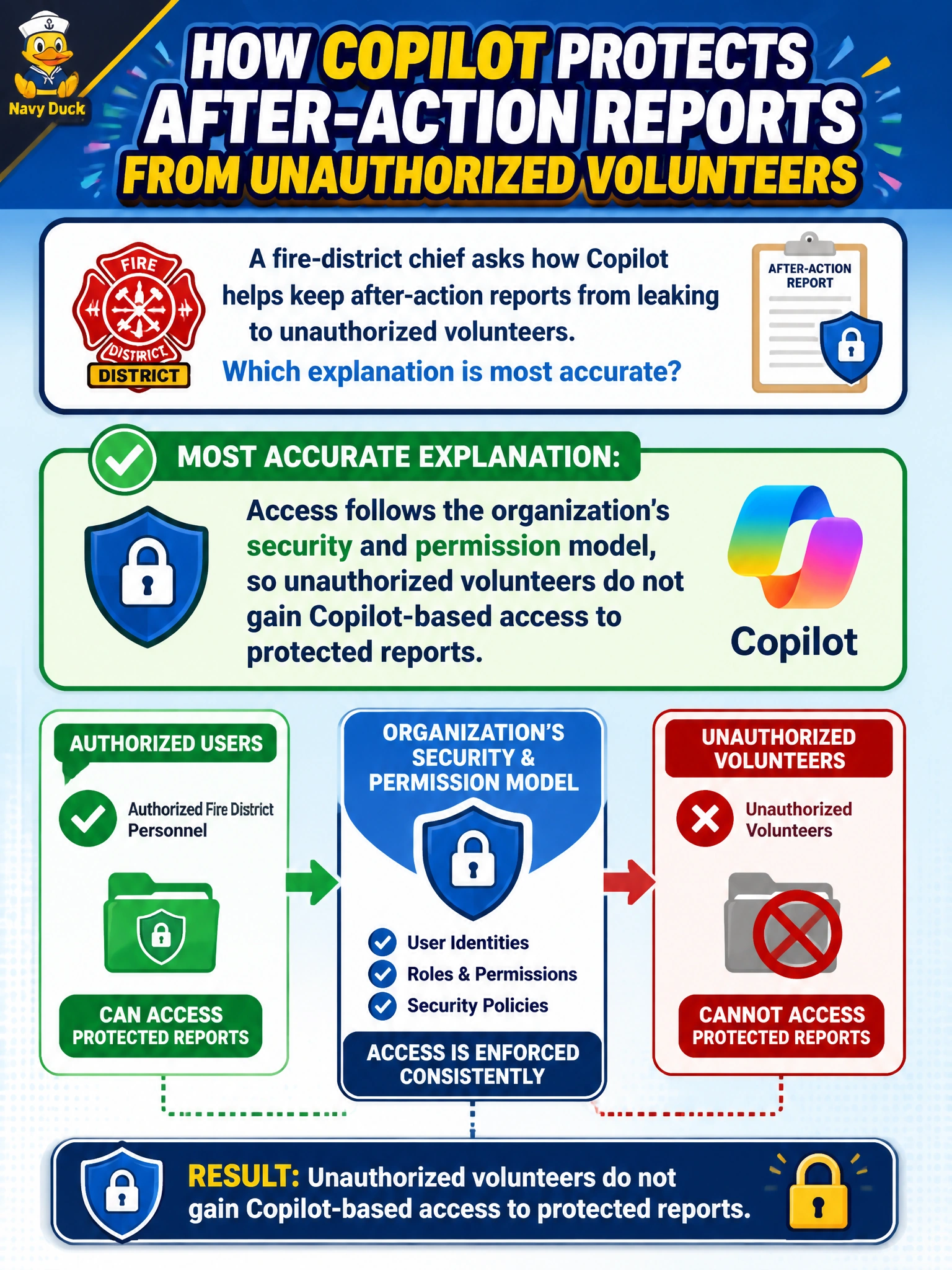
A fire-district chief asks how Copilot helps keep after-action reports from leaking to unauthorized volunteers. Which explanation is most accurate?
Select an answer to reveal the explanation.
Short Explanation
Think of Copilot as another door into the same locked records room—not a side entrance for anyone with the Wi-Fi password. Unauthorized volunteers still don't get after-action reports just because AI is in the mix.
Full Explanation
Copilot does not open a side door around the fire district's security model. Access to after-action reports continues to follow organizational permissions and security controls, so unauthorized volunteers do not gain Copilot-based access to protected reports simply by chatting with the AI. For a fire-district chief, the accurate explanation is that Copilot inherits the same need-to-know boundaries already applied in Microsoft 365 rather than broadcasting sensitive operational lessons learned.
Default email of every after-action report to all volunteers fails because Copilot is not an automatic distribution list for protected reports. Disabling encryption to make volunteer editing easier fails both as a security practice and as a description of Copilot's role; Copilot does not help by turning off encryption. Firehouse Wi-Fi password as an access key fails because network join credentials are not Microsoft 365 authorization; knowing the Wi-Fi password does not entitle a volunteer to retrieve protected reports through Copilot.
Exam caveat: Guest accounts, broken sharing links, and overly broad Microsoft 365 groups can still leak content—but that is a permissions problem, not proof that Copilot invents a volunteer bypass. AB-730 wants the conceptual link between Copilot and org security, not complacency about sharing hygiene.
Operational check: Review who can open after-action report libraries, remove unauthorized volunteer access, require work identities for Copilot use, and verify that volunteers without rights cannot surface report content via Copilot chat.