
Your data science team has built a sophisticated AI agent in Azure AI Foundry that uses custom fine-tuned models and advanced RAG pipelines. The business wants to surface this agent's capabilities through the company's existing Copilot Studio deployment. What integration approach should you use?
Select an answer to reveal the explanation.
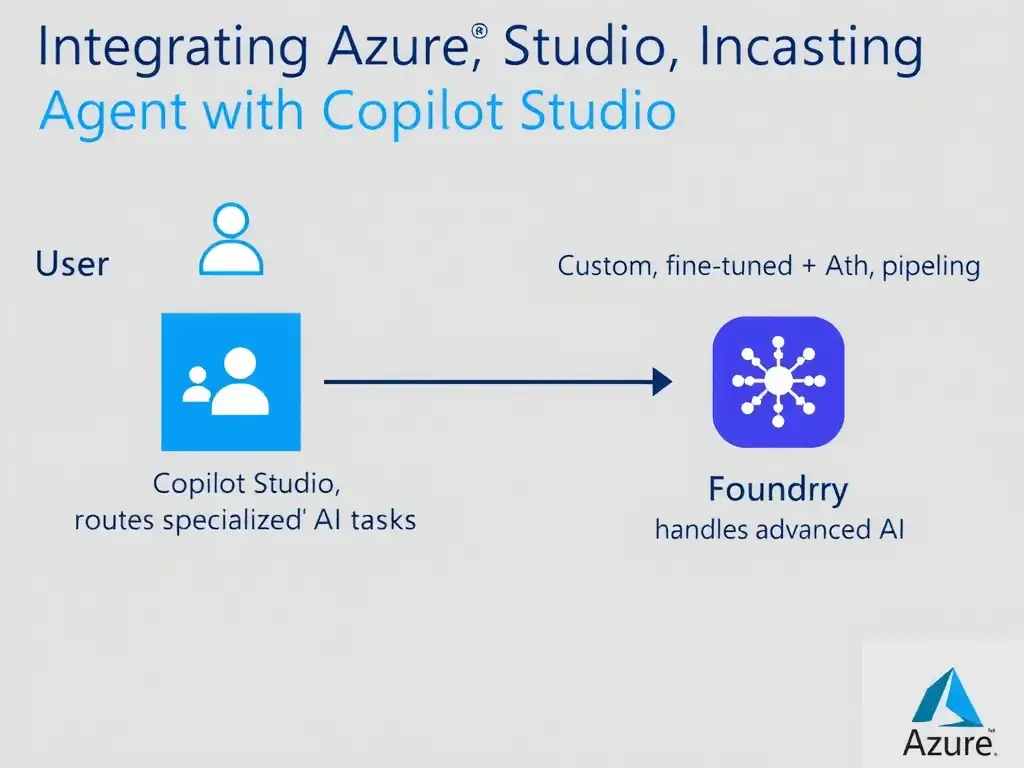
Short Explanation
You don't rebuild the agent. You connect the Azure AI Foundry agent to Copilot Studio as a connected agent, so Copilot Studio can orchestrate and route to it while the Foundry agent keeps its custom models and RAG pipeline.
Full Explanation
Microsoft's AI agent ecosystem supports interoperability between Copilot Studio and Azure AI Foundry. The correct approach is to integrate the Azure AI Foundry agent as a connected agent in Copilot Studio, allowing Copilot Studio to orchestrate and route to it. In this pattern, Copilot Studio handles channel management, authentication, and topic routing, while delegating complex AI reasoning tasks to the Foundry-hosted agent. This integration is configured in Copilot Studio by adding the Foundry agent as a connected service, also described as a connected or child agent. The Copilot Studio agent acts as the orchestrator or front-end, and the Foundry agent provides specialized intelligence, such as custom models, vector search, and advanced RAG pipelines, that would be costly to replicate in Copilot Studio alone. Rebuilding the Azure AI Foundry agent from scratch as a Copilot Studio agent, replicating all its topics and knowledge sources, defeats the purpose of integration because the Foundry agent was built precisely because its capabilities exceed what Copilot Studio's built-in features offer. Exporting the Foundry agent's prompt instructions and importing them as a knowledge source in Copilot Studio misunderstands both systems, because the Foundry agent's value is its execution capability, including fine-tuned models and dynamic RAG, not static instructions you can copy. Publishing the Foundry agent to Azure API Management and calling it via an HTTP action in Copilot Studio is technically possible, but it bypasses the native agent orchestration integration and treats the Foundry agent as a dumb API rather than leveraging agent-to-agent communication protocols, such as the emerging Agent Protocol standards Microsoft is supporting. Exam principle: a Foundry agent surfaced through Copilot Studio should use connected agent integration, with Copilot Studio as the orchestration front-end. This is the native, Microsoft-recommended integration path.