
A backend API requires every request to include a header named X-Api-Version with the value 2024-10. Makers should never see or set it, and the requirement must also cover operations that are added to the connector later, without editing each operation's definition or writing code. What should the developer configure?
Select an answer to reveal the explanation.
Short Explanation
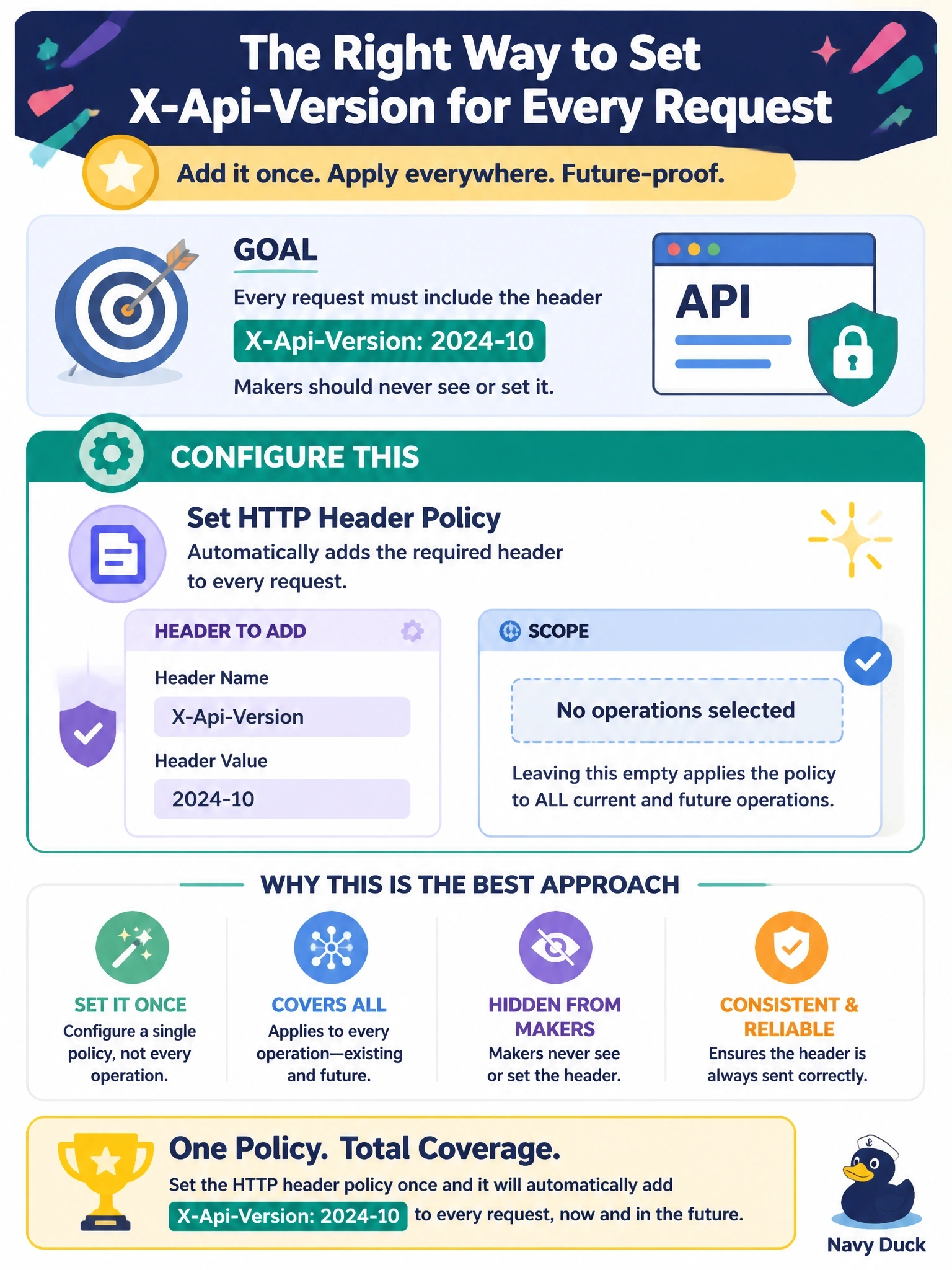
A policy is a rule the connector applies on the way out the door, so you set it once and forget it. The Set HTTP header policy adds the version header, and leaving the operations list empty means new operations get it too. Per-operation internal parameters work today and get forgotten tomorrow.
Full Explanation
Policy templates change connector behavior at runtime without code. The Set HTTP header policy adds or overrides a header on outgoing requests, and when no operations are selected the policy applies to every action and trigger, including ones added later, so the version header is always present and never visible to makers. Defining a header parameter on each operation with internal visibility and a default value does hide it from makers, but it must be repeated on every operation and silently missed on any operation added later, which violates the requirement. The Set query string parameter policy adds a value to the URL's query string, not a header, so the API would still reject requests that lack the header. Custom code could insert the header, but code takes precedence over the codeless definition, adds maintenance, and the requirement explicitly asks for no code. Exam caveat: policies support expressions such as connection parameters, and environment variables in policies are available in preview, which helps when a header value differs between environments. Operational check: add the policy, test an existing operation and a newly added one, and confirm the backend logs show the header with the expected value on both.