
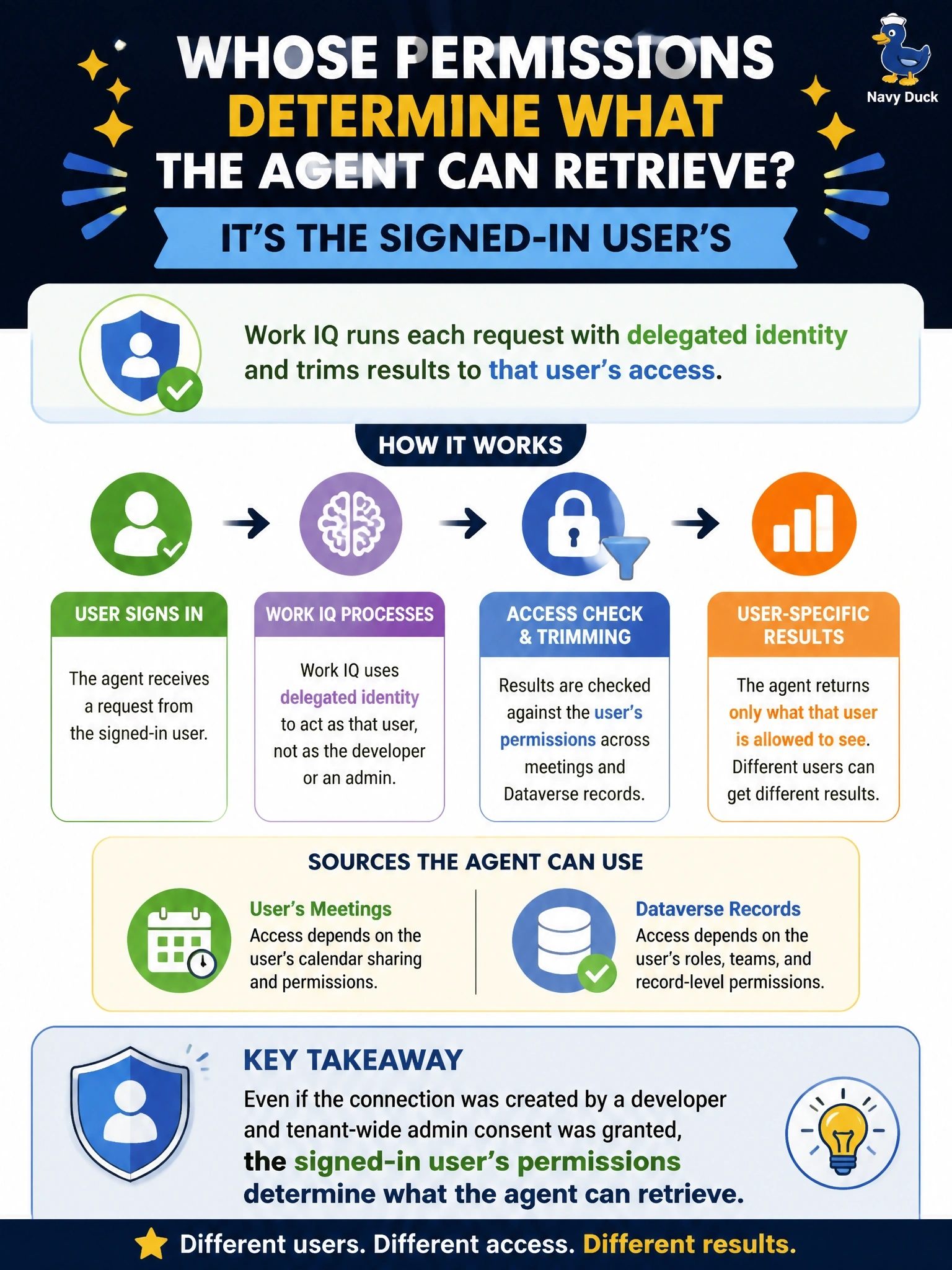
A Foundry agent uses Work IQ to answer questions that combine a user's meetings with Dataverse records. During testing, a regional manager and a sales representative ask the same question and get different results. The Work IQ connection was created by a developer, and a Global Administrator granted tenant-wide admin consent for the Work IQ permission. Whose permissions determine what the agent can retrieve?
Select an answer to reveal the explanation.
Short Explanation
Admin consent is like a landlord approving a building's key system; it doesn't hand everyone the landlord's master key. Work IQ always works as the person asking, so you'll see the manager and the rep get different answers. The trap is thinking whoever set things up lends the agent their access.
Full Explanation
Work IQ uses Microsoft Entra ID delegated authentication. Each request from the agent runs on behalf of the signed-in user, typically through an on-behalf-of flow, and the user's existing permissions, sensitivity labels and compliance policies are enforced automatically. Application-only authentication is not supported, which is why the regional manager and the representative receive different results for the same question. A managed identity would represent the application, and Work IQ does not accept app-only access, so the project's identity does not define what is returned. The developer who created the connection configured the OAuth client details, but requests do not run under that developer's identity at run time. Tenant-wide admin consent approves the application to request the delegated permission for users; consent does not transfer the administrator's own data access to anyone. Exam caveat: the same delegated principle applies to the Copilot Studio client library, which also expects user tokens. Operational check: compare the results for a user who lacks access to a specific Dataverse record or meeting and confirm the agent never surfaces it, then review sign-in logs to see the user identity on each call.