
A Foundry agent answers sellers' open-ended questions such as which accounts they own have stalled opportunities and what was discussed in recent meetings with those customers. The current plan is to write a dedicated Dataverse Web API query for each expected question. Answers must respect each seller's access and the team wants minimal custom retrieval code. What should the developer do instead?
Select an answer to reveal the explanation.
Short Explanation
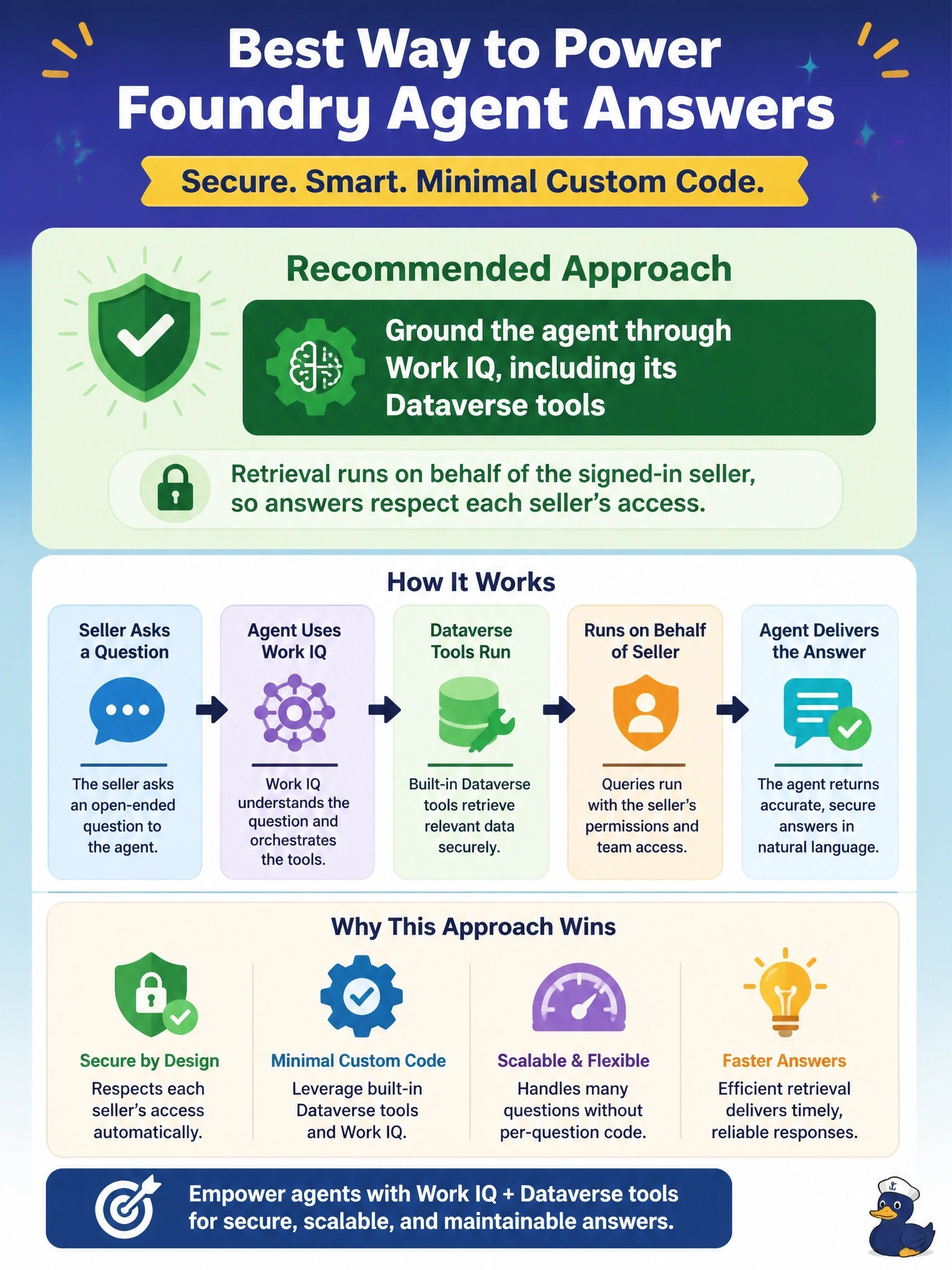
Writing a query per question is like printing a phone book for every possible call; the next question you didn't predict breaks it. Work IQ lets the agent pull work context, records and meetings alike, as the seller, so access stays trimmed. Watch for the admin-account shortcut; it answers fast and leaks everything.
Full Explanation
Open-ended questions that mix Dataverse records with meetings and email are the case Work IQ is designed for. The agent delegates retrieval to Work IQ, whose catalog includes Dataverse tools, and every request runs with the seller's delegated identity, so results are limited to what that seller can already see. The team avoids building and maintaining retrieval code for each question pattern. A query per expected question with a keyword router only covers questions someone anticipated, grows with every new phrasing, and cannot reach meeting context at all. Nightly exports into an indexed store create stale copies, lose row-level security, and add a sync pipeline the team must operate, which is the overhead Work IQ removes. An application user with System Administrator answers everything but ignores each seller's security roles, so a seller could see accounts owned by other teams, which violates the access requirement. Exam caveat: deterministic Web API queries remain the right tool when code needs exact, repeatable results such as a sync job; this scenario is about natural-language grounding. Operational check: ask the same question as two sellers with different ownership and confirm each answer lists only that seller's accounts.