
A user reports that a code app shows empty grids. In the browser network trace, requests to the environment's dynamics.com endpoint return HTTP 401, while the app shell loads normally. How should the developer interpret this?
Select an answer to reveal the explanation.
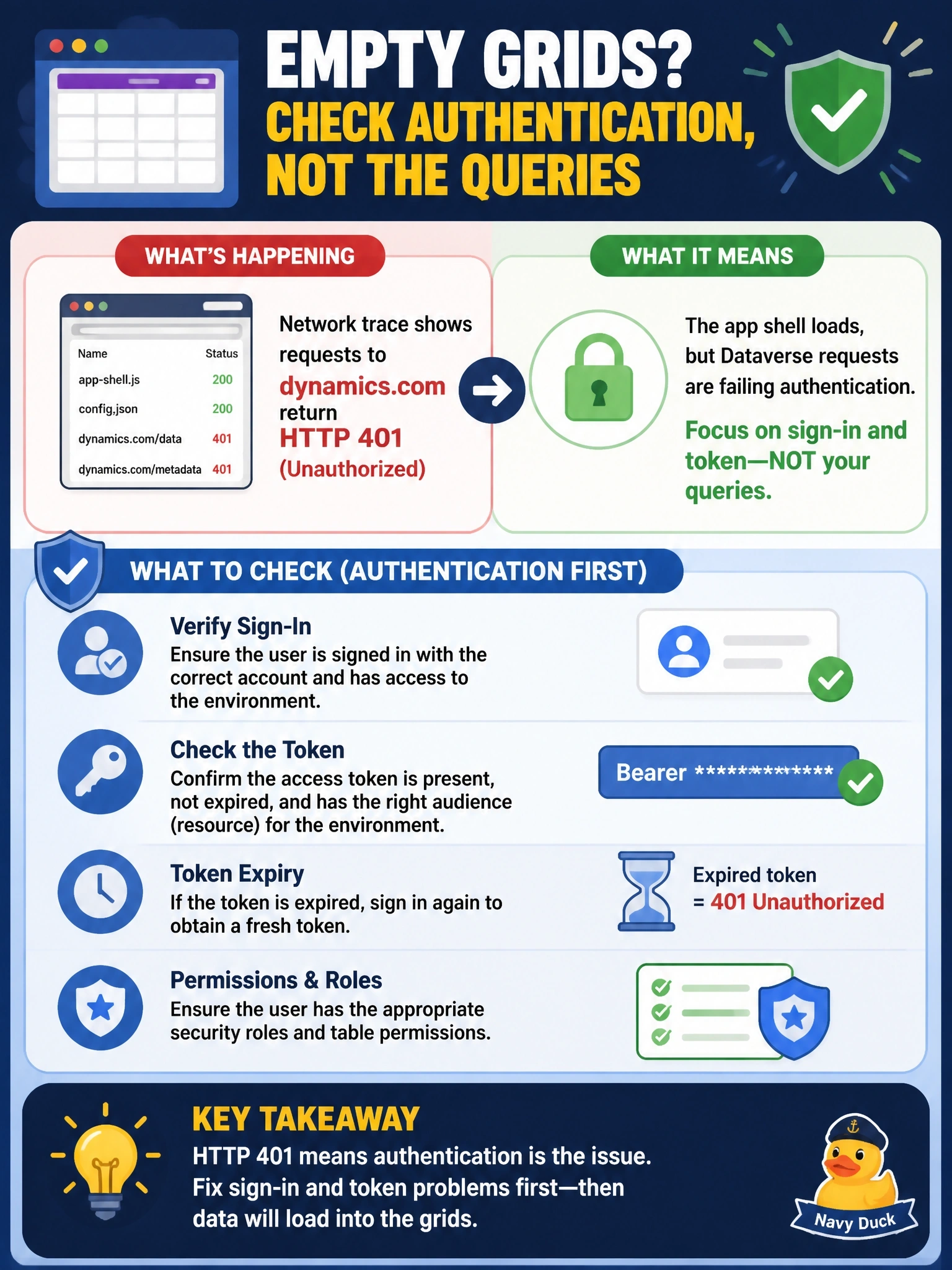
Short Explanation
Status codes are clues, so read them like a detective. A 401 means the server didn't accept who you are; a missing privilege comes back as 403; an empty result is a 200 with no rows. The trap is tuning queries when the request never got past the front desk.
Full Explanation
HTTP status codes separate failure types. A 401 Unauthorized response means the request did not carry credentials the service accepted, so Dataverse never evaluated the query. That points to sign-in and token problems for the Dataverse resource, such as an expired session, a sign-in blocked by Conditional Access, or a user who has not been set up in the environment, rather than to filters or data. An empty grid caused by a query returns 200 with an empty value array, so it looks different in the trace and would point to filters or row-level security. When an authenticated user lacks a required privilege, Dataverse returns 403 Forbidden with an error naming the missing privilege, not 401. A CSP block is enforced inside the browser before the request is sent, so it appears as a blocked request with a console violation message, not as an HTTP status returned by the server. Exam caveat: the app shell loading normally shows that the Power Apps host authenticated the user; the 401 is specific to the data calls. Operational check: inspect the 401 response body and headers for the error code, confirm the user can sign in to the environment directly, and retry after a fresh sign-in.