
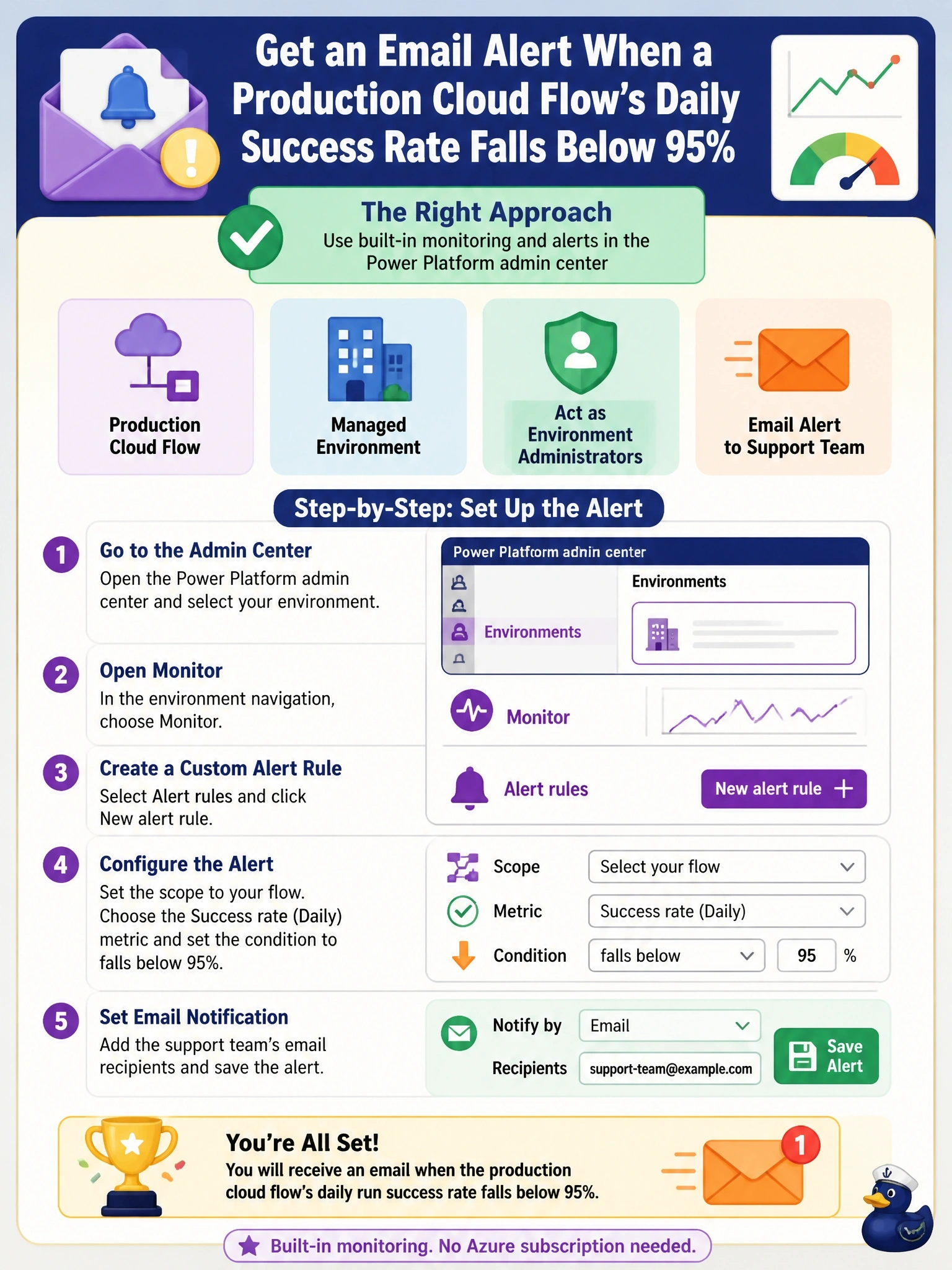
A support team wants an email when a production cloud flow's daily run success rate falls below 95 percent. The environment is a managed environment, the team has no Azure subscription, and they want to set this up as environment administrators. Which approach meets the requirement?
Select an answer to reveal the explanation.
Short Explanation
Think of a Monitor alert rule as a smoke detector you set for your own kitchen: you choose the metric, the threshold and who gets the email. The trap is the predefined alert, which doesn't send email at all, and the Azure route, which needs a subscription the team doesn't have.
Full Explanation
The Monitor area of the Power Platform admin center calculates operational health metrics for resources, including cloud flow run success rate, and lets tenant and environment administrators create alert rules. A rule targets an environment or a specific resource, picks a metric, an operator and a threshold value, assigns a severity, and can send email to the creator and additional recipients. Alerts can be placed only on managed environments, which this environment is, and Monitor does not require an Azure subscription. Metrics are daily aggregates and rules evaluate every 24 hours, which suits a daily success-rate requirement. Predefined alerts from Microsoft monitor high-use resources across the tenant with fixed thresholds that cannot be edited, and they do not send any notification; administrators must check the Monitor pages. Exporting telemetry to Application Insights and creating an Azure Monitor alert is a valid pattern for teams with Azure, but it requires an Azure subscription and Application Insights resource, which the stem rules out. Manual daily review by flow owners is not alerting and depends on people remembering to look. Exam caveat: a tenant can have a limited number of alert rules turned on at once, so keep rules focused on high-value metrics. Operational check: create the rule, confirm it appears on the Alert rules tab with email notification, and check its last run time the next day.